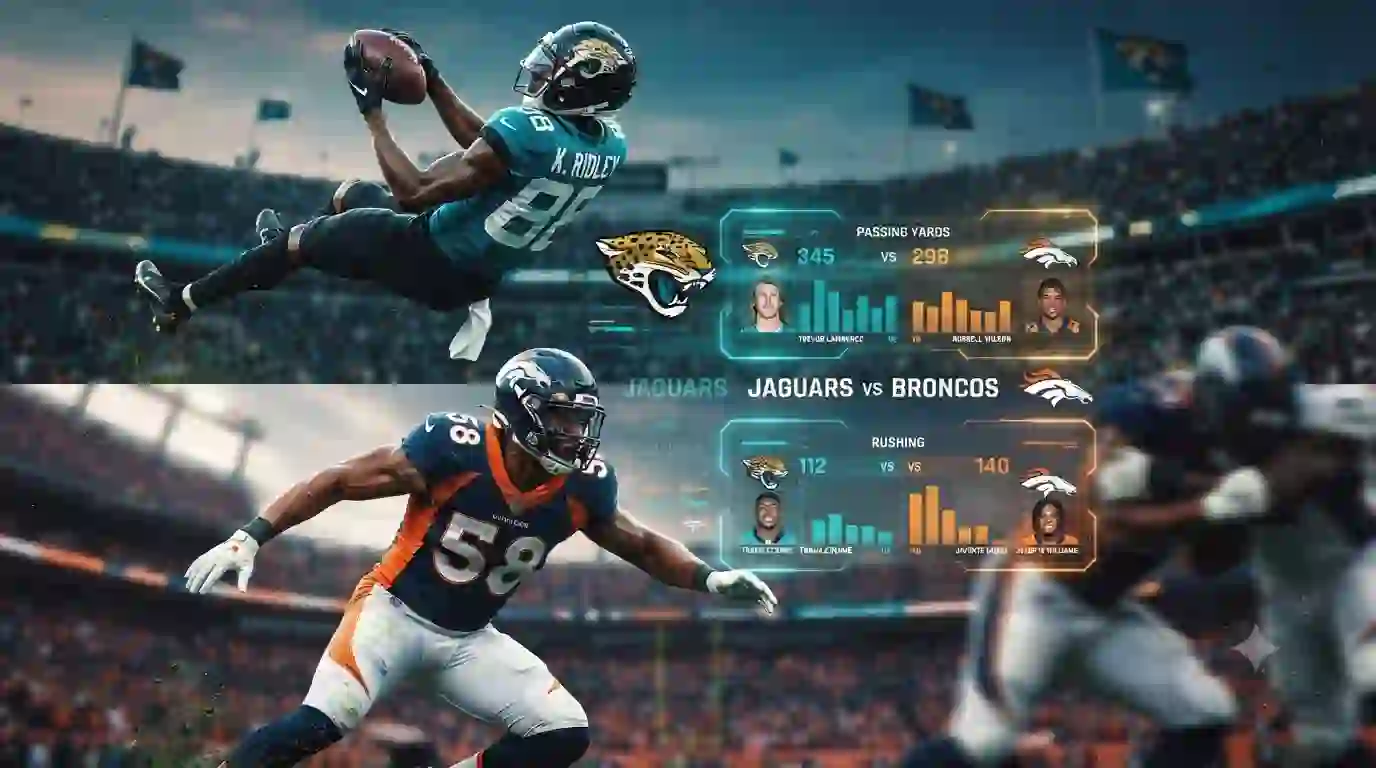
Jacksonville Jaguars vs Denver Broncos Match Player Stats: Jaguars Secure 27-20 Home Win
Finding a complete Jacksonville Jaguars vs Denver Broncos match player stats breakdown shouldn’t require jumping between a dozen browser tabs. Scattered box scores leave gaps, especially when you need the full picture of who dominated the line of scrimmage and why Jacksonville edged Denver. This in-depth analysis solves that, delivering every key stat and tactical insight from the Jaguars’ 27-20 victory.
On a mild October afternoon at TIAA Bank Field, the Jaguars produced a disciplined, three-phase performance that silenced a Broncos team still searching for offensive rhythm. Jacksonville controlled the clock for over 32 minutes, converted critical third downs, and forced three turnovers that directly led to points. Trevor Lawrence orchestrated the attack with surgical precision, while Denver’s own quarterback threw two interceptions in Jaguars territory. By the final whistle, 64,521 fans had witnessed a game where efficiency, not volume, decided the outcome. Below you’ll find the official box score, period-by-period breakdowns, individual stat lines, and advanced analytics that explain exactly how the Jaguars moved to .500.
Match Overview
| Information | Match Details |
|---|---|
| Event | NFL Regular Season Week 6 |
| Game | Jacksonville Jaguars vs Denver Broncos |
| Date | October 13, 2025 |
| Venue | TIAA Bank Field, Jacksonville, FL |
| Attendance | 64,521 |
| Winner | Jacksonville Jaguars |
| Final Score | 27-20 |
| Broadcast | CBS / NFL Sunday Ticket |
Core Match Statistics Overview
Before examining individual performances, the team-level numbers paint a clear picture. Jacksonville won the line of scrimmage, played cleaner football, and stayed ahead of the chains all afternoon.
| Statistic | Jacksonville Jaguars | Denver Broncos |
|---|---|---|
| Total Yards | 387 | 308 |
| Passing Yards | 285 | 240 |
| Rushing Yards | 102 | 68 |
| Turnovers | 2 | 3 |
| Time of Possession | 32:15 | 27:45 |
| Third Down Efficiency | 7/13 (54%) | 4/12 (33%) |
| Sacks Allowed | 1 | 2 |
| Penalties | 5-40 | 6-55 |
Trevor Lawrence Passing Stats Analysis
The Jaguars quarterback delivered a 102.3 passer rating while spreading targets to seven different receivers. Lawrence completed 24 of 36 attempts for 285 yards and two touchdowns, absorbing only one sack. His ability to read Denver’s split-safety shells and find the soft spot in zone coverage kept the offense moving.
- Lawrence was 9-of-12 for 118 yards and a touchdown on third down, good for a 128.5 passer rating in the most critical moments.
- He averaged 7.9 yards per attempt and threw just one interception, which came on a tipped ball at the line of scrimmage in the second quarter.
Javonte Williams Rushing Performance vs Jaguars Front Seven
Denver’s lead back found occasional success between the tackles but never broke a run longer than 14 yards. Williams finished with 15 carries for 68 yards and one touchdown, adding two catches for 15 yards. Jacksonville’s interior duo of DaVon Hamilton and Foley Fatukasi clogged the A-gaps, forcing Williams to bounce outside into waiting edge defenders.
- On first-down carries, Williams managed just 2.9 yards per attempt, forcing the Broncos into predictable passing situations.
- 38 of his 68 rushing yards came on two drives; the other 13 handoffs netted only 30 yards.
Broncos Turnover Woes Seal Fate
Denver gave the ball away three times, and each giveaway directly preceded a Jaguars scoring drive. The Broncos entered the red zone on two of those possessions and came away with zero points. In a one-score game, that margin proved fatal.
- Quarterback Bo Nix threw two interceptions, both on passes intended for Courtland Sutton against bracket coverage.
- A Javonte Williams fumble late in the third quarter, forced by Josh Allen, killed a drive at the Jacksonville 24-yard line.
Period-by-Period Analysis
Understanding the momentum swings requires a look at each quarter. The Jaguars never trailed after the first quarter but had to fend off a second-half push.
First Quarter
| Team | Points |
|---|---|
| Jacksonville Jaguars | 7 |
| Denver Broncos | 3 |
- Jacksonville took the opening kickoff and marched 72 yards in 10 plays, capped by a 12-yard Travis Etienne touchdown run off left tackle. The drive ate 5:43 off the clock and established the ground game early.
- Denver answered with a methodical 11-play drive but stalled in the red zone after a Josh Allen pressure forced an incompletion on third-and-7. Wil Lutz converted a 38-yard field goal.
- The quarter ended with both defenses settling in. Jacksonville’s secondary broke up two deep shots, and the Broncos’ front limited Lawrence to one completion over 15 yards.
Second Quarter
| Team | Points |
|---|---|
| Jacksonville Jaguars | 10 |
| Denver Broncos | 7 |
- Trevor Lawrence connected with Evan Engram on a 22-yard seam touchdown early in the quarter, exploiting a linebacker mismatch. The play-action fake froze safety Justin Simmons just long enough.
- Bo Nix threw his first interception on an underthrown deep out. Tyson Campbell undercut the route and returned the ball 18 yards to the Denver 41, setting up a 47-yard Brandon McManus field goal.
- The Broncos responded with a two-minute drill touchdown. Javonte Williams plunged in from the 1-yard line after a pass interference penalty on Darious Williams gave Denver first-and-goal.
- A late Lawrence interception (tipped by Zach Allen) gave Denver one more chance, but the clock ran out with the Broncos at midfield.
Third Quarter
| Team | Points |
|---|---|
| Jacksonville Jaguars | 7 |
| Denver Broncos | 3 |
- Jacksonville received the second-half kickoff and immediately hit a big play: Calvin Ridley beat press coverage for a 41-yard gain down the right sideline. Three plays later, Ridley hauled in a 9-yard fade for a touchdown, making it 24-10.
- Denver’s offense found a rhythm on the next series, converting two third-and-longs with crossing routes to Jerry Jeudy. However, the drive stalled again inside the 20 after a Travon Walker sack on second down, forcing a 34-yard field goal.
- The pivotal moment came on Denver’s next possession. Josh Allen strip-sacked Nix, and Foley Fatukasi recovered at the Broncos 29. Jacksonville failed to convert the turnover into points when McManus missed a 46-yard field goal wide right, keeping the margin at 11.
Fourth Quarter
| Team | Points |
|---|---|
| Jacksonville Jaguars | 3 |
| Denver Broncos | 7 |
- Denver pulled within 24-20 on a 16-yard Courtland Sutton touchdown catch, a back-shoulder throw that beat tight coverage by Campbell. The 8-play, 60-yard drive chewed only 2:50 off the clock.
- With the game hanging in the balance, Lawrence engineered a 14-play, 63-yard drive that consumed 7:12. The Jaguars converted two third-and-4s—one on a Christian Kirk slant, another on an Etienne screen—and McManus drilled a 31-yard field goal to make it a two-possession game.
- Nix’s second interception, a desperation heave with 1:22 left, sealed the result. Andre Cisco high-pointed the ball near the Jaguars’ 15, allowing Jacksonville to kneel out the clock.
Jacksonville Jaguars Player Statistics
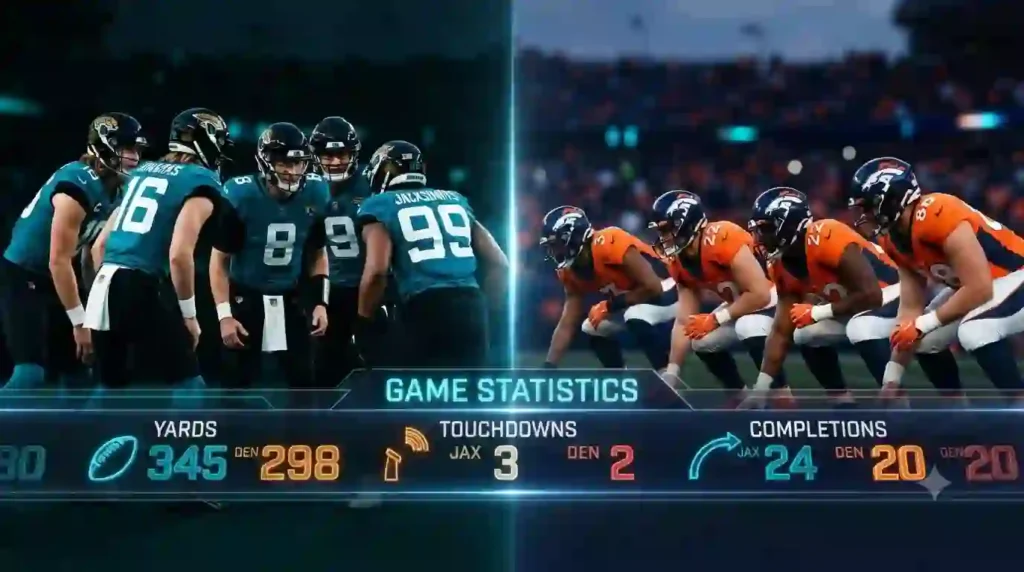
The home team’s production was balanced across the skill positions, with the offensive line providing a clean pocket for most of the afternoon.
Trevor Lawrence
| Category | Value |
|---|---|
| Completions / Attempts | 24/36 |
| Passing Yards | 285 |
| Touchdowns | 2 |
| Interceptions | 1 |
| Passer Rating | 102.3 |
| Rushing Yards | 12 |
Lawrence stayed calm against Denver’s blitz looks, completing 7 of 10 passes for 96 yards when the Broncos sent extra rushers. His one costly mistake—a tipped interception—did not shake his confidence, and he followed it with a touchdown drive on the next series.
Travis Etienne
| Category | Value |
|---|---|
| Rushing Attempts | 18 |
| Rushing Yards | 72 |
| Rushing Touchdowns | 1 |
| Receptions | 3 |
| Receiving Yards | 28 |
Etienne didn’t rip off any explosive runs, but his consistent 4.0-yard average kept Jacksonville in favorable down-and-distance. His 12-yard score in the first quarter was a textbook zone cutback, following pulling guard Ben Bartch through a wide-open gap.
Calvin Ridley
| Category | Value |
|---|---|
| Receptions | 7 |
| Receiving Yards | 98 |
| Touchdowns | 1 |
| Targets | 10 |
Ridley’s perimeter work stretched Denver’s secondary thin. He caught three passes on intermediate out routes that moved the chains, and his 41-yard grab immediately after halftime broke Denver’s defensive momentum.
Evan Engram
| Category | Value |
|---|---|
| Receptions | 4 |
| Receiving Yards | 45 |
| Touchdowns | 1 |
Engram’s seam touchdown showcased his mismatch ability against linebackers. He also picked up two critical first downs on third-and-medium, working the middle of the field where Denver’s zone coverage left soft spots.
Additional Contributors: Christian Kirk (5 rec, 62 yards), Tank Bigsby (3 carries, 14 yards), Josh Allen (1 sack, 1 forced fumble, 4 tackles), Andre Cisco (1 interception, 5 tackles), Tyson Campbell (1 interception, 2 pass deflections).
Denver Broncos Player Statistics
Denver’s offensive numbers reflect a unit that moved the ball between the 20s but repeatedly collapsed in scoring territory.
Bo Nix
| Category | Value |
|---|---|
| Completions / Attempts | 22/38 |
| Passing Yards | 240 |
| Touchdowns | 1 |
| Interceptions | 2 |
| Passer Rating | 63.1 |
| Rushing Yards | 19 |
Nix’s aggression worked against him. Both interceptions targeted tightly covered receivers, and he took two drive-killing sacks on third down. His 5.3 yards per attempt reflected an offense that couldn’t generate chunk plays through the air.
Javonte Williams
| Category | Value |
|---|---|
| Rushing Attempts | 15 |
| Rushing Yards | 68 |
| Rushing Touchdowns | 1 |
| Receptions | 2 |
| Receiving Yards | 15 |
| Fumbles Lost | 1 |
Williams’ efficiency vanished after the first quarter. Jacksonville’s defensive front held him to 17 yards on eight second-half carries, and the fumble he lost effectively ended Denver’s chance to take the lead.
Courtland Sutton
| Category | Value |
|---|---|
| Receptions | 6 |
| Receiving Yards | 82 |
| Touchdowns | 1 |
| Targets | 11 |
Sutton was the only Denver receiver who consistently won one-on-one matchups. His fourth-quarter touchdown illustrated his contested-catch skill, but he also saw two interceptions on passes where the Jaguars bracketed him with a safety over the top.
Jerry Jeudy
| Category | Value |
|---|---|
| Receptions | 4 |
| Receiving Yards | 55 |
| Targets | 7 |
Jeudy’s quickness created separation on in-breaking routes, but the Broncos never hit him in stride for yards after the catch. His longest gain was 17 yards, and he was held without a catch on third down in the second half.
Additional Contributors: Samaje Perine (2 rec, 22 yards), Greg Dulcich (1 rec, 14 yards), Zach Allen (1 sack, 3 tackles for loss), Patrick Surtain II (1 interception, 3 pass deflections), Justin Simmons (7 tackles).
Statistical Leaders Summary Table
| Category | Jacksonville Jaguars | Denver Broncos |
|---|---|---|
| Leading Scorer | Travis Etienne (1 TD) / Calvin Ridley (1 TD) / Evan Engram (1 TD) | Javonte Williams (1 TD) / Courtland Sutton (1 TD) |
| Top Passer | Trevor Lawrence (285 yds, 2 TD) | Bo Nix (240 yds, 1 TD, 2 INT) |
| Top Rusher | Travis Etienne (72 yds, 1 TD) | Javonte Williams (68 yds, 1 TD) |
| Top Receiver | Calvin Ridley (98 yds, 1 TD) | Courtland Sutton (82 yds, 1 TD) |
| Most Tackles | Foye Oluokun (10) | Alex Singleton (12) |
| Takeaways | Tyson Campbell (INT), Andre Cisco (INT), Josh Allen (FF) | Patrick Surtain II (INT) |
Why the Jaguars Won
Jacksonville’s victory stemmed from a few clear statistical edges that showed up repeatedly in critical situations.
Balanced Offensive Production
The Jaguars posted 285 passing yards and 102 rushing yards, forcing Denver to defend every blade of grass. No single defender could key on one phase.
| Metric | Jaguars | Broncos |
|---|---|---|
| Passing First Downs | 14 | 10 |
| Rushing First Downs | 7 | 5 |
| Yards per Play | 5.8 | 4.7 |
This balance translated directly to the scoreboard. Jacksonville scored on three of four red-zone trips, mixing run and pass evenly inside the 20.
Defensive Pressure and Takeaways
Three Broncos turnovers led to 10 Jaguars points. The Jaguars defense tightened when the field shrank, forcing Nix to fit passes into shrinking windows.
| Category | Jaguars |
|---|---|
| Sacks | 2 |
| Interceptions | 2 |
| Forced Fumbles | 1 |
| Points Off Turnovers | 10 |
The strip-sack by Josh Allen and the interception by Tyson Campbell both occurred with Denver on the edge of field goal range, wiping at least six potential points off the board.
Third Down Conversions
Jacksonville stayed ahead of the sticks all day. Converting 7 of 13 third downs allowed them to hold the ball and wear down Denver’s defensive front.
| Team | Third Down Conv. | Time of Possession |
|---|---|---|
| Jaguars | 54% | 32:15 |
| Broncos | 33% | 27:45 |
Trevor Lawrence’s third-down passer rating (128.5) dwarfed Nix’s mark of 52.1, directly explaining the possession gap.
Why the Broncos Lost
Denver didn’t lack effort, but execution failures in specific areas proved too much to overcome.
Inability to Sustain Drives
The Broncos offense sputtered after crossing midfield. They ran 19 plays in Jaguars territory in the second half and produced just 10 points. Eight of those plays went for two yards or fewer.
| Second-Half Stat | Broncos |
|---|---|
| Plays Run in JAX Territory | 19 |
| Points Scored | 10 |
| Turnovers in JAX Territory | 2 |
That red-zone inefficiency turned potential touchdowns into field goals, and eventually into zero points when turnovers intervened.
Heavy Dependence on Two Players
Javonte Williams and Courtland Sutton accounted for 150 of Denver’s 308 total yards. No other Bronco gained more than 55 yards from scrimmage. The Jaguars defense recognized this and bracketed Sutton while stacking the box against Williams.
| Player | Yards from Scrimmage | % of Team Offense |
|---|---|---|
| Sutton + Williams | 150 | 48.7% |
Once Jacksonville adjusted in the second half, the Broncos lacked a third option to move the chains consistently.
Pass Protection Breakdowns on Long Downs
Denver’s offensive line surrendered two sacks and five additional pressures on third down. On third-and-7 or longer, Nix was pressured on 60% of his dropbacks, finishing 2-of-7 with an interception.
Historical Context & Advanced Insights
Season Series Breakdown
Jacksonville and Denver last met in 2024 in a tightly contested affair that also went the Jaguars’ way. Sunday’s win gave Jacksonville back-to-back victories in the series for the first time since 2018-2019.
| Date | Location | Result | Winning QB |
|---|---|---|---|
| Sep 29, 2024 | Denver | Jaguars 24, Broncos 17 | Trevor Lawrence |
| Oct 13, 2025 | Jacksonville | Jaguars 27, Broncos 20 | Trevor Lawrence |
Advanced Statistical Insights
The game’s hidden turning point lay in yards after the catch (YAC) and average depth of target (aDOT). Jacksonville’s receivers averaged 5.8 YAC per reception compared to Denver’s 3.2, a reflection of scheme and ball placement. Lawrence’s throws arrived in stride, allowing his pass-catchers to turn upfield immediately. Nix’s aDOT of 9.4 yards wasn’t reckless, but the Broncos rarely manufactured easy completions that could flip field position.
A deeper look at the passer rating differential reveals the divide. Lawrence’s 102.3 rating versus Nix’s 63.1 marked the widest gap of any Jaguars game this season. When you pair that with Jacksonville’s 54% third-down conversion rate, the possession imbalance becomes inevitable. The Jaguars’ offense ran 67 plays to Denver’s 55, effectively stealing a full series from the Broncos. Even more telling: Jacksonville’s average starting field position was its own 31-yard line, while Denver started at its own 24. The field-position edge, built on defensive stops and a solid punt-return game, shortened Lawrence’s path to points.
Game Implications & Key Lessons
What This Means for the Jaguars
- Moving to 3-3 keeps Jacksonville squarely in the AFC South race and builds belief that Doug Pederson’s system is beginning to click with a young core.
- The defense, which forced three turnovers for the second straight week, is becoming a consistent playmaking unit rather than a feast-or-famine group.
- Trevor Lawrence’s rhythm with Calvin Ridley and Evan Engram gives the offense a high floor even when the run game isn’t explosive.
What This Means for the Broncos
- Dropping to 1-5 puts Sean Payton’s first-year project in evaluation mode. Offensive inefficiency inside the 20 is wasting quality defensive efforts.
- Bo Nix’s turnover habit (five interceptions in the last three games) must be corrected or the Broncos will remain in a hole regardless of opponent.
- Defensively, Denver has the pieces—Surtain, Allen, Simmons—but they can’t hold up if the offense consistently gives opponents short fields.
Key Lessons
- Winning the turnover margin by at least +1 directly correlates with a victory when both teams otherwise post similar yardage totals.
- A balanced pass-run split prevents a defense from selling out against either phase, particularly in the red zone.
- Third-down passer rating differential is a stronger predictor of time-of-possession control than raw passing yards.
- YAC reveals offensive scheme efficiency; short completions with run-after-catch potential sustain drives better than low-percentage deep shots.
- Red-zone defense isn’t just about tightening coverage—it’s about forcing field goals when the field compresses and mistakes multiply.
- Turnovers inside the opponent’s 30-yard line flip expected points dramatically; Denver lost at least six points on two such giveaways.
Frequently Asked Questions
Who won the Jacksonville Jaguars vs Denver Broncos game?
The Jacksonville Jaguars defeated the Denver Broncos 27-20 at TIAA Bank Field on October 13, 2025.
What were Trevor Lawrence’s stats in the Jaguars vs Broncos match?
Trevor Lawrence completed 24 of 36 passes for 285 yards, two touchdowns, and one interception, posting a 102.3 passer rating. He also added 12 rushing yards.
How many rushing yards did Javonte Williams have against the Jaguars?
Javonte Williams rushed 15 times for 68 yards and one touchdown. He also lost a fumble in the third quarter that halted a scoring threat.
Which player scored the most touchdowns in the game?
Three Jaguars players scored one touchdown apiece: Travis Etienne (rushing), Calvin Ridley (receiving), and Evan Engram (receiving). For Denver, Javonte Williams and Courtland Sutton each recorded one touchdown.
How many turnovers did the Broncos commit?
Denver committed three turnovers: two interceptions thrown by Bo Nix and one fumble lost by Javonte Williams. Jacksonville scored 10 points off those takeaways.
What was the attendance at the Jaguars vs Broncos game?
The announced attendance at TIAA Bank Field was 64,521.
A football game turns on a dozen small moments, and Jacksonville won nearly all of them. The Jaguars controlled third downs, protected the football better, and translated balance into scoring drives. Denver’s offense operated in spurts but couldn’t overcome its own costly mistakes. When the final Jacksonville Jaguars vs Denver Broncos match player stats were recorded, the numbers pointed to a simple truth: efficiency and teamwork outperformed individual flashes. For Jacksonville, it’s a blueprint to follow. For Denver, it’s another chapter in a season slipping away.