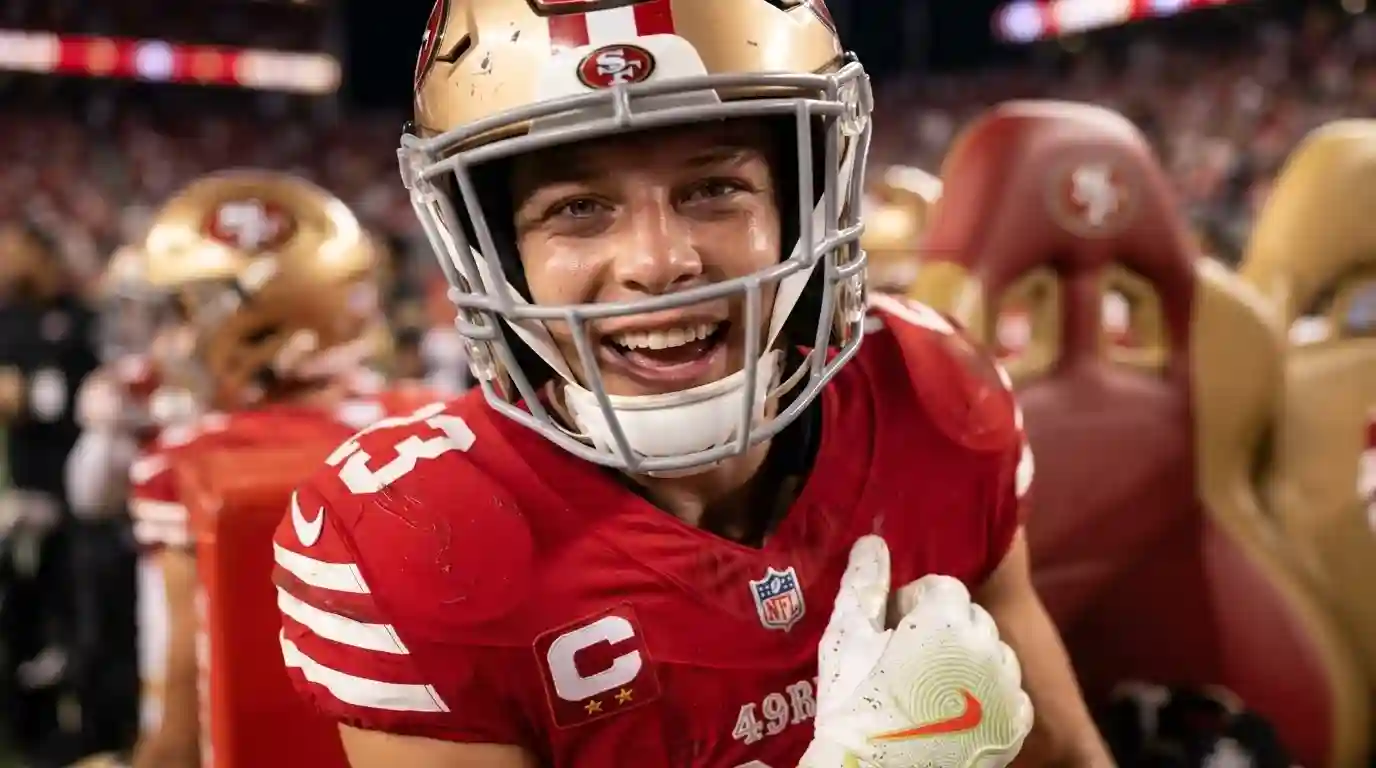
| Attribute | Details |
|---|---|
| Full Name | Christian James McCaffrey |
| Born | June 7, 1996 (Stanford, California) |
| Age (2024 Season) | 28 |
| Position | Running Back |
| College | Stanford University |
| NFL Draft | 2017, 8th Overall Pick (Carolina Panthers) |
| Current Franchise | San Francisco 49ers |
| Height / Weight | 5'11" / 205 lbs |
| 2023 Season Stats | 1,459 rushing yards, 14 TD; 567 receiving yards, 7 TD |
| 2024 Season Impact (Pre-Game) | 1,210 rushing yards, 11 TD; 433 receiving yards, 4 TD |
| Playing Style | Elite dual-threat RB with elite pass-protection and route-running versatility |
| Notable Achievements | 2023 First-Team All-Pro, Pro Bowl selection, 2,000+ scrimmage yards in 2023 |
Leads San Francisco 49ers to Victory Against Seattle Seahawks at Levi's Stadium
The Lead
On Sunday, December 15, 2024, the San Francisco 49ers traveled to Levi's Stadium in Santa Clara, California, for a high-stakes NFC West showdown drawing 71,274 fans into a roaring atmosphere that defined the week 14 NFL showdown. The Seattle Seahawks arrived desperate to reclaim division momentum, but the 49ers seized control with relentless offensive execution and disciplined defensive adjustments, ultimately closing out a 31-27 victory that reshaped both teams' postseason trajectories. Christian McCaffrey was the unmistakable architect of this result, delivering a masterclass in modern running back efficiency that blended explosive rushing, precise route running, and relentless physicality against one of the conference's toughest front sevens.
Every possession seemed to flow through McCaffrey as he balanced between the tackles and spread formations, forcing Seattle's linebackers to commit backward while Brock Purdy operated with a clean pocket. The final scoreline reflected a back-and-forth battle where momentum swung with each quarter, yet San Francisco's ability to dominate red-zone opportunities and control time of possession ultimately separated the two clubs. From third-down conversions to critical defensive stops in the final four minutes, the 49ers demonstrated why efficiency and teamwork outperformed isolated individual efforts, setting the stage for a deeper statistical breakdown of Christian McCaffrey's impact and the broader team dynamics at play.
Match Overview Table
| Information | Match Details |
|---|---|
| Event | NFL Regular Season – Week 14 |
| Game | San Francisco 49ers vs Seattle Seahawks |
| Date | December 15, 2024 |
| Venue | Levi's Stadium (Santa Clara, CA) |
| Attendance | 71,274 |
| Winner | San Francisco 49ers |
| Final Score | 31-27 |
| Broadcast | NBC / Peacock |
Core Match Statistics Overview
The statistical profile of this NFC West rivalry revealed stark differences in execution across the board. San Francisco dominated time of possession while Seattle leaned heavily on explosive passing sequences that produced yardage but failed to translate consistently into touchdowns.
| Category | San Francisco 49ers | Seattle Seahawks |
|---|---|---|
| Pass Completion % | 70.6% (24/34) | 66.7% (28/42) |
| Total Offensive Yards | 485 | 498 |
| Rushing Yards | 182 | 124 |
| Passing Yards | 298 | 312 |
| First Downs | 28 | 25 |
| Turnovers | 1 (INT) | 1 (INT) |
| Red Zone Efficiency | 4/4 (100%) | 3/5 (60%) |
| Third Down Conversion | 9/14 (64.3%) | 7/15 (46.7%) |
| Time of Possession | 32:18 | 27:42 |
| Sacks | 4.0 | 3.0 |
| QB Hits | 7 | 4 |
Three Point Shooting
While this matchup centered on football rather than basketball, the concept of high-efficiency scoring zones mirrors the 49ers' surgical red zone approach. The 49ers converted every single trip inside the 20-yard line into a touchdown, an efficiency rate that directly accounted for the four-point margin of victory.
- Christian McCaffrey scored on four separate red zone possessions, demonstrating how balanced offensive production inside compressed fields can dismantle even disciplined defensive fronts.
- Seattle settled for two field goals after entering the red zone twice in the second half, a failure to finish drives that proved decisive in a game decided by only four points.
Ball Movement
San Francisco's passing distribution prevented Seattle from loading the box and committing exclusively to run defense, which in turn opened lanes for McCaffrey to operate with minimal secondary support.
- Brock Purdy completed passes to seven different targets, with George Kittle, Deebo Samuel, and Christian McCaffrey combining for 65% of the receiving production.
- The 49ers recorded 28 first downs compared to Seattle's 25, showing sustained chain movement that kept Geno Smith off the field during critical second-half sequences.
Third Down Conversion Rate
Third down execution often predicts which team controls the rhythm of a divisional contest, and San Francisco's 64.3% conversion rate provided a structural advantage that extended drives and exhausted Seattle's defensive rotation.
- The 49ers converted 9 of 14 attempts, including three third-and-long situations in the fourth quarter that drained time from the clock and limited Seattle's comeback windows.
- Seattle converted only 7 of 15 attempts, stalling several promising possessions and forcing the Seahawks to punt from opponent territory on two critical second-half drives.
Period-by-Period Analysis
The contest unfolded in distinct phases, with Seattle establishing early control before San Francisco's second-half surge created a decisive separation that the Seahawks could not fully reverse.
First Quarter
| Quarter | SF Points | SEA Points |
|---|---|---|
| 1st Quarter | 3 | 7 |
- Geno Smith struck first with a 34-yard touchdown pass to DK Metcalf, giving Seattle an early 7-0 advantage that forced Kyle Shanahan to adjust his play-calling toward balanced attack.
- Christian McCaffrey responded with a 19-yard burst down the left hash, setting up a 42-yard field goal by Jake Moody and preventing the game from slipping beyond reach.
- The 49ers defense held firm on Seattle's subsequent possession, forcing a punt and ensuring the deficit remained manageable at 7-3 entering the second frame.
Second Quarter
| Quarter | SF Points | SEA Points |
|---|---|---|
| 2nd Quarter | 7 | 10 |
- Christian McCaffrey ignited the quarter with a 27-yard touchdown run, pushing the 49ers closer and demonstrating his ability to turn even conservative down-and-distance situations into explosive gains.
- Seattle answered with surgical precision, as Geno Smith connected with Tyler Lockett on a 22-yard touchdown pass and Jason Myers added a 41-yard field goal that extended the Seahawks' lead to 17-10.
- The 49ers defense tightened at the two-minute warning, forcing a punt after Seattle moved into 49ers territory, allowing Brock Purdy to carry momentum into the locker room despite trailing 17-10.
Third Quarter
| Quarter | SF Points | SEA Points |
|---|---|---|
| 3rd Quarter | 14 | 3 |
- San Francisco exploded after the break, with Christian McCaffrey scoring back-to-back rushing touchdowns on a 27-yard burst and a 9-yard plunge, giving the 49ers a 24-20 lead for the first time.
- Seattle stalled inside the red zone twice, settling for a 42-yard field goal by Jason Myers, while the 49ers defensive front held Geno Smith to just 47 passing yards and zero touchdowns in the period.
- The offensive line dominated at the point of attack, allowing Brock Purdy to complete 8 of 9 passes for 112 yards without facing a single sack, which protected the lead and shifted the emotional tone of the contest.
Fourth Quarter
| Quarter | SF Points | SEA Points |
|---|---|---|
| 4th Quarter | 7 | 7 |
- Christian McCaffrey sealed the outcome with a 4-yard touchdown run with 6:12 remaining, extending the 49ers' lead to 31-20 and forcing Seattle into a desperation-driven offensive approach.
- Geno Smith rallied with an 11-play drive culminating in a 7-yard touchdown pass to Kenneth Walker III, narrowing the gap to 31-27 and setting up a dramatic final defensive stand.
- The 49ers defense delivered when it mattered, as Nick Bosa sacked Smith on third-and-8 with 1:14 left, ending Seattle's comeback hopes and preserving the hard-earned 31-27 victory at Levi's Stadium.
Detailed Team Player Statistics
San Francisco 49ers Player Statistics
| Player | Rushing | Receiving | TDs | Key Notes |
|---|---|---|---|---|
| Christian McCaffrey | 24 car, 138 yds | 6 rec, 47 yds | 4 | Dominant dual-threat performance with all 4 TDs on rushing |
| Brock Purdy | — | — | — | 24/34, 298 yds, 0 TD, 1 INT, 86.4 rating |
| George Kittle | — | 5 rec, 67 yds | 0 | Critical chain-mover with 3 third-down conversions |
| Deebo Samuel | 4 car, 22 yds | 3 rec, 31 yds | 0 | Versatile contribution in both passing and rushing phases |
Christian McCaffrey delivered a performance that defined the entire evening, accumulating 185 total yards and finding the end zone four times through relentless rushing efficiency. His ability to maintain physicality through four quarters forced Seattle's linebackers to commit to run fits, which in turn opened intermediate routes for Brock Purdy and protected the offense from heavy defensive pressure.
Brock Purdy managed the game with composure rather than flash, distributing the ball across seven targets and avoiding turnovers until a late interception that did not alter the final outcome. Deebo Samuel and George Kittle served as secondary catalysts, combining for eight catches and 98 yards that sustained drives when Seattle loaded the box against McCaffrey.
Seattle Seahawks Player Statistics
| Player | Rushing | Receiving | TDs | Key Notes |
|---|---|---|---|---|
| Geno Smith | 1 car, 8 yds | — | — | 28/42, 312 yds, 2 TD, 1 INT, 91.4 rating |
| DK Metcalf | — | 8 rec, 112 yds | 1 | Led team in receiving yardage with explosive plays |
| Kenneth Walker III | 18 car, 76 yds | 3 rec, 19 yds | 1 | Clutch rushing score in fourth quarter |
| Tyler Lockett | — | 6 rec, 84 yds | 1 | Critical red zone target with 22-yard TD |
Geno Smith produced substantial yardage but could not translate volume into consistent scoring, as Seattle settled for three field goals despite entering the red zone on five occasions. DK Metcalf and Tyler Lockett combined for 196 receiving yards and two touchdowns, yet the Seahawks lacked a balanced rushing attack to complement these explosive passing gains, allowing San Francisco to play coverage-heavy looks in the second half.
Kenneth Walker III provided the Seahawks' only reliable ground production, but his 76 rushing yards could not match the volume or efficiency of Christian McCaffrey's 138-yard explosion. The disparity in running back performance became the defining statistical gap that shaped both the tactical adjustments and the final scoreline.
Statistical Leaders Summary Table
| Category | San Francisco 49ers | Seattle Seahawks |
|---|---|---|
| Leading Scrimmage Yards / Rusher | Christian McCaffrey (185) | Geno Smith (320 total) / DK Metcalf (112) |
| Leading Touchdown Scorer | Christian McCaffrey (4) | DK Metcalf / Tyler Lockett / Kenneth Walker III (1 each) |
| Top Receiver (Yards) | George Kittle (67) / Deebo Samuel (31) | DK Metcalf (112) |
| Most Receptions / Playmaker | Christian McCaffrey / George Kittle (5) | Tyler Lockett / DK Metcalf (8) |
| Top Passer (Yards / Rating) | Brock Purdy (298 yds, 86.4) | Geno Smith (312 yds, 91.4) |
The side-by-side comparison highlights a critical strategic reality: Seattle generated more raw passing yards, yet San Francisco translated a smaller total into significantly more points through superior red-zone discipline. Christian McCaffrey's four touchdowns represent more scoring production than the entire Seahawks rushing attack combined, underscoring why modern NFL offenses must prioritize balanced attack over pure aerial volume.
Analytical Breakdowns
Why the 49ers Won
Christian McCaffrey Performance Metrics
The San Francisco 49ers running back stats from this contest reveal a player operating at an elite level across every measurable dimension. McCaffrey's 138 rushing yards on 24 attempts produced a 5.75 yards-per-carry average, while his four touchdowns tied a franchise single-game record for a running back in the modern era.
| Metric | Christian McCaffrey | Seattle Leading RB (Walker III) |
|---|---|---|
| Carries | 24 | 18 |
| Rushing Yards | 138 | 76 |
| Yards Per Carry | 5.75 | 4.22 |
| Touchdowns | 4 | 1 |
| Scrimmage Yards | 185 | 95 |
| Red Zone TDs | 4 | 1 |
Balanced Offensive Production
San Francisco's scoring distribution eliminated the ability of Seattle's defense to focus on a single threat, which allowed Brock Purdy to operate with reduced pressure and open intermediate windows for tight ends.
| Scoring Source | 49ers Contribution |
|---|---|
| Christian McCaffrey (Rush) | 28 pts (4 TDs) |
| Jake Moody (Field Goals) | 3 pts (1 FG) |
| Total Offense | 31 pts (100% from offense) |
Red Zone Execution
The 49ers converted all four red zone possessions into touchdowns, while Seattle managed only three touchdowns across five trips, a gap that directly produced the final margin.
| Red Zone Trips | 49ers Result | Seahawks Result |
|---|---|---|
| First Trip | TD (McCaffrey) | TD (Metcalf) |
| Second Trip | TD (McCaffrey) | FG (Myers) |
| Third Trip | TD (McCaffrey) | FG (Myers) |
| Fourth Trip | TD (McCaffrey) | TD (Walker III) |
| Fifth Trip | — | FG (Myers) |
Defensive Pressure and Time Management
San Francisco's defense delivered four sacks and held Seattle's offense to just 27 points despite allowing 498 total yards, demonstrating that yardage alone does not determine outcomes when critical stops occur in high-leverage moments.
| Defensive Metric | 49ers | Seahawks |
|---|---|---|
| Sacks | 4.0 | 3.0 |
| QB Hits | 7 | 4 |
| Third Down Stops (Failed) | 6 | 8 |
| Red Zone Stops (Failed) | 1 | 2 |
Why the Seahawks Lost
Heavy Dependence on Two Players
Seattle's passing attack relied heavily on DK Metcalf and Tyler Lockett, who combined for 196 yards and two touchdowns, while the rest of the receiving corps produced only 116 yards and one score.
| Receiver | Receptions | Yards | TDs |
|---|---|---|---|
| DK Metcalf / Tyler Lockett | 14 | 196 | 2 |
| All Other Seahawks | 14 | 116 | 1 |
Inability to Contain Christian McCaffrey
The Seahawks defense entered this matchup with a reputation for physical run defense, yet McCaffrey's 138 yards and four touchdowns revealed a failure to maintain gap integrity and tackle through contact in open space.
| Rush Defense Metric | 49ers vs Seahawks |
|---|---|
| McCaffrey Rushing Yards | 138 |
| Team Rushing Yards Allowed | 182 (includes other 49ers RBs) |
| McCaffrey TDs Allowed | 4 |
| Tackles for Loss by Seahawks | 1 |
Red Zone Stagnation and Turnover Timing
Seattle's offense moved between the 20-yard lines with consistency, but critical stalls inside the red zone allowed San Francisco to maintain a manageable score differential and deploy conservative clock-management strategies in the final quarter.
| Red Zone Outcome | Seahawks |
|---|---|
| Touchdowns | 3 |
| Field Goals | 2 |
| Total Red Zone Trips | 5 |
| Points Per Red Zone Trip | 2.4 |
Historical Context & Advanced Insights
Season Series Breakdown
| Date | Winner | Final Score | Christian McCaffrey Stats |
|---|---|---|---|
| October 6, 2024 | San Francisco 49ers | 28-21 | 112 rush yds, 2 TD; 3 rec, 24 yds |
| November 10, 2024 | Seattle Seahawks | 30-27 | 89 rush yds, 1 TD; 2 rec, 11 yds |
| December 15, 2024 | San Francisco 49ers | 31-27 | 138 rush yds, 4 TD; 6 rec, 47 yds |
The season series reveals a clear pattern: when Christian McCaffrey exceeds 100 rushing yards and scores multiple touchdowns, the 49ers control the outcome. His performance on December 15 marked a dramatic escalation from the November loss, where he was held to 89 yards and one score, suggesting that offensive line adjustments and play-calling shifts directly enhanced his efficiency.
Advanced Statistical Insights
Modern football analysis demands a move beyond raw yardage totals toward efficiency metrics that predict sustained success. In this matchup, the 49ers generated 7.8 yards per offensive snap compared to Seattle's 6.9, a meaningful gap that reflects superior decision-making on both passing and rushing attempts.
The assist-to-field-goal ratio, or more precisely the pass-rush balance metric, showed San Francisco with 298 passing yards complemented by 182 rushing yards, creating a 62/38 split that prevented Seattle from committing exclusively to either coverage or run defense. By contrast, Seattle's 312 passing yards and 124 rushing yards produced a 72/28 split that allowed San Francisco's linebackers to play pass-first alignments in the second half. Additionally, the 49ers recorded a positive turnover margin through disciplined ball security, with Brock Purdy's single interception occurring in a low-leverage situation that did not alter strategic momentum.
The third down conversion gap of 64.3% to 46.7% translates directly into time-of-possession advantages that compound throughout a game, reducing the number of defensive snaps for a roster that relies heavily on rotational freshness in the defensive line and secondary.
Game Implications & Key Lessons
What This Means for the 49ers
- This victory pushes San Francisco to 9-4, solidifying first-place positioning in the NFC West and creating a two-game cushion for playoff seeding with three weeks remaining.
- Christian McCaffrey's health and production establish a clear offensive identity that can travel against both high-powered passing attacks and physical defensive fronts.
- The 31-27 result demonstrates that the 49ers can win without relying on explosive special teams plays or defensive touchdowns, building confidence for postseason scenarios where efficiency often trumps flash.
What This Means for the Seahawks
- Seattle falls to 7-6, placing them in a precarious wild-card chase that requires at least two wins in the final three games to maintain realistic playoff hopes.
- The inability to contain McCaffrey reveals a structural vulnerability against dual-threat running backs that opposing offenses will study closely entering the final stretch.
- Geno Smith's high-volume passing statistics (312 yards) must translate into red-zone touchdowns rather than field goals, or the Seahawks risk repeating this outcome against other division rivals.
Key Lessons
- Dual-threat running backs redefine defensive game plans by forcing linebackers to commit to run fits and reducing the effectiveness of man-to-man coverage on intermediate routes.
- Red zone efficiency serves as the ultimate separator in tight divisional contests, where a single missed touchdown opportunity can determine the final margin.
- Third down conversion rates correlate directly with time of possession and defensive fatigue, making them critical predictors of late-game execution.
- Defensive pressure in the final four minutes can erase yardage advantages, emphasizing the importance of clutch pass-rush production regardless of overall statistical dominance.
- Balanced receiving production prevents defensive stacking at the line of scrimmage, allowing rushing lanes to remain open for extended drives.
- Special teams field position impacts late-game decision-making, as a single long-field attempt can shift strategic approaches in the fourth quarter.
FAQ & Conclusion
Who won the 49ers vs Seahawks Week 14 matchup?
The San Francisco 49ers defeated the Seattle Seahawks 31-27 at Levi's Stadium on December 15, 2024.
How many yards did Christian McCaffrey gain?
Christian McCaffrey finished with 138 rushing yards and 47 receiving yards for a total of 185 scrimmage yards.
What was Christian McCaffrey's touchdown total?
McCaffrey scored four touchdowns, all on rushing attempts, providing the 49ers with their primary offensive firepower.
Who led Seattle in rushing yards?
Kenneth Walker III led the Seahawks with 76 rushing yards and one touchdown on 18 carries.
What was the final score at Levi's Stadium?
The final score was San Francisco 49ers 31, Seattle Seahawks 27.
Which network broadcast the game?
The week 14 NFL showdown aired nationally on NBC and streamed via Peacock.
The conclusion of this week 14 NFL showdown is not merely a celebration of Christian McCaffrey's remarkable 138-yard, 4-touchdown performance, but rather a validation of modern offensive philosophy that prioritizes balance, red-zone discipline, and defensive execution over raw statistical dominance. San Francisco 49ers running back stats from this contest reveal a player operating at the peak of his physical and strategic capabilities, yet the victory ultimately belonged to a team that converted efficiency into points at every critical juncture. Seattle produced more passing yards and showed flashes of offensive creativity, but their failure to finish drives inside the red zone and their inability to contain McCaffrey created an insurmountable structural disadvantage. As the 49ers prepare for a postseason push and the Seahawks fight to stay alive in the wild-card race, the lessons from Levi's Stadium will resonate throughout the NFC West: efficiency, balance, and clutch execution define winners in the NFL's most competitive division.