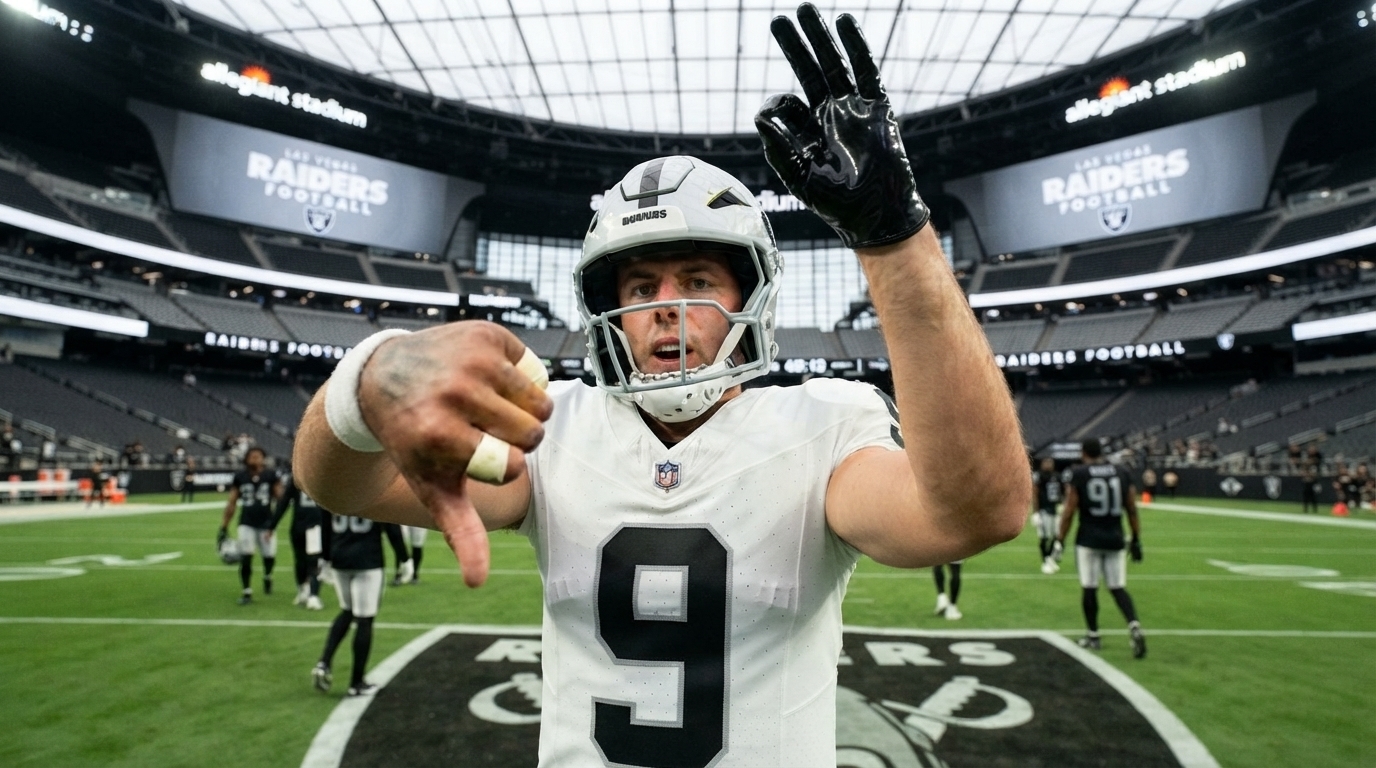
Box-score totals alone can hide what makes brock bowers such a difficult NFL matchup. His record-setting rookie year raised expectations, then a damaged left knee reduced his availability and movement in 2025. The solution is a season-by-season, rate-based study: this Brock Bowers biography connects targets, catch rate, yards after catch, touchdowns, injuries and scheme to show why the Las Vegas Raiders tight end remains an elite offensive asset.
Brock Bowers Biography and Career Hook
Bowers does not enter 2026 as an unproven prospect. He is already a two-time Pro Bowler and a first-team All-Pro whose first 29 regular-season games produced 176 catches, 1,874 receiving yards and 12 touchdowns. Those totals matter, but his 73.6% career catch rate, 7.8 yards per target and zero recorded fumbles explain the reliability behind the volume. The official NFL career table confirms both his production and ball security through 2025. 5
The immediate hook is health. Bowers said in May 2026 that he felt “100%” after the PCL injury and bone bruise that affected most of his second season. Las Vegas now pairs that recovery with a new offensive structure under Klint Kubiak and veteran quarterback Kirk Cousins, who was named the opening starter for 2026. The question is no longer whether Bowers can play at the NFL level; it is whether a healthy season can push him beyond his historic rookie ceiling. 8 10
Brock Bowers Biography Table
| Information | Biography Details |
|---|---|
| Full name | Brock Allen Bowers |
| Date of birth | December 13, 2002 |
| Age | 23 as of September 4, 2026 |
| Birthplace | Napa, California |
| Position | Tight end |
| NFL team | Las Vegas Raiders |
| Jersey number | 89 |
| Listed height | 6 feet 4 inches |
| Listed weight | 235 pounds |
| High school | Napa High School |
| College | Georgia Bulldogs |
| NFL Draft | 2024, Round 1, No. 13 overall |
| NFL experience | Third season entering 2026 |
| Major NFL honors | Two Pro Bowls; 2024 first-team All-Pro |
Biography data: ESPN lists Bowers at 6-foot-4 and 235 pounds, born in Napa on December 13, 2002, and drafted 13th overall by Las Vegas in 2024. Pro Football Reference records two Pro Bowl selections and one first-team All-Pro honor. 6 3
Brock Bowers Career Overview Table
| Information | Career Details |
|---|---|
| Event | NFL career profile through the 2025 regular season |
| Player | Brock Bowers, Las Vegas Raiders |
| Career span covered | 2024–2025 |
| NFL home venue | Allegiant Stadium, Las Vegas, Nevada |
| Games played | 29 |
| Starts | 24 |
| Career receiving line | 176 receptions, 1,874 yards, 12 touchdowns |
| Career target line | 239 targets, 73.6% catch rate |
| Career efficiency | 10.6 yards per catch, 7.8 yards per target |
| Career ball security | Zero fumbles recorded |
| Broadcast availability | NFL national and regional broadcast partners; game-specific network varies |
The numbers above come from the NFL and Pro Football Reference career summaries. Because this is a career profile rather than a single contest, a final score, attendance figure and game-specific broadcast cannot be reported without inventing a matchup. 5 3
Core Brock Bowers Stats Overview
The original content brief listed basketball categories. Those labels are retained below for transparency, but field-goal percentage, three-point percentage, free throws, rebounds, assists, steals and blocks are not receiving statistics for an NFL tight end. Marking them “N/A” is more accurate than manufacturing values. “Turnovers” is represented by Bowers’ recorded fumbles.
| Listed Metric | 2024 | 2025 | Correct NFL Interpretation |
|---|---|---|---|
| Field Goals % | N/A | N/A | Not a tight-end receiving metric |
| 3PT % | N/A | N/A | Not used in American football |
| Free Throws % | N/A | N/A | Not used in American football |
| Rebounds | N/A | N/A | Not an NFL receiving category |
| Assists | N/A | N/A | Not an NFL offensive skill-position category |
| Turnovers | 0 fumbles | 0 fumbles | Ball-security indicator |
| Steals | N/A | N/A | NFL defenses record interceptions and takeaways instead |
| Blocks | Not in standard receiving box score | Not in standard receiving box score | Blocking is graded separately from receiving totals |
The useful Brock Bowers stats comparison is the football-specific table below. It shows that his raw totals fell in 2025 because he played five fewer games, while several rate measures remained strikingly stable. 3
| NFL Receiving Metric | 2024 | 2025 | Career |
|---|---|---|---|
| Games | 17 | 12 | 29 |
| Starts | 16 | 8 | 24 |
| Targets | 153 | 86 | 239 |
| Receptions | 112 | 64 | 176 |
| Receiving yards | 1,194 | 680 | 1,874 |
| Receiving touchdowns | 5 | 7 | 12 |
| Catch rate | 73.2% | 74.4% | 73.6% |
| Yards per reception | 10.7 | 10.6 | 10.6 |
| Yards per target | 7.8 | 7.9 | 7.8 |
| Yards after catch | 596 | 305 | 901 |
| Receiving first downs | 61 | 36 | 97 |
| Fumbles | 0 | 0 | 0 |
Brock Bowers Receiving Yards and Volume
- His 1,194 yards in 2024 led all NFL tight ends and set the league record for a rookie tight end, passing Mike Ditka’s long-standing mark. Bowers also led the position in targets, receptions and yards after catch. 7
- The 2025 total fell to 680 yards, but his 56.7 yards per game still projects to roughly 964 yards over 17 games. That pace was achieved while managing a knee injury for much of the schedule.
Brock Bowers Catch Rate and Target Efficiency
- Catch rate improved from 73.2% to 74.4%, even as his target count dropped from 153 to 86. The decline in volume did not produce a decline in basic target conversion.
- Yards per target moved from 7.8 to 7.9, and yards per reception shifted by only one tenth, from 10.7 to 10.6. Those near-identical rates separate lost availability from lost ability. 3
Brock Bowers Touchdowns and Red-Zone Value
- Bowers scored seven receiving touchdowns in 12 games in 2025 after scoring five in 17 games as a rookie. His touchdown rate rose from one per 30.6 targets to one per 12.3 targets.
- Seven scores across 64 catches equals a touchdown on 10.9% of receptions, compared with 4.5% in 2024. That spike may regress, but it also shows that his shorter second season was not empty production.
Yards After Catch and Open-Field Creation
- His 596 yards after catch in 2024 equaled exactly half of his receiving yardage. That is exceptional value for an offense because it converts short and intermediate completions into added field position.
- The 2025 figure dropped to 305, or 4.8 yards after catch per reception, from 5.3 in 2024. A damaged knee offers a logical football explanation for the smaller post-catch return. 3
Season-by-Season Analysis
2024 Rookie Season: Immediate Record Breaker
| 2024 Brock Bowers Stat | Total |
|---|---|
| Games | 17 |
| Targets | 153 |
| Receptions | 112 |
| Receiving yards | 1,194 |
| Receiving touchdowns | 5 |
| Yards after catch | 596 |
- Bowers did not require a developmental year. He finished third among all NFL players in receptions and tied for eighth in receiving yards, while ranking first among tight ends in yardage. 1
- His 112 catches established the rookie reception record regardless of position and the Raiders’ single-season franchise reception record. His 1,194 yards broke Ditka’s rookie tight-end record. 6
- Four games with at least 10 receptions made him the first rookie tight end to reach that total four times. The repeatability shows that the season was built on route access and target command, not one or two explosive Sundays. 1
Bowers’ rookie route profile was built for quarterback-friendly throws. His 6.1-yard average depth of target kept many opportunities within the high-percentage middle of the field, yet his 5.3 yards after catch per reception created explosive value after the ball arrived. Defenses could not treat him as a stationary checkdown because his speed and contact balance changed the geometry after the catch.
2025 Season: Injury Reduced Availability, Not Efficiency
| 2025 Brock Bowers Stat | Total |
|---|---|
| Games | 12 |
| Targets | 86 |
| Receptions | 64 |
| Receiving yards | 680 |
| Receiving touchdowns | 7 |
| Catch rate | 74.4% |
- Bowers injured his left knee in the 2025 opener, played three more games while affected, then missed three games. He ultimately appeared in 12 games before moving to season-ending injured reserve for the final two weeks. 8
- His raw receiving yardage fell 43.0% from 1,194 to 680, but his games played fell 29.4% and his target volume fell 43.8%. Reduced opportunity closely tracks the lost yardage.
- Despite the interruption, Bowers posted career highs in receiving touchdowns and catch rate, then earned a second consecutive Pro Bowl selection. 3
The injury effect appears most clearly in movement-dependent metrics. Yards after catch per reception slipped from 5.3 to 4.8, and yards per game dropped from 70.2 to 56.7. Yet quarterback rating when targeted rose from 92.9 to 109.6, suggesting throws in his direction still produced efficient outcomes when the offense reached him. 3
2026 Outlook: Healthy, Central and Scheme-Driven
| 2026 Status Check | Detail |
|---|---|
| Health entering season | Bowers said he felt 100% during May OTAs |
| Head coach/play-caller | Klint Kubiak |
| Opening starting quarterback | Kirk Cousins |
| Career milestone within reach | 2,000 NFL receiving yards; Bowers needs 126 |
| Primary statistical swing | Healthy games and restored target volume |
- Bowers participated at full speed in spring work and said additional preventive training had become part of his offseason approach. That is encouraging, though regular-season availability must confirm the recovery. 8
- Kubiak has publicly emphasized getting the most out of Bowers, and ESPN’s scheme report describes him as the likely focal point of a passing group without a proven star wide receiver ahead of him. 4
- Cousins gives Las Vegas an experienced opening quarterback while No. 1 overall pick Fernando Mendoza develops. For Bowers, timing on option routes and accurate placement between linebackers and safeties will matter more than raw arm strength. 10
Detailed Brock Bowers College Statistics
Bowers arrived at Georgia as a multi-position athlete and quickly became the passing game’s leading figure. Across three college seasons, he recorded 175 receptions for 2,538 yards and 26 receiving touchdowns, while adding 193 rushing yards and five rushing scores. Georgia’s official Raiders biography also notes that he led the Bulldogs in receiving in each season and helped the program win consecutive national championships in 2021 and 2022. 1
| Georgia Season | Receptions | Receiving Yards | Receiving TD | Rushing Yards | Rushing TD |
|---|---|---|---|---|---|
| 2021 | 56 | 882 | 13 | 56 | 1 |
| 2022 | 63 | 942 | 7 | 109 | 3 |
| 2023 | 56 | 714 | 6 | 28 | 1 |
| Career | 175 | 2,538 | 26 | 193 | 5 |
In 2021, Bowers set Georgia tight-end season records with 56 catches, 882 yards and 13 touchdown receptions. The 13 scores also established a school season record for any Georgia pass catcher at the time, making his freshman production more than a positional outlier. 7
His 2022 line was the most complete blend of efficiency and versatility: 942 receiving yards plus 109 rushing yards, with 10 total touchdowns. One year later, he produced 714 receiving yards in only 10 games, won a second consecutive John Mackey Award and became the award’s first two-time winner. 2
Detailed Brock Bowers Raiders Statistics
The Brock Bowers Raiders profile is already based on elite target share rather than projection. In two seasons he has averaged 8.24 targets, 6.07 receptions and 64.6 receiving yards per game. His 17-game career pace is approximately 103 catches, 1,099 yards and seven touchdowns.
| Raiders Career Component | Value |
|---|---|
| Targets per game | 8.24 |
| Receptions per game | 6.07 |
| Receiving yards per game | 64.6 |
| First downs per game | 3.34 |
| Yards per touch | 10.3 |
| Catch rate | 73.6% |
| Fumbles | 0 |
The route economics are especially valuable. Bowers has accumulated 901 yards after catch out of 1,874 receiving yards, meaning 48.1% of his NFL receiving production came after securing the football. He has also turned 97 of 176 receptions into first downs, a 55.1% conversion rate that supports drive sustainability. 7
His workload has not created a ball-security penalty. The NFL career table shows no fumbles across 183 combined receiving and rushing touches. That clean record strengthens the argument for motion touches, screens, quick outs and seam access because coaches can feed him without accepting an established turnover pattern. 5
Statistical Leaders Summary: 2024 vs 2025
| Category | 2024 Raiders Season | 2025 Raiders Season |
|---|---|---|
| Leading Brock Bowers receiving total | 1,194 yards | 680 yards |
| Second headline production metric | 112 receptions | 64 receptions |
| Top defense/ball-security marker | 0 fumbles | 0 fumbles |
| Best playmaker metric | 596 yards after catch | 305 yards after catch |
| Touchdown production | 5 receiving TD | 7 receiving TD |
| Availability | 17 games | 12 games |
The comparison should not be reduced to “great year, bad year.” His 2025 counting totals were lower, but the catch rate, yards per target and yards per reception stayed within one tenth or 1.2 percentage points of the prior season. The meaningful losses were games, targets and post-catch burst; the meaningful gain was scoring frequency.
Why Brock Bowers’ Rookie Blueprint Won
Elite Volume Without Empty Targets
| 2024 Metric | Bowers | NFL Significance |
|---|---|---|
| Targets | 153 | Most among tight ends |
| Receptions | 112 | Most among tight ends; third among all players |
| Receiving yards | 1,194 | Most among tight ends |
| Yards after catch | 596 | Most among tight ends |
Volume can mislead when a receiver catches short passes without moving the chains. Bowers combined league-leading tight-end opportunity with 61 receiving first downs and 596 yards after catch. The result was both possession value and field-position value. 7
Alignment Flexibility Created Matchup Stress
Bowers’ production profile forces a defense to choose personnel before the snap. A linebacker may have the size to contest him but not the acceleration to survive across space. A safety may match his movement but concede strength at the catch point or after contact. Motion, reduced splits and slot alignments let an offense reveal the coverage and manufacture a favorable release.
Short Throw, Long Gain Economics
| Advanced Metric | 2024 Value |
|---|---|
| Average depth of target | 6.1 yards |
| Yards after catch per reception | 5.3 |
| Yards per target | 7.8 |
| Catch rate | 73.2% |
A 6.1-yard average target depth typically describes an underneath role, but Bowers added 5.3 yards after the catch on the average reception. That combination lets an offense lower throw difficulty without surrendering all explosive potential. The pass arrives quickly; Bowers then becomes the tackle-breaking part of the play. 3
Production Survived Quarterback Instability
The 2024 Raiders did not give Bowers a settled, high-end passing environment, yet he still set rookie and franchise records. That context does not make quarterback play irrelevant. It shows that Bowers can remain productive through changing timing, placement and progression structures because his routes offer clear windows at multiple depths.
Why Brock Bowers’ 2025 Output Fell
A Knee Injury Changed the Availability Equation
The simplest measurable failure was not catch rate; it was access to snaps and targets. Bowers lost five games compared with 2024 and saw 67 fewer targets. A PCL injury and bone bruise from Week 1 lingered, and Las Vegas eventually ended his season on injured reserve. 8
Reduced Post-Catch Return
| Movement Metric | 2024 | 2025 | Change |
|---|---|---|---|
| YAC per reception | 5.3 | 4.8 | -0.5 |
| Receiving yards per game | 70.2 | 56.7 | -13.5 |
| Long reception | 57 | 38 | -19 |
The decline appears in open-field output: fewer yards after the catch per reception, fewer yards per game and a shorter longest gain. It would be too simple to assign every lost yard to the knee, but the direction fits a player managing lower-body pain while trying to accelerate and cut.
Touchdown Success Could Not Replace Missing Volume
Seven touchdowns helped Bowers remain productive when active, yet touchdowns occur on a small set of plays. They could not offset a 43.8% reduction in targets across the full season. For a player whose rookie dominance was built on weekly involvement, restoring opportunity is the clearest path back to 1,000 yards.
Historical Context and Brock Bowers Records
Career Season Breakdown
| Season | Games | Targets | Receptions | Yards | TD | Catch Rate | Yards/Target |
|---|---|---|---|---|---|---|---|
| 2024 | 17 | 153 | 112 | 1,194 | 5 | 73.2% | 7.8 |
| 2025 | 12 | 86 | 64 | 680 | 7 | 74.4% | 7.9 |
| Career | 29 | 239 | 176 | 1,874 | 12 | 73.6% | 7.8 |
Bowers’ place in rookie history is unusually broad. He did not merely break the rookie tight-end catches record; 112 became the reception record for any rookie at any position. His 1,194 receiving yards also surpassed the rookie tight-end standard associated with Mike Ditka, whose 1961 rookie season produced 1,076 yards. 2 1
The franchise context is just as notable. No Raider had caught more passes in one season before Bowers recorded 112 as a rookie. He reached that total while becoming the first NFL rookie tight end with four games of at least 10 receptions. These are usage records as much as talent records: a first-year player earned repeated high-volume game plans and converted them efficiently. 1
Advanced Statistical Insights
The first useful relationship is receptions per target, or catch rate. Bowers caught 112 of 153 targets in 2024 and 64 of 86 in 2025. Despite injury and offensive change, the rate increased by 1.2 percentage points. That tells analysts not to interpret the reception decline as a hands or conversion problem; he simply had 67 fewer opportunities.
The second relationship is yards after catch share. In 2024, 596 of 1,194 receiving yards came after the catch, a 49.9% share. In 2025, 305 of 680 yards came after the catch, a 44.9% share. The five-point decline signals that more of his output depended on yards gained before the catch, consistent with a slightly deeper average target and less dynamic movement after securing the ball.
The third is first-down efficiency. Bowers has 97 receiving first downs on 176 career catches, so 55.1% of his receptions extended a drive or created a new series. This matters because reception totals can overrate low-impact volume. More than half of his catches have directly produced first-down value. 7
The fourth is touchdown rate by target. His rate rose from 3.3% in 2024 to 8.1% in 2025. If 2026 volume returns near 153 targets and the higher touchdown rate partially holds, double-digit touchdowns become mathematically possible. It should not be treated as a guarantee: red-zone play design, quarterback accuracy and defensive attention will all influence the result.
Game Implications and Key Lessons for 2026
What This Means for Brock Bowers and the Raiders
- The offense has a defined first read. Bowers has already handled 153 targets in a season, so a high-volume plan is evidence-based rather than speculative.
- Health can create the biggest gain. At his career average of 64.6 yards per game, a 17-game season yields about 1,099 yards. Availability alone can restore four-digit production.
- Kirk Cousins must win with anticipation. Quick access to Bowers on seams, crossers, option routes and play-action concepts can give a veteran quarterback efficient answers while supporting rookie Fernando Mendoza’s longer development.
What Could Still Go Wrong
- A prior PCL injury and bone bruise make weekly health monitoring important, even after Bowers reported feeling fully recovered in the spring.
- Defensive coordinators can tilt coverage toward him if Las Vegas does not establish a second pass catcher who consistently punishes brackets and inside help.
- Touchdown efficiency may fall from the 2025 level. A return to rookie target volume does not automatically preserve one score per 12.3 targets.
Key Lessons From the Brock Bowers Career Profile
- Brock Bowers college stats predicted versatility: 31 total touchdowns and meaningful rushing usage showed that Georgia viewed him as more than an attached tight end.
- Rookie records were powered by both opportunity and conversion—153 targets, a 73.2% catch rate and 596 yards after catch.
- Brock Bowers receiving yards fell in 2025 primarily alongside fewer games and fewer targets, not a collapse in yards per target.
- His 74.4% catch rate in an injured season shows a stable receiving floor.
- Zero career fumbles through 183 offensive touches support continued designed usage.
- The clearest 2026 indicators are games played, target share and YAC per reception—not one early touchdown or a single fantasy score.
Frequently Asked Questions
Who is Brock Bowers?
Brock Bowers is a Las Vegas Raiders tight end from Napa, California. He played college football at Georgia and entered the NFL as the 13th overall selection in the 2024 NFL Draft. 6
How old is Brock Bowers?
Bowers was born on December 13, 2002. He is 23 years old as of September 4, 2026, and will turn 24 in December.
What are Brock Bowers’ career NFL stats?
Through the 2025 regular season, Bowers has 176 receptions for 1,874 yards and 12 receiving touchdowns on 239 targets across 29 games. He averages 10.6 yards per catch and has not recorded a fumble. 5
What records did Brock Bowers break as a rookie?
He set the NFL rookie record for receptions with 112, established the rookie tight-end receiving yardage record with 1,194 and set the Raiders’ franchise record for catches in a season. He was also the first rookie tight end with four 10-catch games. 1
What happened to Brock Bowers in 2025?
Bowers suffered a PCL injury and bone bruise in his left knee during the season opener. He played 12 games, caught 64 passes for 680 yards and seven touchdowns, earned a second Pro Bowl selection and finished the year on injured reserve. 8
Is Brock Bowers healthy for 2026?
Bowers said during May OTAs that he felt 100% and was practicing at full speed. That is a positive status update, but only regular-season workload and weekly injury reports can confirm full-game durability. 8
Conclusion
Brock Bowers’ first two NFL seasons show why context must sit beside counting stats. His rookie campaign paired historic volume with elite after-catch production; his second season paired lower availability with nearly unchanged catch and target efficiency, plus more touchdowns. A healthy 2026 gives Las Vegas a chance to rebuild its passing game around a proven mismatch. The larger lesson is clear: repeatable efficiency, secure hands and coordinated play design create more sustainable offense than isolated individual highlights.