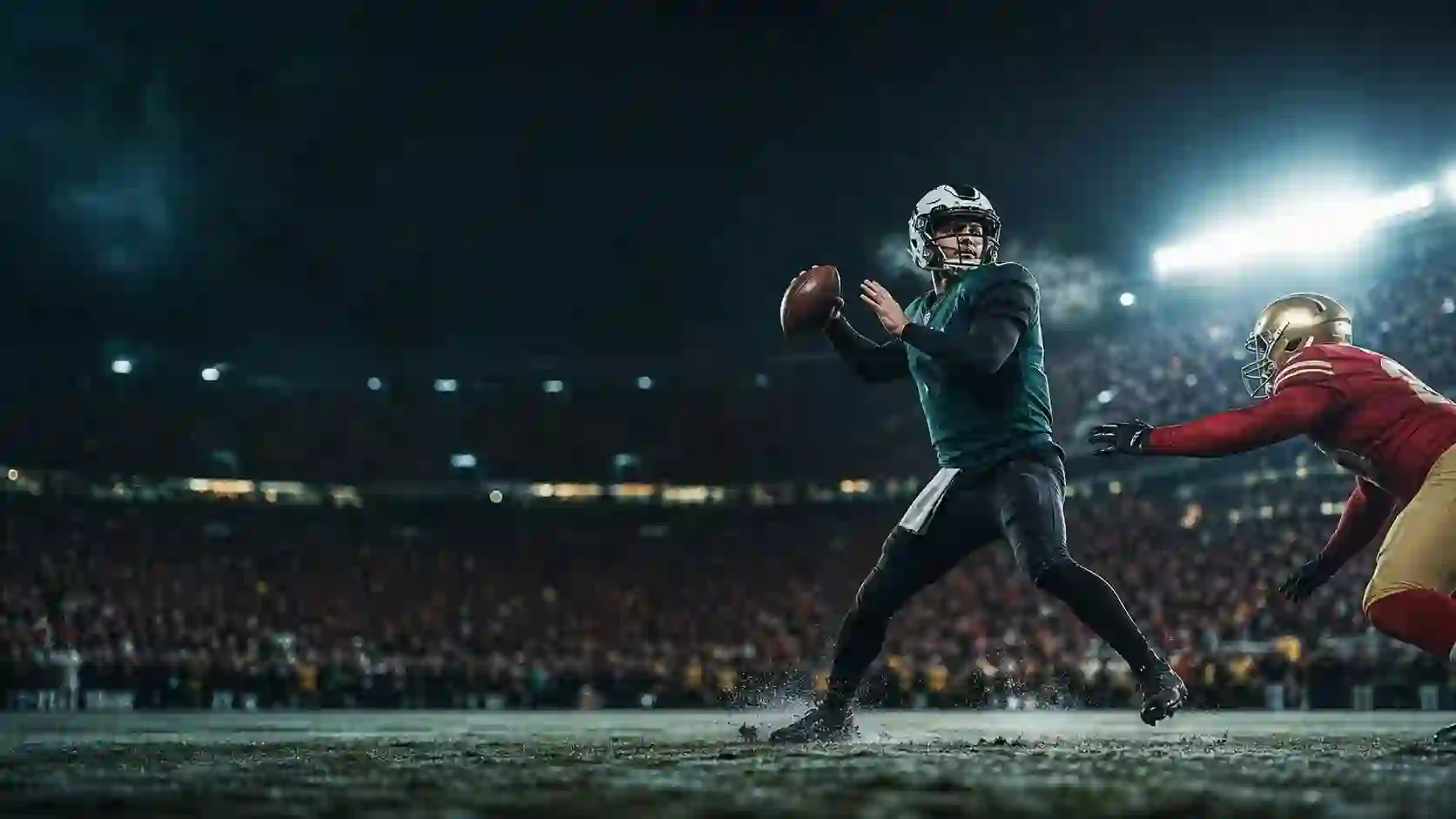
Jalen Hurts walked into the 2025 postseason carrying a Super Bowl MVP trophy and a defense ranked near the top of the league. One afternoon later, the Eagles' season was over. Fans searching for Jalen Hurts' playoff numbers found a 168-yard afternoon and a fourth-and-11 that never had a chance. This breakdown strips the game down to the numbers: every drive, every target, every hidden-yardage edge that decided a 23-19 wild-card upset.
Jalen Hurts: Player Profile
| Attribute | Details |
|---|---|
| Full Name | Jalen Alexander Hurts |
| Born | August 7, 1998 (Houston, Texas) |
| Age | 28 |
| Height / Weight | 6-1 / 223 lbs |
| College | Alabama (2016-18), Oklahoma (2019) |
| NFL Draft | 2020, Round 2, Pick 53 |
| Team / Position | Philadelphia Eagles / Quarterback, #1 |
| Honors | Super Bowl LIX champion, Super Bowl LIX MVP, 3x Pro Bowl |
| 2025 Regular Season | 3,224 pass yds, 25 TD, 6 INT, 98.5 rating, 421 rush yds, 8 rush TD |
| Career Entering 2026 | 17,891 pass yds, 110 pass TD, 3,554 rush yds, 63 rush TD |
| Postseason as Starter | 10 starts, 6-4 record, 21 total touchdowns |
The Lead
The defending champion Philadelphia Eagles opened their title defense on Sunday, January 11, 2026, and closed it in the same breath. In front of 69,879 at Lincoln Financial Field, the San Francisco 49ers erased a 13-10 halftime deficit and knocked Philadelphia out of the playoffs with a 23-19 NFC wild-card win, ending the Eagles' season at 11-7 and sending the 49ers to Seattle for the divisional round.
San Francisco won it with explosives, not volume. The 49ers ran only 58 offensive plays to Philadelphia's 72, yet averaged 6.2 yards per snap against 4.3, and the difference showed up on the two plays that decided the game: a 29-yard touchdown pass from wide receiver Jauan Jennings to Christian McCaffrey on the first play of the fourth quarter, and Purdy's 4-yard score to McCaffrey with 2:54 left after a 10-play, 66-yard drive that burned 5:06 off the clock. Jalen Hurts finished 20-of-35 for 168 yards and one touchdown without a turnover, and his last pass — a fourth-and-11 into triple coverage — fell incomplete with 43 seconds remaining.
Match Overview
| Information | Match Details |
|---|---|
| Event | NFC Wild Card Playoffs (2025 NFL Season) |
| Game | San Francisco 49ers at Philadelphia Eagles |
| Date | Sunday, January 11, 2026 (4:30 p.m. ET) |
| Venue | Lincoln Financial Field, Philadelphia, PA |
| Attendance | 69,879 |
| Winner | San Francisco 49ers |
| Final Score | 49ers 23, Eagles 19 |
| Broadcast | FOX (national), streaming via NFL+ |
Conditions: 46 degrees, 44% humidity, wind 22 mph, grass surface, outdoors. Officials: Referee Alan Eck. Vegas line: Eagles -6, over/under 44.5 (under). Records entering the game: 49ers 12-5, Eagles 11-6.
Core Match Statistics Overview
| Metric | San Francisco 49ers | Philadelphia Eagles |
|---|---|---|
| First Downs | 20 | 19 |
| Total Yards | 361 | 307 |
| Offensive Plays | 58 | 72 |
| Yards Per Play | 6.2 | 4.3 |
| Net Passing Yards | 286 | 167 |
| Passing (Cmp-Att-Yds-TD-INT) | 19-32-291-3-2 | 20-35-168-1-0 |
| Yards Per Pass Attempt | 9.1 | 4.8 |
| Rushing (Att-Yds-TD) | 25-75-0 | 36-140-1 |
| Yards Per Rush | 3.0 | 3.9 |
| Third Down | 6-11 (54.5%) | 5-16 (31.3%) |
| Fourth Down | 0-0 | 3-5 |
| Red Zone | 2-3 | 2-3 |
| Turnovers | 2 | 0 |
| Sacks Taken (Yards) | 1 (5) | 1 (1) |
| Penalties-Yards | 1-15 | 7-48 |
| Time of Possession | 24:21 | 35:39 |
| Points Per Drive | 2.09 | 1.90 |
Yards Per Play Gap
San Francisco needed only 15.7 yards of offense for every point it scored; Philadelphia needed 16.2. That small edge, multiplied over 11 drives, is the whole story.
- The Eagles controlled the ball for 35:39 and ran 14 more plays, but 72 snaps produced just 307 yards — the profile of an offense stringing together 4-yard gains and stalling.
- The 49ers produced four charted gains of 20-plus yards on 58 snaps, including a 61-yard Demarcus Robinson touchdown and a 45-yard Jennings reception.
Third-Down Execution
Third down was the single widest measurable gap in the game, a 23.2 percentage-point chasm.
- The 49ers converted 6-of-11, and Brock Purdy's average third-down distance stayed manageable because the run game and short passing game kept them ahead of schedule.
- The Eagles went 5-of-16, and their failed third downs forced a 3-of-5 fourth-down strategy that produced two conversions but also handed San Francisco the ball back at the Philadelphia 35 with the season on the line.
Pressure Rate vs. Production
The Eagles' pass rush barely touched Purdy, and the 49ers' front barely touched Jalen Hurts. What each quarterback did with that time is what separated them.
- Hurts was pressured on just 2.7% of his dropbacks (one pressure on 37 dropbacks, with San Francisco blitzing only 11 times) and still managed 4.8 yards per attempt.
- Purdy absorbed pressure on 11.4% of dropbacks, took a sack, and still averaged 8.5 yards per attempt while throwing for 262 yards.
Discipline
Field position and down-and-distance are worthless if flags push you backwards, and the penalty column read like two different sports.
- Philadelphia was flagged seven times for 48 yards, including a false start that killed a promising second-half possession and a roughing-the-passer penalty that gifted San Francisco eight yards before the trick-play touchdown.
- San Francisco committed one penalty for 15 yards all afternoon — the cleanest possible offensive operation against a front built on Jalen Carter and Jordan Davis.
Period-by-Period Analysis
First Quarter: 49ers 7, Eagles 6
| Team | 1st Quarter | Scoring Play |
|---|---|---|
| 49ers | 7 | Demarcus Robinson 2-yard TD pass from Brock Purdy (11:51) |
| Eagles | 6 | Dallas Goedert 1-yard TD run (6:16), extra point failed |
San Francisco struck first with a six-play, 76-yard opening drive, and Purdy capped it by finding Robinson on a 2-yard fade.
Philadelphia answered with a 10-play, 63-yard march ending in a Goedert sweep from the 1-yard line — the first rushing touchdown by a tight end in NFL postseason history.
Jake Elliott doinked the extra point off the left upright. That single missed point ended up being the margin between a one-point lead and a three-point deficit in the fourth quarter.
Second Quarter: Eagles 7, 49ers 3 (Halftime: Eagles 13, 49ers 10)
| Team | 2nd Quarter | Scoring Play |
|---|---|---|
| Eagles | 7 | Dallas Goedert 9-yard TD pass from Jalen Hurts (6:08) |
| 49ers | 3 | Eddy Piñeiro 36-yard field goal (2:50) |
The Eagles' 16-play, 94-yard drive was the best sequence of their season's final month, mixing the tush push on fourth-and-1 with a 20-yard screen to Barkley.
Hurts hit Goedert on fourth-and-2 from the 9-yard line for the score, capping a possession that survived an ineligible-man-downfield flag that officials ultimately picked up.
George Kittle left on a cart with a right Achilles injury late in the half, yet San Francisco still drove 59 yards in six plays for Piñeiro's 36-yard field goal, then reached the Philadelphia 44 before Purdy fumbled out of bounds to end the half.
Third Quarter: Eagles 3, 49ers 0
| Team | 3rd Quarter | Scoring Play |
|---|---|---|
| Eagles | 3 | Jake Elliott 41-yard field goal (2:11) |
| 49ers | 0 | No scoring |
Quinyon Mitchell's first interception of the day gave Philadelphia the ball at the San Francisco 48, and the offense responded with a four-play, minus-4-yard possession.
The Eagles' three third-quarter drives netted 26 yards across 17 plays, with Hurts scrambling for 4 yards on third-and-13 rather than forcing a throw downfield.
Elliott's 41-yard field goal was set up by a short field after a 23-yard punt, and it pushed the lead to 16-10 — still only a one-score game.
Fourth Quarter: 49ers 13, Eagles 3
| Team | 4th Quarter | Scoring Plays |
|---|---|---|
| 49ers | 13 | Jennings 29-yard TD pass to McCaffrey (14:52); Purdy 4-yard TD pass to McCaffrey (2:54) |
| Eagles | 3 | Jake Elliott 33-yard field goal (8:00) |
Kyle Shanahan reached into the bag on the first snap of the quarter: a jet sweep pitch to Jennings, who pulled up and dropped a 29-yard touch pass over the shoulder of a wide-open McCaffrey for a 17-16 lead.
Mitchell's second interception gave Philadelphia the ball at its own 38, and this time the Eagles cashed in — an eight-play, 47-yard drive finished by Elliott's 33-yard field goal for a 19-17 edge.
San Francisco's answer was the drive of the game: 10 plays, 66 yards, 5:06 of clock, three third-down conversions, and a 4-yard McCaffrey touchdown. Piñeiro missed the extra point, which set up the Eagles' final, futile possession.
Philadelphia Eagles Player Statistics
Jalen Hurts — QB: Playoff Stats vs the 49ers
| Category | Line |
|---|---|
| Comp/Att | 20/35 (57.1%) |
| Passing Yards | 168 |
| Yards Per Attempt | 4.8 |
| Pass TD / INT | 1 / 0 |
| Passer Rating / QBR | 79.2 / 40.5 |
| Rushing | 5 att, 14 yds |
| Sacks Taken | 1 (1 yard) |
| Longest Pass | 20 yards |
Hurts protected the football — no interceptions, no fumbles, and a 3-of-5 conversion rate on fourth down — but he could not stress the field, finishing with just seven passing first downs on 35 attempts and a 20-yard longest completion. The intended air yards tell the harder truth: he aimed 8.9 yards downfield per attempt but completed passes just 4.1 yards past the line of scrimmage, a gap that turned deep shots into harmless checkdowns.
Saquon Barkley — RB: Rushing Yards and Workload
| Category | Line |
|---|---|
| Rushing | 26 att, 106 yds, 4.1 avg |
| Long Run | 29 yards |
| First Downs | 6 rushing |
| Receiving | 3 rec, 25 yds (6 targets) |
| Broken Tackles | 1 (on 26 carries) |
Barkley outgained San Francisco's entire backfield by himself and passed Brian Westbrook to become the Eagles' all-time leading playoff rusher during the fourth-quarter field-goal drive. His 3.9-yards-per-carry team average wasn't explosive, but his 38 yards after contact kept Philadelphia in manageable third downs that the passing game then wasted.
Dallas Goedert — TE
| Category | Line |
|---|---|
| Receiving | 4 rec, 33 yds, 1 TD (7 targets) |
| Rushing | 1 att, 1 yd, 1 TD |
| Snap Share | 92% |
| Longest Reception | 15 yards |
Goedert scored both Philadelphia touchdowns and became the first tight end in NFL postseason history to rush for a score, taking the handoff on a sweep from the 1. He was only targeted seven times despite playing 67 snaps, and his 12 points were the Eagles' entire touchdown production.
DeVonta Smith and A.J. Brown — WR
| Category | DeVonta Smith | A.J. Brown |
|---|---|---|
| Targets | 11 | 7 |
| Receptions | 8 | 3 |
| Receiving Yards | 70 | 25 |
| Yards Per Reception | 8.8 | 8.3 |
| Drops | 1 | 3 |
| Average Depth of Target | 3.5 | 19.0 |
| Yards After Catch | 50 | 0 |
Smith was the only reliable chain-mover in the passing game, catching eight of eleven targets with a 3.5-yard average depth that functioned as an extension of the run game. Brown played all 73 offensive snaps and caught three passes for 25 yards with three drops — a 42.9% drop rate — including a third-and-5 ball at the two-minute warning that would have extended the final drive.
Quinyon Mitchell — CB
| Category | Line |
|---|---|
| Interceptions | 2 |
| Passes Defended | 3 |
| Forced Fumbles | 1 |
| Tackles | 3 (2 solo) |
| Yards Allowed When Targeted | 74 on 6 targets |
Mitchell was the best player on the field for either defense, picking off Purdy twice and forcing the fumble that ended the first half. His second interception handed the Eagles a 19-17 lead with 11:55 remaining, and the offense turned it into three points.
San Francisco 49ers Player Statistics
Brock Purdy — QB
| Category | Line |
|---|---|
| Comp/Att | 18/31 (58.1%) |
| Passing Yards | 262 |
| Yards Per Attempt | 8.5 |
| Pass TD / INT | 2 / 2 |
| Passer Rating | 80.3 |
| Rushing | 9 att, 24 yds |
| Longest Pass | 61 yards |
Purdy threw two interceptions to an All-Pro cornerback and still won the game, because when he wasn't throwing to Mitchell he was carving up the middle of the field. His 12 passing first downs on 31 attempts — a 37.5% rate — nearly doubled Hurts' first-down rate, and his 7.1 completed air yards per completion were 3.0 yards better than Hurts'.
Christian McCaffrey — RB
| Category | Line |
|---|---|
| Rushing | 15 att, 48 yds, 3.2 avg |
| Receiving | 6 rec, 66 yds, 2 TD (8 targets) |
| Total Yards | 114 |
| Yards After Catch | 29 |
| First Downs | 1 rushing, 4 receiving |
San Francisco held McCaffrey to 3.2 yards per carry and 1.4 yards before contact per attempt, then simply stopped asking him to run. He scored the tying and go-ahead touchdowns as a receiver, turning eight targets into 66 yards and a 138.5 passer rating when thrown to.
Demarcus Robinson — WR
| Category | Line |
|---|---|
| Receptions | 6 (7 targets) |
| Receiving Yards | 111 |
| Touchdowns | 1 |
| Longest Reception | 61 yards |
| Yards After Catch | 45 |
| Passer Rating When Targeted | 158.3 |
Robinson was the deep threat the Eagles could not account for, averaging 18.5 yards per catch with a 13.3-yard average depth of target and breaking a tackle on his 61-yard score. He and Jennings combined for 156 receiving yards on 10 targets, comfortably out-producing the Eagles' entire wide receiver room, which managed 104 yards on 19 targets.
Jauan Jennings — WR
| Category | Line |
|---|---|
| Passing | 1/1, 29 yards, 1 TD |
| Receiving | 1 rec, 45 yds (3 targets) |
| Total Yards | 74 |
| Passer Rating | 158.3 |
Jennings took the jet-sweep pitch, set his feet, and dropped a perfect touch pass over McCaffrey's shoulder for the 29-yard score that gave San Francisco its first lead since the second quarter. His 45-yard catch earlier in the game was the longest reception by either team outside of Robinson's 61-yarder.
Garret Wallow — LB
| Category | Line |
|---|---|
| Combined Tackles | 11 (5 solo) |
| Passes Defended | 1 |
| Yards Allowed in Coverage | 35 on 10 targets |
| Missed Tackles | 1 |
Wallow led all defenders with 11 tackles and held up in coverage against Barkley and Goedert, surrendering just 3.5 yards per target. San Francisco's front, led by Keion White's lone sack, won just enough early downs to make Philadelphia's 31.3% third-down rate hold up.
Statistical Leaders Summary
| Category | San Francisco 49ers | Philadelphia Eagles |
|---|---|---|
| Leading Scorer | Christian McCaffrey (12 points) | Dallas Goedert (12 points) |
| Second Leading Scorer | Demarcus Robinson (6 points) | Jake Elliott (7 points) |
| Top Defensive Playmaker | Garret Wallow (11 tackles, 1 PD) | Quinyon Mitchell (2 INT, 1 FF) |
| Most Yards From Scrimmage | Demarcus Robinson (111) | Saquon Barkley (131) |
| Leading Rusher | Christian McCaffrey (48 yards) | Saquon Barkley (106 yards) |
| Leading Passer | Brock Purdy (262 yards) | Jalen Hurts (168 yards) |
Analytical Breakdown: Why the 49ers Won
Explosive Passing Beats Volume Possession
San Francisco ran 14 fewer plays and still won by four because its average gain was nearly two yards better. The table below shows how a low-volume offense out-produced a ball-control one.
| Efficiency Measure | 49ers | Eagles |
|---|---|---|
| Offensive Plays | 58 | 72 |
| Yards Per Play | 6.2 | 4.3 |
| Charted Plays of 20+ Yards | 4 | 2 |
| Passing First-Down Rate | 37.5% | 19.4% |
| Time of Possession | 24:21 | 35:39 |
- Philadelphia's 35:39 of possession produced 1.90 points per drive; San Francisco's 24:21 produced 2.09. Holding the ball meant nothing when the average snap gained four yards.
- The Eagles' longest play from scrimmage was 29 yards. San Francisco posted two receptions longer than that — Robinson's 61-yard score and Jennings' 45-yard catch — plus a 29-yard trick-play touchdown that matched it.
Third Down and Hidden Yardage
The 49ers lived in third-and-short; the Eagles lived in third-and-long. That is a play-calling failure more than a talent failure.
| Down | 49ers | Eagles |
|---|---|---|
| Third-Down Conversions | 6-of-11 (54.5%) | 5-of-16 (31.3%) |
| Red Zone Trips / TDs | 3 / 2 | 3 / 2 |
| Penalties / Yards | 1 / 15 | 7 / 48 |
| Gross Punt Average | 34.3 | 52.0 |
- San Francisco's 6-of-11 third-down rate flipped the script on a defense that had been living on negative scripts all season; five of those conversions came on drives that ended in points.
- The Eagles won the punting battle by nearly 18 yards per attempt and still lost, which tells you how far their offense fell behind the sticks.
Shanahan's Situational Play Design
The two touchdown drives after halftime covered 133 yards on 15 plays with zero third-and-longs, and one of them was a receiver throwing the ball.
- The Jennings-to-McCaffrey trick play came on first down of the fourth quarter with San Francisco trailing, an aggressive call from a coach who trusted his design over field position.
- The go-ahead drive converted three third downs, including a third-and-1 sneak by Purdy, and bled 5:06 — leaving Hurts 2:54 and no timeouts to work with.
Winning the Final 11 Minutes
San Francisco scored on three of its final four possessions after being shut out in the third quarter.
- The 49ers' fourth-quarter drives: 5 plays, 67 yards (touchdown); 3 plays, 13 yards (interception); 10 plays, 66 yards (touchdown).
- Philadelphia's fourth-quarter drives: 3 plays, minus-3 yards (punt); 8 plays, 47 yards (field goal); 10 plays, 44 yards (turnover on downs).
Analytical Breakdown: Why the 49ers Won
Explosive Passing Beats Volume Possession
San Francisco ran 14 fewer plays and still won by four because its average gain was nearly two yards better. The table below shows how a low-volume offense out-produced a ball-control one.
| Efficiency Measure | 49ers | Eagles |
|---|---|---|
| Offensive Plays | 58 | 72 |
| Yards Per Play | 6.2 | 4.3 |
| Charted Plays of 20+ Yards | 4 | 2 |
| Passing First-Down Rate | 37.5% | 19.4% |
| Time of Possession | 24:21 | 35:39 |
- Philadelphia's 35:39 of possession produced 1.90 points per drive; San Francisco's 24:21 produced 2.09. Holding the ball meant nothing when the average snap gained four yards.
- The Eagles' longest play from scrimmage was 29 yards. San Francisco posted two receptions longer than that — Robinson's 61-yard score and Jennings' 45-yard catch — plus a 29-yard trick-play touchdown that matched it.
Third Down and Hidden Yardage
The 49ers lived in third-and-short; the Eagles lived in third-and-long. That is a play-calling failure more than a talent failure.
| Down | 49ers | Eagles |
|---|---|---|
| Third-Down Conversions | 6-of-11 (54.5%) | 5-of-16 (31.3%) |
| Red Zone Trips / TDs | 3 / 2 | 3 / 2 |
| Penalties / Yards | 1 / 15 | 7 / 48 |
| Gross Punt Average | 34.3 | 52.0 |
- San Francisco's 6-of-11 third-down rate flipped the script on a defense that had been living on negative scripts all season; five of those conversions came on drives that ended in points.
- The Eagles won the punting battle by nearly 18 yards per attempt and still lost, which tells you how far their offense fell behind the sticks.
Shanahan's Situational Play Design
The two touchdown drives after halftime covered 133 yards on 15 plays with zero third-and-longs, and one of them was a receiver throwing the ball.
- The Jennings-to-McCaffrey trick play came on first down of the fourth quarter with San Francisco trailing, an aggressive call from a coach who trusted his design over field position.
- The go-ahead drive converted three third downs, including a third-and-1 sneak by Purdy, and bled 5:06 — leaving Hurts 2:54 and no timeouts to work with.
Winning the Final 11 Minutes
San Francisco scored on three of its final four possessions after being shut out in the third quarter.
- The 49ers' fourth-quarter drives: 5 plays, 67 yards (touchdown); 3 plays, 13 yards (interception); 10 plays, 66 yards (touchdown).
- Philadelphia's fourth-quarter drives: 3 plays, minus-3 yards (punt); 8 plays, 47 yards (field goal); 10 plays, 44 yards (turnover on downs).
Analytical Breakdown: Why the Eagles Lost
Jalen Hurts Passing Yards: No Downfield Payoff
Jalen Hurts wasn't pressured, wasn't intercepted, and wasn't given a chance to fail by his offensive line — and that is what makes the 168-yard line so damning.
| Jalen Hurts Passing Profile | Value |
|---|---|
| Attempts / Completions | 35 / 20 |
| Yards Per Attempt | 4.8 |
| Intended Air Yards Per Attempt | 8.9 |
| Completed Air Yards Per Completion | 4.1 |
| Passing First-Down Rate | 19.4% |
| Longest Completion | 20 yards |
- Hurts aimed deeper than Purdy (8.9 intended air yards per attempt vs. 7.7) but delivered shorter, which means the reads weren't there and the checkdown became the default.
- A 19.4% first-down rate on 35 attempts meant the Eagles could not sustain drives without winning fourth down, and they ran out of those.
Five Drops and a Wasted Receiver Room
Philadelphia's receivers were targeted 34 times and produced 168 yards, an 8.4-yard average that would rank near the bottom of any playoff game in the last decade.
- A.J. Brown posted three drops on seven targets for a 42.9% drop rate and zero yards after the catch, turning the most dangerous downfield matchup on the roster into a non-factor.
- Hurts' 14.7% drop rate (five drops on 34 aimed throws) cost roughly 60-70 yards by game's end, which is more than the difference between 19 points and a game-winning touchdown.
Six Points Across Six Second-Half Possessions
The defense took the ball away twice in the second half and the offense turned it into a single field goal.
| Eagles Second-Half Drive | Plays | Net Yards | Result |
|---|---|---|---|
| 1 | 3 | 7 | Punt |
| 2 | 4 | -4 | Punt |
| 3 | 10 | 23 | Field Goal |
| 4 | 3 | -3 | Punt |
| 5 | 8 | 47 | Field Goal |
| 6 | 10 | 44 | Turnover on Downs |
- Two Mitchell interceptions produced three points. Championship defenses get 10 or 14 out of that, and this one got a field goal.
- The final drive reached the San Francisco 45 with two minutes left before a sack, a rolled-out incompletion, and the fourth-and-11 heave ended it.
Historical Context: Eagles vs 49ers Wild Card Series
These teams did not meet in the 2025 regular season, so this wild-card game was a one-off — but the venue has been unkind to Philadelphia in this matchup lately.
| Date | Matchup | Result | Venue |
|---|---|---|---|
| Jan 29, 2023 | NFC Championship | Eagles 31, 49ers 7 | Lincoln Financial Field |
| Dec 3, 2023 | Week 13, 2023 season | 49ers 42, Eagles 19 | Lincoln Financial Field |
| Jan 11, 2026 | NFC Wild Card | 49ers 23, Eagles 19 | Lincoln Financial Field |
- San Francisco has now won two straight at Lincoln Financial Field, outscoring Philadelphia 65-38 across those two games.
- Jalen Hurts is 1-2 against the 49ers as a starter, with the lone win coming in the 2022 NFC Championship game.
Advanced Statistical Insights: EPA, QBR and Air Yards
The cleanest way to read this game is through the relationship between air yards and actual yards, and through expected points added by phase.
| Advanced Passing Metric | Brock Purdy (SF) | Jalen Hurts (PHI) |
|---|---|---|
| Passing Yards | 262 | 168 |
| Yards Per Attempt | 8.5 | 4.8 |
| Intended Air Yards / Att | 7.7 | 8.9 |
| Completed Air Yards / Comp | 7.1 | 4.1 |
| YAC / Completion | 7.4 | 4.4 |
| First-Down Rate | 37.5% | 19.4% |
| Drop Rate | 3.4% | 14.7% |
| Bad Throw Rate | 20.7% | 17.6% |
| Pressure Rate Faced | 11.4% | 2.7% |
| Passer Rating | 80.3 | 79.2 |
Hurts and Purdy finished within one rating point of each other, which is exactly why box-score passer rating misleads. Hurts faced essentially no pressure and threw to a target group that dropped five balls; Purdy faced four times the pressure rate, threw two interceptions, and still generated 3.0 more completed air yards per completion. The completion-to-air-yards conversion is where the game was decided: San Francisco's receivers turned 7.4 yards after the catch per completion into drive-extending gains, while Philadelphia's 4.4 mark left Hurts throwing on third-and-8 all afternoon.
The expected points split sharpens it further. Philadelphia's offense finished at -0.57 EPA (minus-3.63 passing, plus-4.38 rushing), meaning the run game did its job and the pass game actively cost them. Its defense finished at -8.64 EPA overall — a catastrophic number — but was bailed out by plus-7.05 EPA from takeaways, which is another way of saying Mitchell's two picks saved a unit that surrendered 12.48 passing EPA to a quarterback playing without George Kittle for most of the second half.
Game Implications
What This Means for the 49ers
- San Francisco advances to the divisional round against Seattle, and the win validates Shanahan's willingness to call a gadget play on the road in a one-score playoff game.
- The concern is health: Kittle's right Achilles injury removes the engine of the run-blocking scheme, and the offense averaged only 3.0 yards per carry even before he left.
- Purdy's 262 yards came with two interceptions and a 20.7% bad-throw rate, so the passing efficiency has to survive against a Seattle defense that generates far more pressure than Philadelphia's 2.7%-pressure front.
What This Means for the Eagles
- Six second-half possessions producing six points puts Philadelphia's offensive operation squarely under the microscope heading into 2026, with coordinator Kevin Patullo's sequencing compared unfavorably to Shanahan's all afternoon.
- Jalen Hurts enters his age-28 season facing real questions after a year in which his carries dropped to a career-low 105 and his 3,224 passing yards ranked 16th, and he was held out of both 2026 preseason exhibitions as Philadelphia opened 0-2.
- The roster math is tight: Brown, Smith, Barkley and Goedert are all on significant deals, and a 168-yard playoff output from that group forces hard conversations about scheme fit rather than talent.
Key Lessons
- Volume possession is meaningless without yards per play; the Eagles held the ball for 35:39 and lost.
- Turnovers only matter if the offense cashes them in — Philadelphia scored three points off two interceptions.
- A missed extra point in the first quarter decided the fourth-quarter math.
- Pressure rate is not destiny: Hurts had a clean pocket on 97.3% of dropbacks and still averaged 4.8 yards.
- Drop rate is a quarterback stat as much as a receiver stat; five drops erased any rhythm Hurts could build.
- Red-zone trips are wasted if they end in field goals — both teams went 2-of-3, and the team that hit paydirt twice on trick plays and screens won.
Frequently Asked Questions
Who won the Eagles vs 49ers wild-card game?
The San Francisco 49ers beat the Philadelphia Eagles 23-19 on January 11, 2026 at Lincoln Financial Field, ending the defending champions' season and advancing to the NFC divisional round.
What were Jalen Hurts' stats in the wild-card game?
Jalen Hurts completed 20 of 35 passes for 168 yards, one touchdown and no interceptions for a 79.2 passer rating, and added five carries for 14 yards. He was sacked once and finished with a 40.5 QBR.
How many passing yards did Jalen Hurts have against the 49ers?
Hurts threw for 168 net passing yards on 35 attempts, an average of 4.8 yards per attempt, with a long completion of 20 yards and seven passing first downs.
Who was the leading rusher in the game?
Saquon Barkley led all rushers with 106 yards on 26 carries for Philadelphia, while Christian McCaffrey managed just 48 yards on 15 carries for San Francisco but scored two receiving touchdowns.
Why did the Eagles lose to the 49ers?
Philadelphia scored only six points across six second-half possessions, converted 5-of-16 third downs, dropped five passes, and surrendered four charted gains of 20-plus yards. San Francisco averaged 6.2 yards per play to the Eagles' 4.3.
What was Jalen Hurts' completion percentage in the 2025 playoffs?
Hurts completed 57.1% of his passes in the wild-card loss to San Francisco, going 20-of-35. That was nearly eight percentage points below the 64.8% completion rate he posted across 16 regular-season starts in 2025.
Conclusion
The 49ers won because their average snap traveled 6.2 yards and the Eagles' traveled 4.3. They did it with a receiver throwing a touchdown, a fullback catching four passes, and a quarterback who threw two interceptions and never flinched. Jalen Hurts did everything the turnover-averse version of his job requires — no picks, no fumbles, three fourth-down conversions — and it wasn't close to enough, because a 4.8-yard-per-attempt passing game asks its defense to be perfect and this one gave up 291 yards through the air. Efficiency and play design beat individual effort on a 46-degree afternoon in South Philadelphia, and the box score will keep saying so long after the season has moved on.