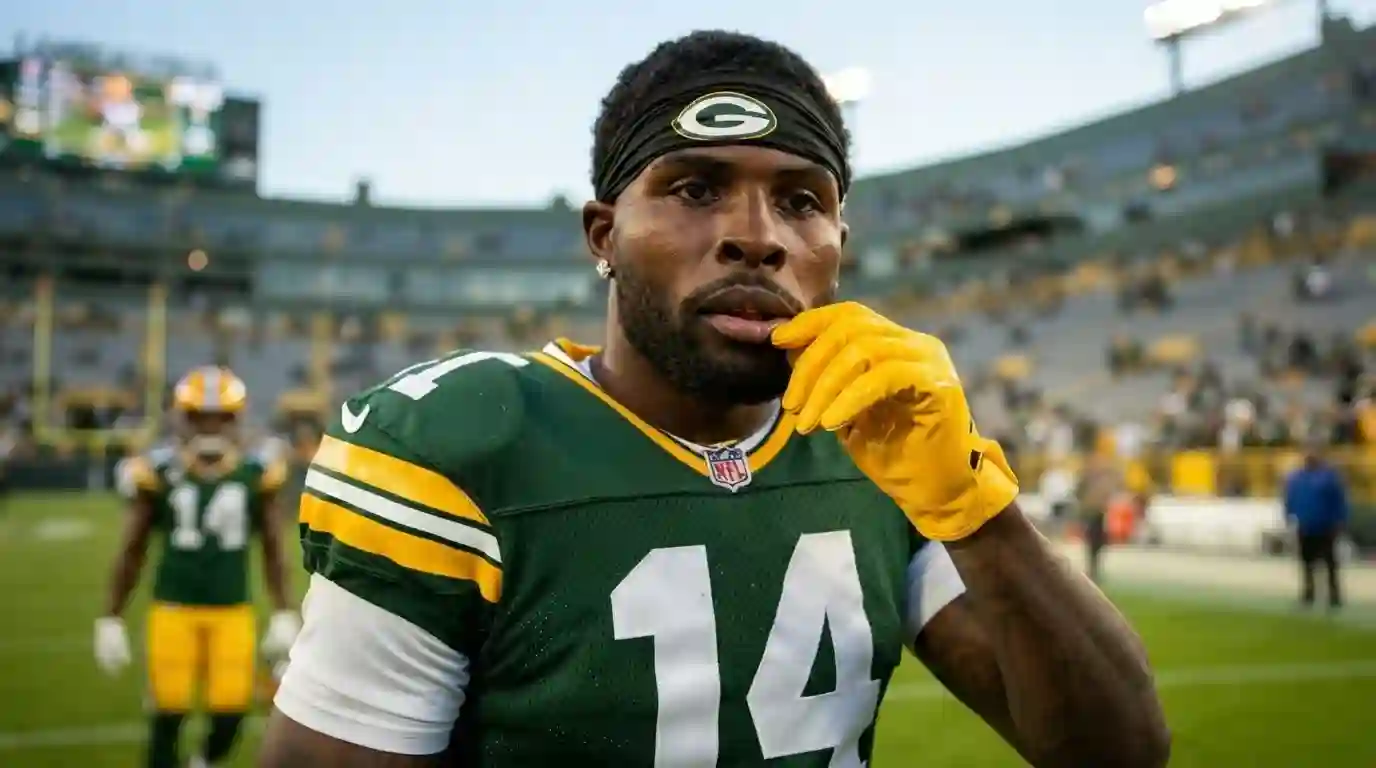
Jayden Reed box scores from the NFC wild-card night are easy to miss because the final score swallowed the first-half story. Search for Jayden Reed after Green Bay’s collapse and you mostly find Caleb Williams headlines, not the 18-yard touchdown or the jet-sweep that still moved the chains. This breakdown puts every Jayden Reed receiving yards figure, target, and snap next to the team numbers so the slot work is not lost under Chicago’s 25-point fourth quarter.
Born April 28, 2000, in Chicago and raised in Naperville, Illinois, Jayden Reed is the 5-foot-11, 187-pound Green Bay Packers slot receiver drafted 50th overall in 2023 after starring at Michigan State. On January 10, 2026, he scored in the building where he grew up watching Bears football, then watched Soldier Field explode around him. The Packers led 21-3 at halftime and 21-6 after three quarters. Chicago scored 25 points in the fourth and won 31-27. Reed finished 4-of-7 for 43 yards and a touchdown, plus one carry for 14 yards, in front of 60,338 fans on a 32-degree night streamed nationally on Amazon Prime Video.
The Packers (9-8-1) walked into the wild-card round after dropping their last five regular-season games and sitting Jordan Love for the finale. Love returned and threw four touchdowns. It was not enough. The Bears (12-6), in Ben Johnson’s first season, completed their seventh fourth-quarter comeback of the year and their first playoff win since the 2010 postseason. Reed’s night sits in that gap: efficient enough to help build an 18-point cushion, not large enough to stop the second-half stall that decided the rivalry’s latest chapter.
Match Overview Table
| Information | Match Details |
|---|---|
| Event | NFL NFC Wild Card Playoffs (2025 season) |
| Game | Green Bay Packers vs Chicago Bears |
| Date | Saturday, January 10, 2026 |
| Venue | Soldier Field, Chicago, Illinois |
| Attendance | 60,338 |
| Winner | Chicago Bears |
| Final Score | Bears 31, Packers 27 |
| Broadcast | Amazon Prime Video (Al Michaels, Kirk Herbstreit, Kaylee Hartung); local over-the-air in Chicago and Green Bay |
Core Match Statistics Overview
Football does not keep field-goal or three-point percentages the way a basketball box score does. The cleanest side-by-side for this Packers vs Bears player statistics night is volume, efficiency, and situational football.
| Metric | Green Bay Packers | Chicago Bears |
|---|---|---|
| Total Yards | 421 | 445 |
| Yards per Play | 6.0 | 5.8 |
| Passing (Net) | 322 | 352 |
| Completions-Attempts | 24-46 | 24-48 |
| Passing Touchdowns | 4 | 2 |
| Interceptions | 0 | 2 |
| Rushing Yards | 99 | 93 |
| Rush Attempts | 23 | 28 |
| Yards per Rush | 4.3 | 3.3 |
| First Downs | 21 | 24 |
| Third Down | 6-of-15 (40.0%) | 10-of-19 (52.6%) |
| Fourth Down | 3-of-3 | 2-of-6 |
| Red Zone | 3-of-3 | 2-of-5 |
| Turnovers | 0 | 2 |
| Penalties | 7 for 65 yards | 2 for 5 yards |
| Time of Possession | 27:19 | 32:41 |
| Sacks Allowed | 1 for 1 yard | 1 for 9 yards |
Third Down Conversion Rate
- Chicago converted 10 of 19 third downs, which is how a team that threw two interceptions still ran 77 plays and held the ball for 32:41.
- Green Bay went 6 of 15 and punted four times after halftime. The first-half rhythm that produced the Jayden Reed touchdown never returned on long-yardage downs.
Red Zone Finishing
- The Packers were a perfect 3-for-3 in the red zone, scoring touchdowns to Christian Watson, Romeo Doubs, and (from just outside the paint on the previous snap sequence) converting the Reed score that made it 14-3.
- The Bears were only 2-for-5 inside the 20. Cairo Santos field goals of 27, 34, and 51 yards kept them alive until D’Andre Swift and the late passing scores finally paid off those trips.
Time of Possession and Play Volume
- Chicago ran seven more plays and held the ball 5:22 longer. That extra volume showed up as 24 first downs to Green Bay’s 21 and as a fourth quarter that never gave the Packers defense a clean stop.
- Green Bay’s 421 yards looked like a winning night until you split them by half. The offense produced three touchdown drives before the break and one after it, then missed a 44-yard field goal that would have made the final two minutes a two-score problem for Chicago.
Turnover Margin That Did Not Travel
- Green Bay won the takeaway battle 2-0. Carrington Valentine and Ty’Ron Hopper each intercepted Caleb Williams, and the Packers lost zero of four fumbles.
- Expected-points tables from the game still favored Chicago’s late passing efficiency over Green Bay’s early scoring. A plus-two turnover margin usually wins January football. It did not on a night when Brandon McManus missed an extra point and a 44-yard kick and the defense allowed 25 points in one quarter.
Period-by-Period Analysis
First Quarter: Bears Strike First, Packers Answer Through Watson
| Team | First Quarter Points |
|---|---|
| Green Bay Packers | 7 |
| Chicago Bears | 3 |
- Chicago won the toss, chewed 7:51 off the clock on a 16-play opening drive, and still settled for a 27-yard Santos kick after stalling at the Green Bay 14.
- Jordan Love answered with a nine-play, 85-yard march. Reed’s 3-yard catch on third-and-2 kept the series alive, and Love rolled out to hit Watson for a 7-yard touchdown at 2:06.
- The Packers already owned the explosive edge. Chicago had more snaps and fewer points, a pattern that held until the fourth quarter flipped the math.
Second Quarter: Jayden Reed Touchdown Stretches the Lead to 21-3
| Team | Second Quarter Points |
|---|---|
| Green Bay Packers | 14 |
| Chicago Bears | 0 |
- Love found Jayden Reed for an 18-yard touchdown at 6:46, capping a 10-play, 87-yard drive. Reed won the intermediate window and finished the catch in stride for the 14-3 lead.
- Williams threw an interception on fourth down. Green Bay took over at the Chicago 32 and punched in a 1-yard Doubs score at 1:56 for 21-3.
- A late Packers field-goal try missed, which looked harmless at the time. Chicago left the locker room with 3 points, two failed fourth downs, and a deficit that felt like a blowout inside the oldest rivalry in the league.
Third Quarter: Packers Go Quiet, Bears Chip Away
| Team | Third Quarter Points |
|---|---|
| Green Bay Packers | 0 |
| Chicago Bears | 3 |
- Green Bay’s first three second-half possessions went punt, punt, punt for a net of 19 yards. The run game stalled, and Love’s timing with the outside receivers slipped.
- Santos hit a 34-yarder at 10:07 to make it 21-6. Hopper later intercepted Williams near the goal line, which should have frozen the comeback.
- Instead the takeaway produced nothing. The Packers could not turn a short field or a defensive stand into a 24-6 or 28-6 game, and the door stayed cracked.
Fourth Quarter: Chicago Outscores Green Bay 25-6
| Team | Fourth Quarter Points |
|---|---|
| Green Bay Packers | 6 |
| Chicago Bears | 25 |
- Santos opened the quarter with a 51-yard field goal. Swift then scored from 6 yards at 10:08 to cut it to 21-16 after a 66-yard drive.
- Love hit Matthew Golden for a 23-yard touchdown at 6:36, Golden breaking multiple tackles. McManus missed the extra point, leaving the score 27-16 instead of 28-16.
- Williams threw an 8-yard score to Olamide Zaccheaus and a two-point pass to Colston Loveland (27-24), McManus missed a 44-yarder, and Williams hit DJ Moore for 25 yards at 1:43. Love’s final heave was deflected by Jaquan Brisker as time expired.
Green Bay Packers Player Statistics
Jordan Love, QB
| Comp-Att | Yards | TD | INT | Rating | Rush |
|---|---|---|---|---|---|
| 24-46 | 323 | 4 | 0 | 103.8 | 1-11 |
Love missed the final two regular-season games after a helmet-to-helmet hit from Austin Booker in Week 16 at this same stadium. He returned with four touchdown passes and no picks. The first-half version of Love sliced Chicago for scores to Watson, Reed, and Doubs. The second-half version managed one more score and two empty red-zone-adjacent possessions, including the dropped snap on the last play.
Romeo Doubs, WR
| Targets | Rec | Yards | TD | Long |
|---|---|---|---|---|
| 11 | 8 | 124 | 1 | 34 |
Doubs led Green Bay with 124 receiving yards and caught the 1-yard score that made it 21-3. His 34-yard grab on the failed late field-goal drive was the Packers’ last real chunk play. He was the possession spine of the passing game while Reed worked the slot and Watson stretched the boundary.
Jayden Reed, WR
| Targets | Rec | Yards | TD | Long | Rush |
|---|---|---|---|---|---|
| 7 | 4 | 43 | 1 | 20 | 1-14 |
Jayden Reed stats on this night look modest until you stack them against a seven-game 2025 regular season that produced only 19 catches, 207 yards, and one score after a broken clavicle and a Jones fracture wiped out most of the year. He tied for second on the team in receptions, matched Watson with seven targets, and supplied the only designed run among the wideouts. The 18-yard scoring route was the cleanest Love-to-Reed timing of the night. The three incompletions were contested or late-down shots, including a 2-yard catch on the doomed 44-yard field-goal series that never got him the ball again in space.
Matthew Golden, WR
| Targets | Rec | Yards | TD | Long |
|---|---|---|---|---|
| 5 | 4 | 84 | 1 | 36 |
Golden’s 23-yard touchdown, his first career score, should have iced a 11-point lead with 6:36 left. Instead the missed extra point kept Chicago’s two-score math alive. Golden’s 84 yards on four catches were the most efficient Green Bay line on the field.
Josh Jacobs, RB
| Att | Yards | TD | Rec | Rec Yards |
|---|---|---|---|---|
| 19 | 55 | 0 | 1 | 3 |
Jacobs never found the crease. 2.9 yards per carry against a Bears front that lost T.J. Edwards to a broken fibula still tells you Green Bay abandoned the ground game’s identity after the break. One catch for 3 yards left the passing game to carry every scoring drive.
Christian Watson, WR
| Targets | Rec | Yards | TD | Long |
|---|---|---|---|---|
| 7 | 3 | 36 | 1 | 22 |
Watson opened the scoring and then disappeared into a 3-for-7 night. The seven-yard corner route in the first quarter was the only time Green Bay consistently won the outside. After that, Chicago’s boundary corners and Brisker over the top closed the deep window.
Chicago Bears Player Statistics
Caleb Williams, QB
| Comp-Att | Yards | TD | INT | Rating | Rush |
|---|---|---|---|---|---|
| 24-48 | 361 | 2 | 2 | 71.6 | 4-20 |
Williams’ passer rating sat in the low 70s because of the two interceptions and a 50 percent completion rate. His fourth-quarter tape is the reason Chicago is still playing. The pump-fake to Moore for 25 yards at 1:43 was his first playoff go-ahead throw. He also hit Zaccheaus from 8 yards and Loveland for the two-point play that made the miss by McManus fatal.
Colston Loveland, TE
| Targets | Rec | Yards | TD | Long |
|---|---|---|---|---|
| 15 | 8 | 137 | 0 | 29 |
Loveland was the game’s leading receiver. Fifteen targets is a feature-tight-end workload, and the 137 yards were a career high. He moved the chains on third down, set up the Swift score, and caught the two-point conversion. Green Bay never found an answer for the seam and the sit-down over the ball.
DJ Moore, WR
| Targets | Rec | Yards | TD | Rush |
|---|---|---|---|---|
| 7 | 6 | 64 | 1 | 1-(-5) |
Moore was quiet for three quarters and then ended Green Bay’s season. Six catches on seven targets is a clean night. The 25-yard touchdown with 1:43 left is the play this game will be remembered for, not the jet sweep that lost 5 yards earlier.
D’Andre Swift, RB
| Att | Yards | TD | Rec | Rec Yards |
|---|---|---|---|---|
| 13 | 54 | 1 | 2 | 38 |
Swift’s 6-yard touchdown at 10:08 was the first real punch of the rally. His 23-yard catch in the flat later moved Chicago to the Green Bay 25 right before the Moore score. Combined 92 yards from scrimmage made him Chicago’s most complete offensive skill player besides Williams.
Rome Odunze and Luther Burden III
Odunze caught 2 of 6 for 44 yards, including a 27-yarder that kept a late drive on schedule. Burden added 3 catches for 42 yards and a minus-4 rush. Neither scored, but both occupied safeties so Loveland and Moore could work the intermediate middle that Green Bay could not cover once Micah Parsons was already lost for the year.
Statistical Leaders Summary Table
| Category | Green Bay Packers | Chicago Bears |
|---|---|---|
| Leading Scorer | Jordan Love (4 pass TDs, 24 points responsible for) | Caleb Williams (2 pass TDs, 2-pt, 14 points responsible for) |
| Second Leading Scorer | Romeo Doubs (124 yards, 1 TD) / Jayden Reed (43 yards, 1 TD) | DJ Moore (64 yards, 1 TD) / D’Andre Swift (1 rush TD) |
| Top Receiver | Romeo Doubs (8-124-1) | Colston Loveland (8-137-0) |
| Top Rusher / Defense | Josh Jacobs (19-55); Edgerrin Cooper (8 tackles) | D’Andre Swift (13-54-1); Jaquan Brisker (9 tackles, game-sealing breakup) |
| Most Assists / Playmaker | Jordan Love (24 completions, 4 TD) | Caleb Williams (24 completions, 361 yards) |
| Jayden Reed receiving yards | 43 (plus 14 rush, 1 TD) | — |
Why the Chicago Bears Won
Fourth-Quarter Scoring Rate
Chicago outscored Green Bay 25-6 after the 13:29 mark of the fourth quarter if you start with Santos’ 51-yarder. That is not a single explosive play. It is four scoring drives in a row: field goal, Swift touchdown, Zaccheaus touchdown plus two-point play, Moore touchdown.
| Fourth-Quarter Item | Bears | Packers |
|---|---|---|
| Points | 25 | 6 |
| Offensive Touchdowns | 3 | 1 |
| Two-Point Conversions | 1-1 | 0-0 |
| Field Goals | 1 | 0-1 |
Third-Down Persistence
Ten conversions on 19 tries kept the Bears on the field after two interceptions. Green Bay’s defense, already missing Parsons after the Week 15 knee injury in Denver, could not get off the field on third-and-medium. Williams repeatedly found Loveland and Swift on those downs. The Packers’ 6-of-15 mark turned their second-half script into a three-and-out loop.
Complementary Special Teams
Santos went 3-for-3 on field goals, including the 51-yarder that started the avalanche. McManus missed an extra point and a 44-yard try. In a one-score game decided by 4 points, those two Green Bay kicks are the entire margin. Chicago also won the hidden-yardage battle with only 5 penalty yards against Green Bay’s 65.
Williams’ Late-Down Aggression
The Bears went for it on fourth down six times and converted only two, which looks sloppy until you remember the first half included a fourth-down interception that Green Bay turned into a touchdown. Johnson did not get conservative after that. The fourth-quarter calls stayed aggressive, and the last two conversions in scoring range produced 14 points plus the two-point play.
Why the Green Bay Packers Lost
Second-Half Offensive Drought
Green Bay scored 21 points in the first 28 minutes and 6 points in the last 32. After the break the first four possessions were punt, punt, punt, punt. Love finished 24 of 46, which means 22 incompletions, and too many of those came on second-and-long after Jacobs was stuffed. The Jayden Reed slot receiver package that moved the ball before halftime was not featured on early downs after the break.
Heavy Dependence on the Pass After Jacobs Stalled
| Rushing Split | Attempts | Yards | Yards per Carry |
|---|---|---|---|
| Josh Jacobs | 19 | 55 | 2.9 |
| Rest of Packers (Brooks, Reed, Love, Wilson) | 4 | 44 | 11.0 |
The change-of-pace runs worked. Reed’s 14-yard carry and Chris Brooks’ 16-yarder were the two most efficient designed runs Green Bay had. The staff still fed Jacobs into a stacked front for 19 carries and never built a second-half drive around the jet and toss elements that had stressed Chicago’s edges.
Special Teams Execution Failures
McManus missed the extra point after Golden’s touchdown and later pushed a 44-yard field goal wide right with 2:51 left. Either make, and Williams needs a touchdown plus a two-point play just to tie, or the Bears start the final drive down two scores. Green Bay also took a delay-of-game penalty that pushed that 44-yard attempt back. Those are coaching and operation errors, not talent gaps.
Empty Takeaways
A plus-two turnover margin and a 3-for-3 red-zone night should be a playoff win. Green Bay turned Hopper’s third-quarter interception near the goal line into a punt. The defense forced two empty fourth-down stands in the first half and then allowed 66, 76, and 66 yards on Chicago’s last three touchdown drives. The unit that created the 21-3 lead could not finish a stop when the lead shrank.
Historical Context and Advanced Insights
Season Series Breakdown
These clubs played three times in five weeks. Green Bay took the December 7 meeting at Lambeau Field, 28-21, behind a late Keisean Nixon interception. Chicago answered on December 20 at Soldier Field, 22-16 in overtime. The wild-card game was the rubber match and the first postseason meeting since the 2010 NFC Championship, which Green Bay won 21-14 on the way to Super Bowl XLV.
| Date | Site | Result | Jayden Reed Line |
|---|---|---|---|
| Dec. 7, 2025 | Lambeau Field | Packers 28, Bears 21 | 4 rec, 31 yards, 2 rush, 22 yards |
| Dec. 20, 2025 | Soldier Field | Bears 22, Packers 16 (OT) | 3 rec, 35 yards, 1 rush, 6 yards |
| Jan. 10, 2026 | Soldier Field | Bears 31, Packers 27 | 4 rec, 43 yards, 1 TD, 1 rush, 14 yards |
Reed’s three-game series total: 11 catches, 109 yards, one touchdown, four carries for 42 yards. He was Green Bay’s most consistent multi-phase skill player against Chicago even in an injury-shortened year. The Bears still took two of three, including the only game that extended the season.
Jayden Reed Biography in Context of This Matchup
Reed is a Naperville Central product who began at Western Michigan (797 receiving yards as a freshman) before transferring to Michigan State, where he piled up 2,069 yards over three seasons, earned first-team All-America all-purpose honors in 2021, and returned punts for touchdowns. The Packers took him in the second round in 2023. As a rookie he caught 64 balls for 793 yards and eight scores and added 119 rushing yards. In 2024 he posted 55-857-6 through the air and 163 rushing yards. The 2025 regular season shrunk to seven games and a 19-207-1 receiving line after the Week 2 clavicle break and the lingering foot injury. He returned in December and immediately slid back into the slot. In April 2026 Green Bay signed him to a three-year, $50.25 million extension through 2029 with $20 million guaranteed, a number that now reads like a bet on the version of Reed who scored at Soldier Field, not the version who missed 10 games.
Advanced Statistical Insights
Love’s 103.8 passer rating and four touchdowns produced 20.22 expected points on pass plays for Green Bay. Williams posted 13.06 expected points on pass plays despite two interceptions, because the late completions came in high-leverage spots. Chicago’s rushing expected points were negative (minus-1.12). Green Bay’s rushing expected points were worse (minus-2.51). Both staffs won this game through the air. Only one staff kept throwing after the lead flipped.
Completion rate was identical at 24 completions. Chicago needed 48 attempts, Green Bay 46. The difference sat in yards after catch and in who got the ball on third down. Loveland’s 8-for-15 usage is a 53 percent catch rate on a massive target share. Reed’s 4-for-7 is a 57 percent catch rate on a 15 percent target share (7 of Love’s 46 attempts). If you measure efficiency per target, Reed (6.1 yards per target, plus a score) beat several higher-volume Packers looks, including Watson’s 5.1 yards per target. Volume still ran through Doubs (11.3 yards per target) and Golden (16.8). Green Bay’s problem was not Reed’s per-route value. It was that the slot package vanished on the four empty third-quarter series.
Assist-to-score translation is the football version of an assist-to-field-goal ratio. Love spread touchdowns to four different receivers: Watson, Reed, Doubs, Golden. That is balanced offensive production on the scoresheet. Chicago’s two passing scores went to Zaccheaus and Moore, with Loveland as the connective tissue. The Bears won because their connective tissue kept moving the chains in the fourth quarter. Green Bay’s four touchdown passers became spectators while McManus and a tired front seven tried to close.
Net yards per play favored Green Bay 6.0 to 5.8. Winning the per-play battle and the turnover battle and the red-zone battle and still losing is the definition of a special-teams and finishing problem. Add 65 penalty yards and a 40 percent third-down rate after a 21-3 start, and the advanced profile matches the eye test: the Packers played a winning first half and a losing second half in the same stadium.
Game Implications and Key Lessons
What This Means for the Chicago Bears
- A first playoff win in 15 years validates Johnson’s fourth-quarter identity. Seven comeback wins in one season is now a postseason fact, not a regular-season quirk.
- Williams has a signature January throw. The Moore touchdown will follow him into the divisional round at home, whether the opponent is the Rams or the leftover NFC seed after Sunday.
- Loveland is no longer a developmental tight end in this scheme. Fifteen targets in a win-or-go-home game is a usage statement for the rest of the winter.
What This Means for the Green Bay Packers
- The 2025 season ends at 9-8-1 after a five-game losing streak and a blown 18-point playoff lead. Love’s four-touchdown return does not paper over a defense that lost Parsons and a kicking operation that missed twice in the fourth quarter.
- Jayden Reed Packers contract talks already resolved in April 2026, so the offseason question is health and role, not franchise-tag math. He showed enough in three Bears games (109 yards, a score, 42 rushing yards) to keep the slot job. He did not get enough early-down work after halftime to change this result.
- Doubs, Watson, Golden, and Reed all scored or topped 80 yards in this game. The skill room is not the roster hole. Protection, run-game stubbornness, and late-game kicking are.
Key Lessons
- An 18-point halftime lead is not a win if your third-down rate collapses after the break.
- Plus-two turnover margin dies when you punt after a goal-line interception.
- A missed extra point changes two-score math into one-score math. Chicago needed that extra point to make the Moore throw a lead throw instead of a tying throw.
- Jayden Reed stats travel better when the jet sweep stays in the call sheet. His 14-yard run was Green Bay’s second-best designed gain on the ground.
- Feature tight ends still decide January games. Loveland’s 137 yards mattered more than any single Packers skill-player line after halftime.
- Rivalry history does not play the fourth quarter. Green Bay’s long-term series lead did not stop Chicago from taking two of the last three meetings.
Frequently Asked Questions
Who won the Packers vs Bears wild-card game?
The Chicago Bears won 31-27 on January 10, 2026, at Soldier Field, rallying from a 21-3 halftime deficit and a 21-6 score after three quarters. It was Chicago’s first playoff victory since the 2010 postseason.
What were Jayden Reed stats in the wild-card game?
Jayden Reed caught 4 of 7 targets for 43 yards and an 18-yard touchdown. He also rushed once for 14 yards. He tied for second on Green Bay in receptions and matched Christian Watson with seven targets.
Who scored the most receiving yards in the game?
Colston Loveland led all players with 8 catches for 137 yards. Romeo Doubs led the Packers with 8 catches for 124 yards and a touchdown.
What numbers did Jordan Love have versus the Bears?
Love completed 24 of 46 passes for 323 yards, four touchdowns, and zero interceptions (103.8 rating). He added one scramble for 11 yards. His scoring throws went to Watson, Reed, Doubs, and Golden.
Did Jayden Reed score a touchdown against Chicago?
Yes. Love hit Reed for an 18-yard touchdown at 6:46 of the second quarter, putting Green Bay ahead 14-3. It was Reed’s only receiving score of the 2025 season, regular season or playoffs.
Where can I find Jayden Reed biography details?
Reed was born April 28, 2000, stands 5-foot-11 and 187 pounds, played at Naperville Central, Western Michigan, and Michigan State, and was selected 50th overall by Green Bay in 2023. After an injury-shortened 2025, he signed a three-year, $50.25 million extension through 2029.
Closing
Jayden Reed did his job in the building he grew up near. He scored, he converted a jet sweep, and he finished with a 57 percent catch rate on seven targets while the Packers built a 21-3 lead. Chicago still won because Williams, Loveland, Moore, and Swift scored 25 points in a single quarter and because Green Bay stopped running the plays that had worked, then missed two kicks that turned a two-score night into a one-score loss. Four touchdown passers and a plus-two turnover margin lost to third-down staying power and a clean kicking operation. That is the entire wild-card tape. Reed’s line is the first-half proof that Green Bay had a working slot plan. The final score is the proof that a working plan only counts if you keep calling it after the lead feels safe.