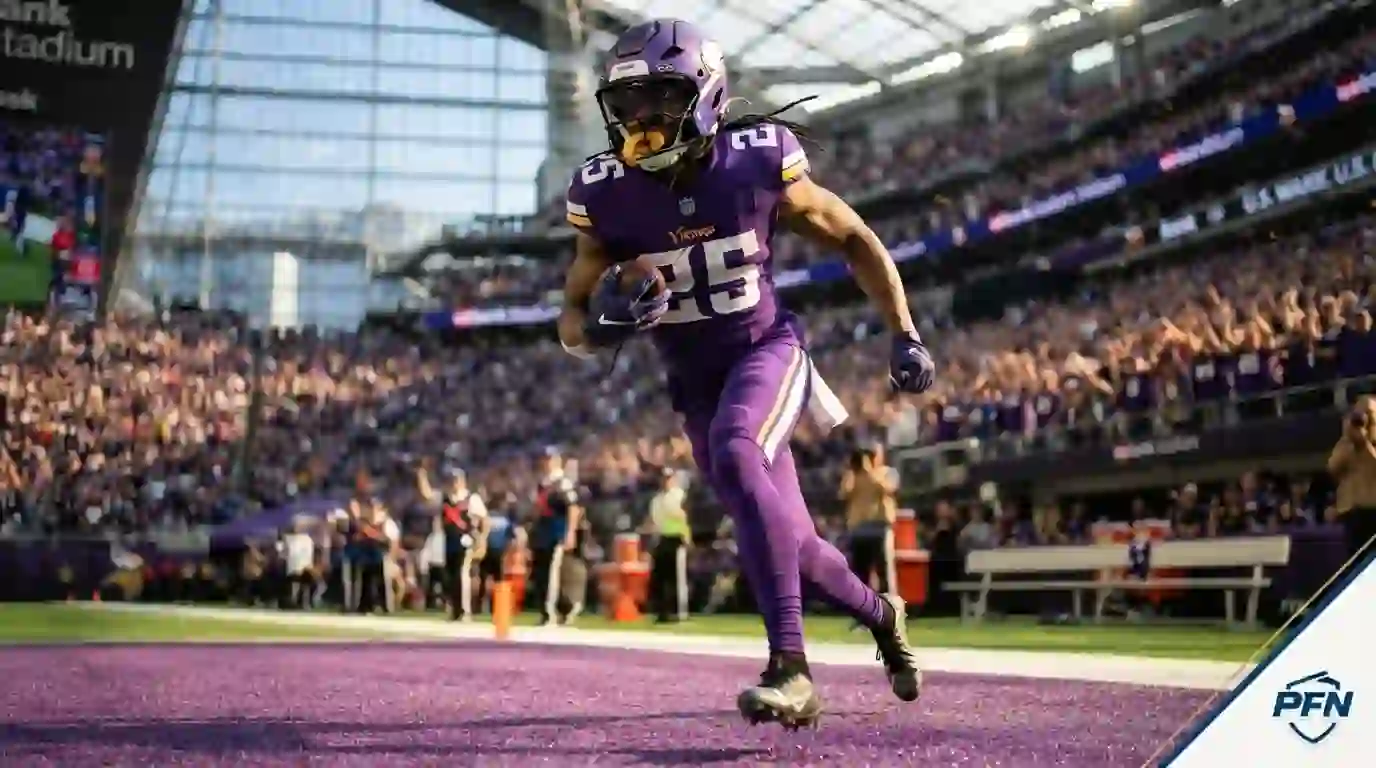
Jordan Mason: Biography
| Information | Details |
|---|---|
| Full Name | Jordan Ponchez Mason |
| Date of Birth | May 24, 1999 |
| Position | Running Back |
| Height | 5'11" |
| Weight | 223 lbs |
| College | Georgia Tech |
| NFL Draft | 2022 Undrafted Free Agent |
| Current Team | Minnesota Vikings |
| Former Team | San Francisco 49ers (2022-2024) |
| Jersey Number | #24 (49ers), #27 (Vikings) |
Jordan Mason Steals the Show as 49ers Crush Jets 32-19 on Monday Night Football
Christian McCaffrey's unexpected absence created panic among San Francisco 49ers fans ninety minutes before kickoff. By halftime, nobody remembered his name. Jordan Mason, the undrafted third-year running back from Georgia Tech, seized his first career start and delivered a performance that will echo through the NFL for weeks to come.
Mason carried the ball 28 times for 147 yards and a touchdown, bulldozing through a Jets defense that had no answers for his violent downhill running style. The 49ers dominated from start to finish, controlling possession for nearly 39 minutes while racking up 401 total yards in a 32-19 demolition at Levi's Stadium. Aaron Rodgers' hyped return from his 2023 Achilles injury became an afterthought as Mason and the San Francisco offensive line imposed their will on every snap.
Match Overview
| Information | Match Details |
|---|---|
| Event | NFL Week 1 - Monday Night Football |
| Game | New York Jets vs San Francisco 49ers |
| Date | Monday, September 9, 2024 |
| Venue | Levi's Stadium, Santa Clara, CA |
| Attendance | 71,319 |
| Winner | San Francisco 49ers |
| Final Score | 49ers 32, Jets 19 |
| Broadcast | ESPN / ABC |
| Weather | Sunny |
| Referee | Carl Cheffers |
| Game Duration | 2 hours, 51 minutes |
Core Match Statistics Overview
Team Stats Comparison
| Statistic | San Francisco 49ers | New York Jets |
|---|---|---|
| Total Yards | 401 | 266 |
| Passing Yards | 221 | 198 |
| Rushing Yards | 180 | 68 |
| Yards Per Play | 5.7 | 5.4 |
| Yards Per Pass | 7.6 | 6.8 |
| Rush Average | 4.7 | 3.6 |
| First Downs | 24 | 15 |
| Third Down Efficiency | 8/15 (53%) | 3/10 (30%) |
| Time of Possession | 38:44 | 21:16 |
| Turnovers | 0 | 2 |
| Penalties | 5 | 4 |
| Sacks Allowed | 1 | 2 |
Dominant Ground Game Control
The 49ers rushing attack generated 180 yards on 38 carries, averaging 4.7 yards per attempt. San Francisco's offensive line created massive lanes all night, with multiple linemen firing off the ball in unison on run plays. The Jets switched to a five-man front mid-game and still couldn't contain Mason's punishing style.
Jordan Mason forced 13 missed tackles according to Next Gen Stats, leading all NFL ball carriers in Week 1 by five missed tackles over the next closest player. His ability to break contact and gain yards after initial hits turned what should have been short gains into chunk plays throughout the contest.
Turnover Battle Decisive
The Jets committed two turnovers while the 49ers played clean football with zero giveaways. Aaron Rodgers threw a critical interception, and New York's inability to protect the ball gave San Francisco additional possessions in a game already tilted by time of possession. The turnover margin directly correlated with the final scoring difference.
Third Down Efficiency Gap
San Francisco converted 53% of their third downs compared to just 30% for New York. The 49ers sustained long drives throughout the game, keeping Rodgers and the Jets offense on the sideline. This efficiency gap allowed San Francisco to control tempo and wear down New York's defensive front as the game progressed.
Period-by-Period Analysis
First Quarter
| Team | Score |
|---|---|
| San Francisco 49ers | 3 |
| New York Jets | 7 |
The Jets struck first with Breece Hall punching in a 3-yard touchdown run after an efficient opening drive. San Francisco answered with a Jake Moody 46-yard field goal but struggled to find early rhythm. The quarter ended with New York holding a surprising 7-3 lead, energizing their sideline after Rodgers' emotional return.
Second Quarter
| Team | Score |
|---|---|
| San Francisco 49ers | 13 |
| New York Jets | 0 |
This is where the game flipped entirely. Moody drilled a 51-yard field goal to cut the deficit to one point. Deebo Samuel capped a Mason-heavy drive with a 2-yard touchdown run, giving San Francisco the lead for good. Moody added a 31-yard field goal as time expired in the half, sending the 49ers into the locker room with a 16-7 advantage. The Jets managed zero points and minimal possession during this critical stretch.
Third Quarter
| Team | Score |
|---|---|
| San Francisco 49ers | 10 |
| New York Jets | 6 |
Mason delivered the knockout blow early in the second half. An 11-play, 70-yard drive consumed over seven minutes of clock before Mason bulldozed into the end zone from 5 yards out. Moody's franchise-record-tying 53-yard field goal pushed the lead to 26-7. Rodgers salvaged some pride with a 36-yard touchdown pass to Allen Lazard on a free play, but the two-point conversion failed, leaving the score at 26-13.
Fourth Quarter
| Team | Score |
|---|---|
| San Francisco 49ers | 6 |
| New York Jets | 6 |
The 49ers milked the clock with methodical drives, adding two more Moody field goals from 23 and 42 yards. Tyrod Taylor connected with Lazard for a meaningless 3-yard touchdown with 25 seconds remaining. The garbage-time score made the final margin slightly more respectable at 32-19, but the outcome was never in doubt after halftime.
San Francisco 49ers Player Statistics
Jordan Mason - RB
| Stat | Value |
|---|---|
| Carries | 28 |
| Rushing Yards | 147 |
| Yards Per Carry | 5.3 |
| Long Run | 24 |
| Rushing TD | 1 |
| Receptions | 1 |
| Receiving Yards | 5 |
| Missed Tackles Forced | 13 |
| Fantasy Points | 21 |
Mason's 147 yards doubled his previous career-high of 69 rushing yards in a single game. The undrafted back ran with violent intent on every carry, consistently falling forward for extra yardage while punishing Jets defenders at the point of contact.
Brock Purdy - QB
| Stat | Value |
|---|---|
| Completions/Attempts | 19/29 |
| Passing Yards | 231 |
| Touchdowns | 0 |
| Interceptions | 0 |
| Passer Rating | 89.9 |
| Rush Attempts | 1 |
| Rush Yards | 11 |
Purdy managed the game efficiently, avoiding turnovers while taking what the defense gave him. His 231 passing yards came without a touchdown, but his clean stat line allowed the running game to carry the offensive load without pressure.
Deebo Samuel - WR
| Stat | Value |
|---|---|
| Carries | 8 |
| Rushing Yards | 23 |
| Rushing TD | 1 |
| Receptions | 5 |
| Receiving Yards | 54 |
| Total Touches | 13 |
| Total Yards | 77 |
Samuel's versatility shined as Kyle Shanahan deployed him as a change-of-pace back alongside Mason. His 2-yard rushing touchdown in the second quarter extended the lead, and his 54 receiving yards provided crucial production through the air.
Jauan Jennings - WR
| Stat | Value |
|---|---|
| Receptions | 5 |
| Receiving Yards | 64 |
| Yards Per Reception | 12.8 |
| Long | 22 |
| Targets | 5 |
Jennings led all 49ers receivers with 64 yards on 5 catches, finding soft spots in the Jets secondary throughout the game. His ability to convert on intermediate routes helped sustain multiple scoring drives.
New York Jets Player Statistics
Breece Hall - RB
| Stat | Value |
|---|---|
| Carries | 16 |
| Rushing Yards | 54 |
| Yards Per Carry | 3.4 |
| Long Run | 16 |
| Rushing TD | 1 |
| Receptions | 5 |
| Receiving Yards | 39 |
Hall scored the Jets' only offensive touchdown but was largely contained by San Francisco's improved run defense. His 3.4 yards per carry average reflected the 49ers' dominance in the trenches on both sides of the ball.
Aaron Rodgers - QB
| Stat | Value |
|---|---|
| Completions/Attempts | 13/21 |
| Passing Yards | 167 |
| Touchdowns | 1 |
| Interceptions | 1 |
| Passer Rating | 82.8 |
| Rush Attempts | 1 |
| Rush Yards | -1 |
Rodgers' return from his Achilles injury produced mixed results. His 167 yards and interception fell short of expectations, and his inability to sustain drives kept the Jets defense on the field far too long against Mason and the 49ers ground attack.
Allen Lazard - WR
| Stat | Value |
|---|---|
| Receptions | 6 |
| Receiving Yards | 89 |
| Touchdowns | 2 |
| Yards Per Reception | 14.8 |
| Long | 36 |
| Targets | 9 |
Lazard was the lone bright spot for New York's offense, catching both Jets touchdowns. His 36-yard scoring grab in the third quarter came on a free play after a 49ers penalty, and his late 3-yard touchdown from Tyrod Taylor came in garbage time.
Garrett Wilson - WR
| Stat | Value |
|---|---|
| Receptions | 6 |
| Receiving Yards | 60 |
| Yards Per Reception | 10.0 |
| Long | 16 |
| Targets | 11 |
Wilson's 60 yards on 6 catches represented solid volume, but the Jets couldn't get him the ball in high-leverage situations. The 49ers secondary limited his explosive plays, keeping everything in front of them.
Statistical Leaders Summary Table
| Category | San Francisco 49ers | New York Jets |
|---|---|---|
| Leading Rusher | Jordan Mason (147 YDS, 1 TD) | Breece Hall (54 YDS, 1 TD) |
| Leading Passer | Brock Purdy (231 YDS) | Aaron Rodgers (167 YDS, 1 TD, 1 INT) |
| Leading Receiver | Jauan Jennings (64 YDS) | Allen Lazard (89 YDS, 2 TD) |
| Leading Scorer | Jake Moody (20 PTS, 6/6 FG) | Allen Lazard (12 PTS, 2 TD) |
| Top Defender | Fred Warner (7 TOT) | Tony Adams (12 TOT) |
Why the 49ers Won
Jordan Mason's Breakout Performance
Mason's 28-carry, 147-yard explosion provided the foundation for everything San Francisco accomplished offensively. His 5.3 yards per carry average and 13 forced missed tackles created a ground game that the Jets simply could not solve. Mason's punishing style set the tone early and wore down New York's defensive front as the game progressed.
The 49ers offensive line deserves massive credit for creating running lanes. On a 9-yard Mason run in the early second quarter, all five linemen fired off the line at a right angle and won their blocks in a stunning display of coordination that defined the night.
Jake Moody's Perfect Kicking
Moody converted all six field goal attempts, tying a franchise record and accounting for 20 of San Francisco's 32 points. His range stretched from 23 yards to a 53-yard bomb, providing consistent scoring whenever drives stalled. The kicker's reliability meant the 9ers never had to settle for punts in plus territory.
Zero Turnovers
San Francisco played mistake-free football while forcing two Jets giveaways. Purdy's clean stat line without interceptions or fumbles ensured the 49ers never gave New York short fields or momentum swings. This turnover differential directly contributed to the final 13-point margin.
Time of Possession Dominance
The 49ers held the ball for nearly 39 minutes compared to just 21 minutes for the Jets. This massive gap kept Rodgers on the sideline and prevented New York's offense from establishing any rhythm. San Francisco's methodical, run-first approach ground the clock and exhausted the Jets defense.
Why the Jets Lost
Defensive Collapse Against the Run
The Jets entered the game expecting to face Christian McCaffrey's backup and instead got steamrolled by a motivated Jordan Mason. New York's defense, typically their strongest unit, allowed 180 rushing yards and looked soft at the point of attack all night. Their inability to set the edge or fill gaps allowed Mason to consistently gain yards after contact.
Rodgers' Inefficient Return
Aaron Rodgers' 13-for-21, 167-yard performance with an interception failed to provide the offensive spark New York needed. His inability to sustain drives meant the Jets defense spent too much time on the field, and his turnover contributed directly to San Francisco's scoring opportunities.
Inability to Win Third Downs
The Jets converted just 3 of 10 third-down attempts, a 30% rate that killed drives repeatedly. This inefficiency meant New York couldn't stay on the field long enough to rest their defense or establish offensive momentum against a 49ers team that controlled tempo all game.
Historical Context and Advanced Insights
Season Series History
The 49ers and Jets don't meet often as cross-conference opponents, making this Monday Night Football matchup a rare treat. San Francisco's dominance in this game continued a historical trend of success against New York, with the 49ers holding a significant all-time advantage in the series.
Jordan Mason's Career Trajectory
Mason entered the 2024 season with just 464 career rushing yards across two seasons as a backup. His 147-yard explosion against the Jets represented more than 30% of his previous career rushing total in a single game. The Georgia Tech product's development from undrafted free agent to featured back showcases the 49ers' ability to develop talent at the running back position.
His 609 rushing yards through the first six games of the 2024 season tied for the most in 49ers history with running back Charlie Garner from 2000. Mason's yards after contact rate of 3.62 ranked sixth in the NFL among qualified rushers.
Advanced Rushing Metrics
Among players with at least 150 rushing attempts during the 2024 season, Mason led the league with a missed tackles forced percentage of 37.3% according to Next Gen Stats. This elite contact balance made him nearly impossible to bring down on first contact, turning modest blocking into significant yardage.
The 49ers' 4.7 yards per carry average against the Jets reflected their offensive line's dominance in the trenches. San Francisco's zone-blocking scheme created consistent cutback lanes that Mason exploited with decisive vision and violent acceleration through the hole.
Game Implications and Key Lessons
What This Means for the 49ers
- San Francisco proved they could win convincingly without Christian McCaffrey, adding a dangerous dimension to their offense if both backs remain healthy
- Jordan Mason's emergence as a legitimate starting-caliber running back gives Kyle Shanahan another weapon to deploy in his creative offensive system
- The 49ers' defensive improvement against the run, after finishing 26th in the NFL the previous season, suggests a more complete team heading into the 2024 campaign
What This Means for the Jets
- New York's defensive performance raised serious concerns about their ability to stop physical rushing attacks, a troubling sign in an AFC loaded with strong ground games
- Aaron Rodgers' rust was evident, and the Jets need their quarterback to play significantly better if they hope to compete for a playoff spot
- The Jets' offensive line struggled to create running lanes for Breece Hall, limiting New York's ability to control tempo and protect their defense
Key Lessons from This Game
- Undrafted players can make massive impacts when given opportunities, as Mason proved with his historic debut performance
- Time of possession remains one of football's most underrated statistics, with San Francisco's 39-minute advantage directly correlating to their dominant victory
- A team's rushing attack is only as good as its offensive line, and the 49ers' front five dominated the line of scrimmage all night
- Turnover margin continues to be one of the strongest predictors of NFL game outcomes, with the 49ers' clean sheet proving decisive
- Special teams matter, and Jake Moody's perfect 6-for-6 field goal performance provided consistent scoring whenever the offense stalled
- A quarterback returning from a major injury needs time to regain form, and Rodgers' interception served as a reminder that rust is real
Frequently Asked Questions
Who won the 49ers vs Jets Monday Night Football game?
The San Francisco 49ers defeated the New York Jets 32-19 on Monday Night Football in Week 1 of the 2024 NFL season. The game was played at Levi's Stadium in Santa Clara, California on September 9, 2024.
What were Jordan Mason's stats against the Jets?
Jordan Mason rushed for 147 yards and 1 touchdown on 28 carries, averaging 5.3 yards per attempt with a long run of 24 yards. He also caught 1 pass for 5 receiving yards. Mason forced 13 missed tackles, leading all NFL ball carriers in Week 1.
How many field goals did Jake Moody kick against the Jets?
Jake Moody converted all six field goal attempts, tying a 49ers franchise record. His makes came from 46, 51, 31, 53, 23, and 42 yards, accounting for 20 of San Francisco's 32 points in the victory.
What was Aaron Rodgers' stat line in his return game?
Aaron Rodgers completed 13 of 21 passes for 167 yards with 1 touchdown and 1 interception, posting an 82.8 passer rating. It was his first game action since tearing his Achilles tendon four plays into his Jets debut in 2023.
Why didn't Christian McCaffrey play against the Jets?
Christian McCaffrey was ruled inactive 90 minutes before kickoff due to a calf and Achilles injury. His absence opened the door for Jordan Mason to make his first career start, which resulted in the 147-yard breakout performance.
How many total yards did the 49ers gain against the Jets?
The San Francisco 49ers gained 401 total yards against the Jets, including 221 passing yards and 180 rushing yards. They dominated time of possession with 38 minutes and 44 seconds compared to just 21 minutes and 16 seconds for New York.
Conclusion
Jordan Mason's 147-yard explosion against the Jets demonstrated that efficiency and teamwork will always outperform individual hype. While Aaron Rodgers' return dominated the pregame narrative, it was an undrafted running back and his dominant offensive line that controlled the game from start to finish. The 49ers' combination of a punishing ground game, clean quarterback play from Brock Purdy, and flawless kicking from Jake Moody created a formula that overwhelmed New York on both sides of the ball. Mason's performance served as a reminder that in the NFL, opportunity meets preparation, and when it does, special things happen on Monday Night Football.