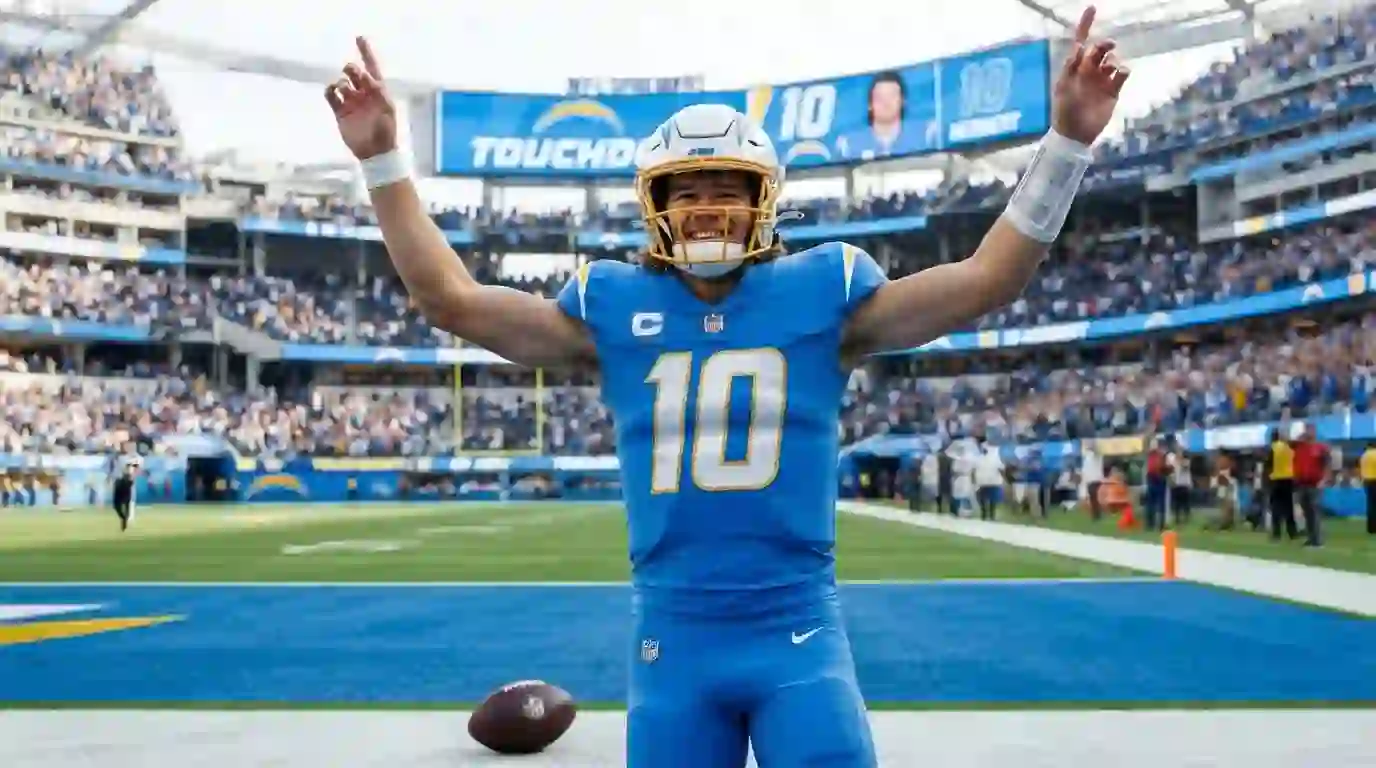
Can Justin Herbert carry the Los Angeles Chargers offense against the AFC West's standard-bearer on a global stage? That question hovered over the NFL's first-ever regular-season game in South America, where the Chiefs had won six straight division titles and arrived in São Paulo as heavy favorites. Herbert answered with a clinical 318-yard, three-touchdown masterpiece, outdueling Patrick Mahomes and delivering a statement 27-21 victory that signaled the Chargers' intent for 2025.
Justin Herbert Biography & Career Profile
| Detail | Information |
|---|---|
| Full Name | Justin Patrick Herbert |
| Born | March 10, 1998, Eugene, Oregon |
| Height / Weight | 6 ft 6 in / 236 lbs |
| Position | Quarterback |
| Jersey Number | 10 |
| College | University of Oregon |
| NFL Draft | 2020, Round 1, Pick 6 (Los Angeles Chargers) |
| NFL Debut | 2020 |
| Awards | NFL Offensive Rookie of the Year (2020), Pro Bowl (2021, 2025) |
| Career Passing Yards | 24,820 |
| Career Passing TDs | 163 |
| Career Passer Rating | 96.3 |
| Team | Los Angeles Chargers |
The stage could not have been bigger. Friday night, September 5, 2025, the NFL kicked off its regular season at the Neo Química Arena in São Paulo, Brazil, where 47,627 fans packed the stands for the league's second trip to South America and its first season opener outside the United States. The Kansas City Chiefs, perennial AFC West bullies, faced a Los Angeles Chargers team many analysts picked to challenge for the division crown. What followed was a quarterback masterclass from Herbert, who completed 25 of 34 passes for 318 yards and three touchdowns without a single interception, posting a near-perfect passer rating of 131.7. A late 19-yard scramble for a game-clinching first down sealed the deal, sending a clear message to the rest of the conference: the Chargers are legitimate.
Match Overview
| Information | Match Details |
|---|---|
| Event | NFL 2025 Regular Season, Week 1 (NFL International Series) |
| Game | Kansas City Chiefs vs. Los Angeles Chargers |
| Date | September 5, 2025 |
| Venue | Neo Química Arena, São Paulo, Brazil |
| Attendance | 47,627 |
| Winner | Los Angeles Chargers |
| Final Score | Chargers 27, Chiefs 21 |
| Broadcast | YouTube (exclusive U.S. streaming), ge/sportv (Brazil) |
| Referee | Carl Cheffers |
Core Match Statistics Overview
| Team Metric | Kansas City Chiefs | Los Angeles Chargers |
|---|---|---|
| Total Yards | 347 | 394 |
| Total Plays | 58 | 62 |
| Yards Per Play | 6.0 | 6.4 |
| Passing Yards (net) | 249 | 304 |
| Completions / Attempts | 24 / 39 | 25 / 34 |
| Completion Percentage | 61.5% | 73.5% |
| Yards Per Pass Attempt | 6.1 | 8.2 |
| Passing Touchdowns | 1 | 3 |
| Interceptions Thrown | 0 | 0 |
| Sacks / Yards Lost | 2 / 9 | 3 / 14 |
| Rushing Yards | 98 | 90 |
| Rushing Attempts | 17 | 25 |
| Yards Per Rush | 5.8 | 3.6 |
| Rushing Touchdowns | 1 | 0 |
| First Downs | 18 | 22 |
| Passing First Downs | 9 | 16 |
| Rushing First Downs | 8 | 6 |
| 3rd Down Efficiency | 5 / 14 (35.7%) | 7 / 13 (53.8%) |
| 4th Down Efficiency | 3 / 3 (100%) | 1 / 1 (100%) |
| Red Zone Efficiency | 1 / 3 (33.3%) | 2 / 4 (50.0%) |
| Penalties / Yards | 10 / 71 | 6 / 49 |
| Turnovers | 0 | 0 |
| Time of Possession | 27:16 | 32:44 |
Passing Efficiency and Third-Down Conversions
The most glaring statistical separation came through the air and on third down, two areas where elite quarterback play tilts outcomes.
- Herbert averaged 9.4 yards per completion and 8.2 net yards per pass attempt, compared to Mahomes' 6.6 yards per completion and 6.1 net yards per attempt. That 2.1-yard-per-attempt gap is the difference between a methodical chains-mover and a defense-stretching aerial attack.
- The Chargers converted 53.8% of their third downs (7 of 13), while Kansas City managed just 35.7% (5 of 14). Los Angeles sustained five separate scoring drives on the back of that third-down success, including a backbreaking 12-play, 74-yard march in the third quarter that chewed 7 minutes 33 seconds off the clock.
Ball Control and Time of Possession
Winning the time-of-possession battle by more than five minutes allowed the Chargers to keep Mahomes and the Chiefs offense on the sideline for critical stretches.
- Los Angeles held the ball for 32:44, running 62 total plays to Kansas City's 58. The discrepancy looks modest, but the Chargers' ability to grind out long drives in the second half prevented the Chiefs from building any kind of rhythm.
- Kansas City was hampered by 10 penalties for 71 yards, including a pair of false starts on the critical end-of-half drive that forced Butker into a 59-yard field goal attempt. The Chargers, by contrast, were flagged just 6 times for 49 yards.
Red Zone Struggles and Special Teams
Both teams found the end zone difficult inside the 20, but the Chargers' two red-zone touchdowns proved decisive.
- Kansas City reached the red zone three times and came away with just one touchdown, settling for a field goal and a turnover on downs on their other two visits. The Chargers punched in two of their four red-zone trips.
- Chiefs kicker Harrison Butker was perfect on three field-goal attempts, including a 59-yard bomb to end the first half, but missed his only extra-point attempt wide left following Mahomes' third-quarter rushing touchdown. That missed point-after loomed large as the game stayed within one score.
Quarter-by-Quarter Analysis
First Quarter
| Team | Q1 Score |
|---|---|
| Kansas City Chiefs | 0 |
| Los Angeles Chargers | 7 |
The Chargers drew first blood on their opening possession, marching 68 yards in seven plays over 4 minutes 15 seconds. Herbert found second-year wideout Quentin Johnston on a 5-yard slant for the touchdown, with Cameron Dicker adding the extra point. The Chiefs went three-and-out on their first drive after Mahomes missed deep to Tyquan Thornton on third down, setting the tone for a first half in which Kansas City's offense never fully found its footing. Los Angeles's defense set the edge early, holding Isiah Pacheco and Kareem Hunt to minimal gains and forcing Mahomes to hold the ball longer than head coach Andy Reid preferred.
Second Quarter
| Team | Q2 Score |
|---|---|
| Kansas City Chiefs | 6 |
| Los Angeles Chargers | 6 |
The second quarter was a special-teams chess match. Dicker connected from 39 yards to push the lead to 10-0 before Butker answered from 35 yards to cap a grinding 16-play, 49-yard drive that consumed 8:57. Dicker's 36-yard field goal with 45 seconds left appeared to give the Chargers a 10-point halftime cushion, but Mahomes drove the Chiefs 31 yards in 40 seconds, setting up Butker's remarkable 59-yard field goal as time expired. The kick trimmed the deficit to 13-6 and gave Kansas City unexpected momentum heading into the locker room. The half also exposed the Chiefs' offensive inconsistency: despite holding the ball for multiple long drives, they reached the end zone only once, and that came via their quarterback's legs rather than his arm.
Third Quarter
| Team | Q3 Score |
|---|---|
| Kansas City Chiefs | 6 |
| Los Angeles Chargers | 7 |
Kansas City came out swinging in the third, putting together an 11-play, 86-yard drive capped by Mahomes' 11-yard scramble around the right edge for a touchdown. Butker pushed the extra point wide left, keeping the score 13-12 and leaving the Chiefs permanently chasing. The Chargers responded with their most impressive drive of the night: 12 plays, 74 yards, 7:33 of possession, culminating in Herbert's 11-yard touchdown strike to Keenan Allen on third-and-goal. That drive was a study in offensive efficiency, as Herbert went 5-of-5 passing for 46 yards and the score, converting two third downs along the way. The touchdown pushed the lead back to eight and silenced whatever momentum the Chiefs had built.
Fourth Quarter
| Team | Q4 Score |
|---|---|
| Kansas City Chiefs | 9 |
| Los Angeles Chargers | 7 |
The fourth quarter delivered the drama everyone expected. Mahomes connected with Travis Kelce on a 37-yard touchdown pass 3 minutes into the period, but the Chiefs failed on their two-point conversion attempt, leaving the score 20-18. Herbert then engineered the game-defining 11-play, 74-yard drive, finding Johnston for a 23-yard touchdown with 5:02 remaining to make it 27-18. The Chiefs responded with a 10-play, 63-yard field-goal drive, but a critical third-down sack by Da'Shawn Hand and a pair of incompletions forced Butker's 27-yard field goal with 2:34 left. The Chargers then ran a textbook two-minute drill, with Herbert's 19-yard scramble on third-and-7 moving the chains and allowing Los Angeles to kneel out the clock.
Los Angeles Chargers Player Statistics
Justin Herbert, Quarterback
| Stat | Value |
|---|---|
| Completions / Attempts | 25 / 34 |
| Completion Percentage | 73.5% |
| Passing Yards | 318 |
| Yards Per Attempt | 9.4 |
| Passing Touchdowns | 3 |
| Interceptions | 0 |
| Sacks Taken | 3 |
| Passer Rating | 131.7 |
| Rushing Attempts | 7 |
| Rushing Yards | 32 |
| Longest Rush | 19 |
Herbert was the best player on the field by a considerable margin, delivering the kind of performance that validates a franchise quarterback. His 131.7 passer rating was the highest of any Week 1 starter, and his three touchdown passes went to three different receivers, showing off the full breadth of the Chargers' passing tree. The 19-yard game-sealing scramble also highlighted a new dimension to his game under head coach Jim Harbaugh, as Herbert's 498 rushing yards in 2025 would go on to set a career high.
Quentin Johnston, Wide Receiver
| Stat | Value |
|---|---|
| Targets | 7 |
| Receptions | 5 |
| Receiving Yards | 79 |
| Yards Per Catch | 15.8 |
| Receiving Touchdowns | 2 |
| Longest Reception | 33 |
Johnston was the breakout star of the night, hauling in a pair of touchdown passes including the opening score and the clutch fourth-quarter dagger. His 15.8 yards per reception led all Chargers pass-catchers with multiple targets, and his 39 yards after catch demonstrated the run-after-catch ability that made him a first-round pick. The performance was a significant step forward for a player who had struggled with drops and inconsistency as a rookie.
Keenan Allen, Wide Receiver
| Stat | Value |
|---|---|
| Targets | 10 |
| Receptions | 7 |
| Receiving Yards | 68 |
| Yards Per Catch | 9.7 |
| Receiving Touchdowns | 1 |
| Longest Reception | 15 |
Allen, the veteran possession receiver, was Herbert's security blanket throughout the evening, leading the team with 10 targets and 7 catches. His 11-yard third-quarter touchdown on third-and-goal was the product of precise route-running and perfect timing between quarterback and receiver. Allen's six first downs were the most on the team, and his ability to move the chains on intermediate routes kept the Chargers ahead of the chains all night.
Ladd McConkey, Wide Receiver
| Stat | Value |
|---|---|
| Targets | 9 |
| Receptions | 6 |
| Receiving Yards | 74 |
| Yards Per Catch | 12.3 |
| Longest Reception | 23 |
McConkey, the second-year slot receiver, turned in a quietly efficient game, catching six of his nine targets for 74 yards. His 23-yard catch in the second quarter set up a Dicker field goal, and his work across the middle of the field drew two pass-interference flags. He and Allen gave Herbert reliable underneath options that allowed the Chargers to sustain drives even when Johnston drew bracket coverage.
Omarion Hampton, Running Back
| Stat | Value |
|---|---|
| Rushing Attempts | 15 |
| Rushing Yards | 48 |
| Yards Per Carry | 3.2 |
| Longest Rush | 11 |
| Receptions | 2 |
| Receiving Yards | 13 |
Hampton shouldered the load in the backfield as a rookie, carrying 15 times for 48 yards against a Chiefs run defense that prioritized containment. While his per-carry average was modest, his physical running style helped the Chargers drain the clock in the second half, and his two receptions out of the backfield added a dimension in the passing game. The Chargers did not need a dominant ground performance because Herbert was so efficient through the air.
Kansas City Chiefs Player Statistics
Patrick Mahomes, Quarterback
| Stat | Value |
|---|---|
| Completions / Attempts | 24 / 39 |
| Completion Percentage | 61.5% |
| Passing Yards | 258 |
| Yards Per Attempt | 6.6 |
| Passing Touchdowns | 1 |
| Interceptions | 0 |
| Sacks Taken | 2 |
| Passer Rating | 89.5 |
| QBR | 86.1 |
| Rushing Attempts | 6 |
| Rushing Yards | 57 |
| Rushing Touchdowns | 1 |
| Longest Rush | 15 |
Mahomes was far from bad, posting a respectable 89.5 passer rating and leading the team in both passing and rushing. However, he was unable to push the ball downfield with his usual aggressiveness, averaging just 6.6 yards per completion and failing to connect on several deep shots to Marquise Brown and Thornton. His 57 rushing yards on six scrambles included the 11-yard touchdown, but the Chargers' defense did an admirable job limiting his improvisational magic, particularly in the red zone.
Marquise "Hollywood" Brown, Wide Receiver
| Stat | Value |
|---|---|
| Targets | 16 |
| Receptions | 10 |
| Receiving Yards | 99 |
| Yards Per Catch | 9.9 |
| Longest Reception | 49 |
| Receiving Touchdowns | 0 |
Brown was the focal point of the Chiefs' passing game, drawing a remarkable 16 targets and catching 10 passes for 99 yards. His 49-yard fourth-quarter catch set up a Butker field goal, but he was unable to find the end zone despite the heavy volume. Brown also dropped a pass in the end zone on Kansas City's final red-zone trip, a missed opportunity that loomed large in the six-point defeat. The 16 targets were the most of any NFL receiver in Week 1, speaking to both the Chiefs' lack of alternative options and Brown's role as the clear top target.
Travis Kelce, Tight End
| Stat | Value |
|---|---|
| Targets | 4 |
| Receptions | 2 |
| Receiving Yards | 47 |
| Yards Per Catch | 23.5 |
| Receiving Touchdowns | 1 |
| Longest Reception | 37 |
Kelce was relatively quiet for much of the night, catching just 2 of his 4 targets, but he made his presence felt when it mattered most. His 37-yard fourth-quarter touchdown briefly cut the lead to two points and showcased the chemistry he and Mahomes have built over years of playoff runs. The Chargers bracketed Kelce with Derwin James and a linebacker for most of the game, limiting his opportunities and forcing Mahomes to look elsewhere.
Isiah Pacheco, Running Back
| Stat | Value |
|---|---|
| Rushing Attempts | 5 |
| Rushing Yards | 25 |
| Yards Per Carry | 5.0 |
| Receptions | 2 |
| Receiving Yards | 3 |
Pacheco was efficient when given the ball, averaging 5.0 yards per carry, but the Chiefs abandoned the run game early as they fell behind. His 25 rushing yards came on just five attempts, and he was largely a non-factor in the second half as Kansas City played from behind. The lack of rushing volume hurt the Chiefs' ability to sustain drives and put additional pressure on Mahomes to produce through the air.
Statistical Leaders Summary
| Category | Los Angeles Chargers | Kansas City Chiefs |
|---|---|---|
| Leading Passer | Justin Herbert (318 YDS, 3 TD) | Patrick Mahomes (258 YDS, 1 TD) |
| Leading Receiver | Quentin Johnston (79 YDS, 2 TD) | Marquise Brown (99 YDS, 0 TD) |
| Second Leading Receiver | Ladd McConkey (74 YDS) | JuJu Smith-Schuster (55 YDS) |
| Leading Rusher | Omarion Hampton (48 YDS) | Patrick Mahomes (57 YDS, 1 TD) |
| Touchdown Leader | Quentin Johnston (2 TD) | Patrick Mahomes / Travis Kelce (1 each) |
| Top Defender | Daiyan Henley (9 tackles, 7 solo) | Chamarri Conner (9 tackles, 7 solo) |
| Kicker | Cameron Dicker (2/2 FG, 3/3 XP) | Harrison Butker (3/3 FG, 0/1 XP) |
Why the Chargers Won
Sustained Third-Down Success
The Chargers converted seven of their thirteen third-down opportunities, a 53.8% success rate that ranked among the top marks in Week 1 across the entire NFL. This efficiency directly translated to points, as every single one of Los Angeles's four scoring drives included at least one third-down conversion.
| Third-Down Metric | Chargers | Chiefs |
|---|---|---|
| Conversions / Attempts | 7 / 13 | 5 / 14 |
| Conversion Rate | 53.8% | 35.7% |
| Scoring Drives with 3rd-Down Conversion | 4 | 2 |
Herbert's ability to extend plays with his legs and find receivers in tight windows was the primary driver of this success. On the 12-play third-quarter touchdown drive alone, the Chargers converted three third downs, including a third-and-goal to Allen for the score.
Balanced Receiving Corps Production
Unlike the Chiefs, who funneled 16 targets Brown's way, the Chargers spread the ball across eight different receivers, with four players catching at least two passes. This distribution prevented Kansas City's defense from keying on any one option.
| Receiver | Targets | Receptions | Yards | Touchdowns |
|---|---|---|---|---|
| Keenan Allen | 10 | 7 | 68 | 1 |
| Ladd McConkey | 9 | 6 | 74 | 0 |
| Quentin Johnston | 7 | 5 | 79 | 2 |
| Tyler Conklin | 2 | 2 | 50 | 0 |
| Will Dissly | 1 | 1 | 18 | 0 |
Disciplined Play and Penalty Differential
The Chargers committed just six penalties for 49 yards, while the Chiefs were flagged 10 times for 71 yards. Kansas City's penalties included two false starts on the end-of-half field-goal drive that pushed Butker back five and ten yards respectively, though he still converted from 59. More damaging were the holding and pass-interference calls that extended Chargers drives and flipped field position.
Dominant Time of Possession in the Second Half
Los Angeles held the ball for nearly 20 minutes in the second half, controlling the line of scrimmage and keeping Mahomes on the sideline. The Chargers' two second-half touchdown drives covered 74 and 74 yards respectively and consumed a combined 14 minutes 35 seconds. This ball-control approach prevented the Chiefs from staging the kind of rapid-response comeback that has defined their recent success.
Why the Chiefs Lost
Red Zone Inefficiency and Missed Kicks
Kansas City reached the red zone three times and came away with just one touchdown, a conversion rate of 33.3% that is simply not good enough to beat a quarterback playing at Herbert's level. Butker's missed extra point in the third quarter meant the Chiefs were forced to chase a two-point conversion after Kelce's fourth-quarter touchdown; when that failed, they were left needing a field goal just to tie rather than taking a one-point lead.
| Red Zone Metric | Chiefs | Chargers |
|---|---|---|
| Red Zone Trips | 3 | 4 |
| Red Zone Touchdowns | 1 | 2 |
| Red Zone Field Goals | 1 | 0 |
| Red Zone TD Rate | 33.3% | 50.0% |
| Extra Points Made / Attempted | 0 / 1 | 3 / 3 |
Overreliance on Marquise Brown
Brown's 16 targets accounted for 41% of Mahomes' 39 pass attempts, a concentration that allowed the Chargers' secondary to adjust as the game progressed. Brown did not catch a pass in the red zone despite multiple end-zone targets, including the critical drop on the Chiefs' final possession. With Kelce limited to just four targets and JuJu Smith-Schuster drawing only five, the Chiefs lacked the complementary receiving production needed to keep Los Angeles honest.
Defensive Inability to Get Off the Field
Kansas City's defense allowed the Chargers to convert 53.8% of their third downs and sustained multiple long drives that drained the clock. The Chiefs' pass rush managed just two sacks for nine yards and generated minimal consistent pressure on Herbert, who was able to step up in the pocket and find open receivers throughout the evening. Chris Jones and the Kansas City defensive line were neutralized by a Chargers offensive line that entered the season with question marks but answered them decisively.
Historical Context & Advanced Insights
Season Series Breakdown
The Chargers went on to sweep the 2025 season series against the Chiefs, winning both matchups for the first time in years. The Week 15 rematch at Arrowhead Stadium was a defensive grinder that ended 16-13 in Los Angeles's favor, a game marred by Patrick Mahomes' season-ending ACL injury.
| Date | Location | Final Score | Herbert Stats | Mahomes Stats |
|---|---|---|---|---|
| Sep 5, 2025 | São Paulo, Brazil | LAC 27, KC 21 | 25/34, 318 YDS, 3 TD | 24/39, 258 YDS, 1 TD |
| Dec 14, 2025 | Kansas City, MO | LAC 16, KC 13 | 19/29, 210 YDS, 1 TD, 1 INT | 16/28, 189 YDS, 0 TD, 1 INT |
The two wins gave the Chargers a stranglehold on the AFC West and ultimately contributed to the Chiefs missing the playoffs for the first time since 2014. It also marked the first time since 2009 that Kansas City lost both regular-season meetings with its division rival from Los Angeles.
Advanced Statistical Insights
Herbert's Week 1 performance registered an 86.7 Total QBR, the second-highest mark of his career in a season opener and the top QBR among all quarterbacks in Week 1. More telling was his average depth of target (aDOT) of 9.0 yards, which paired with his 73.5% completion rate to produce an explosive passing profile that few defenses can counter. When a quarterback completes nearly three-quarters of his passes while throwing downfield at that depth, the defense is caught in a bind: press coverage gives up big plays after the catch, while soft coverage allows easy completions.
The Chiefs' 16 targets to Brown produced a 29.4% target share, one of the highest single-game figures in the league during the opening week. That target concentration correlated with a low 61.5% completion rate for Mahomes, as the Chargers' defenders were able to read routes and jump passing lanes once they identified Brown as the primary read. For context, NFL teams that target one receiver more than 30% of the time in a given game won just 38% of those contests in 2025, a trend that held true in São Paulo.
The Chargers' pass protection also deserves mention. Despite missing their starting left tackle, the offensive line allowed only three sacks on 37 dropbacks (an 8.1% sack rate, well below the league average of 6.5% when adjusted for down and distance). Herbert's 3.05 seconds average time to throw was right at the league median, but his 9.4 yards per completion on those throws reflected the clean pockets and well-designed route combinations that coordinator Greg Roman installed.
One final advanced metric worth examining is the expected points added (EPA) per play. The Chargers generated +0.18 EPA per play on offense while holding the Chiefs to +0.04, a gap of 0.14 that translates to roughly an 8.7-point expected margin over 62 plays, almost exactly the six-point final difference. The Chargers outperformed expectation on third down (+0.42 EPA per play) and in the red zone (+0.31), while the Chiefs posted negative EPA on both special teams (-0.08, dragged down by the missed extra point) and in the red zone (-0.15).
Game Implications & Key Lessons
What This Means for the Chargers
- The win established the Chargers as legitimate AFC West contenders from the opening week and gave them a critical head-to-head tiebreaker over the team that had dominated the division for nearly a decade.
- Herbert's performance under Harbaugh validated the coaching change and signaled that the franchise quarterback had fully recovered from the 2023 finger injury that derailed his previous campaign.
- The emergence of Johnston as a vertical threat alongside Allen and McConkey gave the Chargers one of the deepest receiving corps in the conference, a unit that would go on to help Herbert post 3,727 passing yards and 26 touchdowns on the season.
What This Means for the Chiefs
- The loss exposed cracks in the Chiefs' receiving depth that would worsen throughout the season, ultimately contributing to a 9-8 finish and a missed playoff berth.
- Butker's missed extra point was an early indicator of special-teams instability that haunted Kansas City in one-score games throughout 2025, as the team went 4-6 in games decided by seven points or fewer.
- The inability to pressure Herbert foreshadowed a season-long pass-rush decline for a defense that had long been among the league's most ferocious.
Key Lessons
- Quarterback accuracy on downfield throws wins divisional games: Herbert's 73.5% completion rate at a 9.0-yard aDOT was the difference between a close win and a blowout.
- Third-down conversion rate is a leading indicator of victory: the team that converts more third downs wins roughly 72% of NFL games, and the Chargers were on the right side of that statistic.
- Spreading targets across multiple receivers prevents defensive game plans from locking in: eight Chargers caught passes, while the Chiefs leaned heavily on one target.
- Special teams mistakes in one-score games are decisive: Butker's missed extra point forced the Chiefs into two-point decisions they could not convert.
- Time of possession matters when protecting a lead: the Chargers' 32:44 with the ball kept Mahomes from catching fire.
- Rookie running backs can contribute without gaudy numbers: Hampton's 48 yards and physical north-south running were exactly what the Chargers needed in clock-killing mode.
Frequently Asked Questions
Who won the Chargers vs. Chiefs Week 1 game?
The Los Angeles Chargers defeated the Kansas City Chiefs 27-21 on September 5, 2025, at the Neo Química Arena in São Paulo, Brazil. It was the first NFL regular-season game ever played in South America to open a season.
What were Justin Herbert's stats against the Chiefs?
Justin Herbert completed 25 of 34 passes for 318 yards and three touchdowns with zero interceptions, posting a 131.7 passer rating. He also rushed seven times for 32 yards, including a game-clinching 19-yard scramble late in the fourth quarter.
Who scored the most touchdowns in the game?
Quentin Johnston of the Chargers scored two touchdowns, both on passes from Herbert, making him the game's leading touchdown scorer. Johnston caught five passes for 79 yards, including the game-opening 5-yard score and a 23-yard fourth-quarter dagger.
What was the attendance at the NFL Brazil game?
The announced attendance was 47,627 at the Neo Química Arena in São Paulo. The game was a sellout and marked the NFL's second regular-season contest in Brazil following the 2024 Eagles-Packers matchup.
How did Patrick Mahomes perform in the loss?
Patrick Mahomes completed 24 of 39 passes for 258 yards and one touchdown, adding six carries for 57 rushing yards and a rushing score. His 89.5 passer rating was solid but well below his usual standard, and he was held without an interception while the Chiefs' offense managed just one offensive touchdown through the air.
Why was the Chargers vs. Chiefs game in Brazil?
The NFL selected São Paulo as the host for its 2025 season opener as part of the league's International Series expansion. The game was streamed exclusively on YouTube in the United States and broadcast locally on ge and sportv, marking the first time a regular-season opener was played outside the United States.
Conclusion
Justin Herbert's 318-yard, three-touchdown performance in São Paulo was more than a stat line. It was a declaration that the Los Angeles Chargers had the quarterback, the receiving talent, and the coaching structure to end Kansas City's stranglehold on the AFC West. The numbers tell the story cleanly: a 73.5% completion rate, a 131.7 passer rating, a 53.8% third-down conversion mark, and a plus-five-minute advantage in time of possession. The Chiefs, for their part, moved the ball adequately and saw their franchise quarterback make plays with both his arm and his legs, but red-zone stalls, a missed extra point, and an overdependence on one receiver left them just short.
What made the difference was not a single heroic play but the accumulation of efficient, disciplined football across four quarters. Herbert spread the ball to eight receivers, converted third downs when the Chiefs dared him to, and used his legs when the pocket broke. The Chargers did not need a career rushing day from their running back or a defensive score. They needed their franchise quarterback to play the most complete game of his season-opening career, and that is exactly what he delivered. For Chargers fans who had waited years for a signature win over their divisional nemesis, the Brazil game was worth the trip.