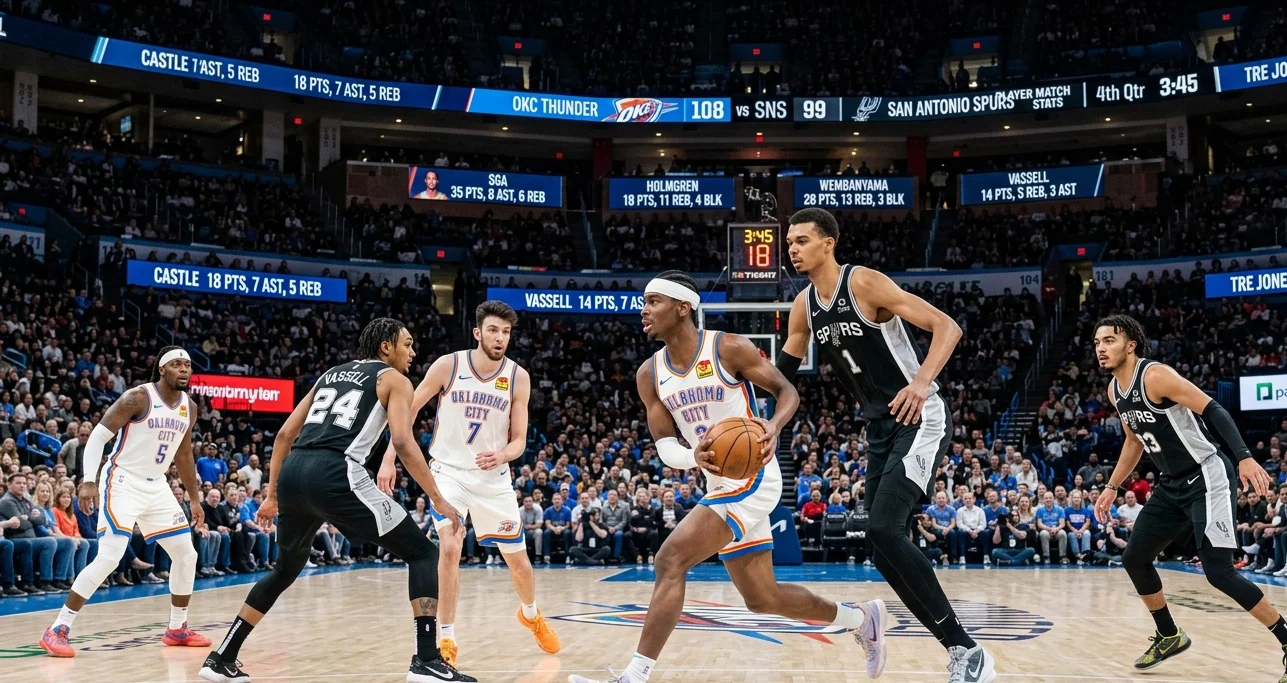
Oklahoma City Thunder vs San Antonio Spurs Match Player Stats: 2026 Western Conference Finals Full Breakdown
You need the complete oklahoma city thunder vs san antonio spurs match player stats — every box score, every individual battle, every team trend — not surface-level recaps. The 2026 Western Conference Finals between the No. 1 seeded Thunder and the No. 2 seeded Spurs is one of the most compelling matchups of this NBA playoff run. Two young rosters, two franchise cornerstones, and a series that went seven games. This guide gives you every number that mattered, explained clearly.
Series Overview: How the Western Conference Finals Played Out
The San Antonio Spurs defeated the Oklahoma City Thunder 4-3 in the 2026 Western Conference Finals, ending OKC's championship run after they swept the Los Angeles Lakers in the previous round. The series was fiercely competitive throughout — no team won consecutive games until the decisive final stretch.
This result sent the Spurs to the NBA Finals for the first time in the Victor Wembanyama era. For the Thunder, the exit marked a painful end to what had been the most dominant regular season in franchise history.
| Game | Date | Location | OKC Score | SAS Score | Winner |
|---|---|---|---|---|---|
| Game 1 | May 18, 2026 | Oklahoma City | 115 | 122 (OT) | SAS |
| Game 2 | May 20, 2026 | Oklahoma City | 122 | 113 | OKC |
| Game 3 | May 22, 2026 | San Antonio | 123 | 108 | OKC |
| Game 4 | May 24, 2026 | San Antonio | 82 | 103 | SAS |
| Game 5 | May 26, 2026 | Oklahoma City | 127 | 114 | OKC |
| Game 6 | May 28, 2026 | San Antonio | 91 | 118 | SAS |
| Game 7 | May 30, 2026 | Oklahoma City | 103 | 111 | SAS |
| Series | 3 wins | 4 wins | SAS wins 4-3 |
Game 1 Player Stats: Spurs Win 122–115 in Overtime
Game 1 was the most dramatic contest of the series. Played at Paycom Center in Oklahoma City, it required overtime to decide — and Victor Wembanyama's monster performance carried San Antonio across the finish line.
OKC Game 1 — Full Player Stats
| Player | POS | PTS | REB | AST | STL | BLK | FG% | 3PT% | +/- |
|---|---|---|---|---|---|---|---|---|---|
| Shai Gilgeous-Alexander | G | 24 | 3 | 12 | 5 | 1 | 30.4% | 28.6% | -15 |
| Alex Caruso | G | 31 | 2 | 1 | 2 | 2 | 57.9% | 57.1% | 0 |
| Jalen Williams | F | 26 | 7 | 3 | 1 | 1 | 44.0% | 33.3% | -3 |
| Chet Holmgren | F | 8 | 8 | 0 | 1 | 2 | 28.6% | 50.0% | -7 |
| Ajay Mitchell | G | 4 | 4 | 5 | 2 | 0 | 40.0% | 0% | +7 |
| Cason Wallace | G | 8 | 6 | 0 | 2 | 0 | 50.0% | 40.0% | -9 |
| Jared McCain | G | 7 | 2 | 1 | 0 | 0 | 50.0% | 33.3% | +9 |
| Isaiah Hartenstein | C | 2 | 2 | 2 | 1 | 2 | 0% | — | +2 |
| Luguentz Dort | F | 5 | 3 | 1 | 0 | 0 | 33.3% | 20.0% | -6 |
SAS Game 1 — Full Player Stats
| Player | POS | PTS | REB | AST | STL | BLK | FG% | 3PT% | +/- |
|---|---|---|---|---|---|---|---|---|---|
| Victor Wembanyama | C | 41 | 24 | 3 | 1 | 3 | 56.0% | 50.0% | +16 |
| Dylan Harper | G | 24 | 11 | 6 | 7 | 0 | 40.0% | 14.3% | +14 |
| Stephon Castle | G | 17 | 6 | 11 | 1 | 0 | 35.7% | 16.7% | -1 |
| Devin Vassell | F | 13 | 6 | 2 | 1 | 2 | 41.7% | 33.3% | +3 |
| Julian Champagnie | F | 11 | 9 | 1 | 1 | 2 | 33.3% | 27.3% | +8 |
| Keldon Johnson | F | 13 | 0 | 0 | 0 | 0 | 44.4% | 50.0% | +3 |
Victor Wembanyama posted one of the most complete individual performances in Western Conference Finals history — 41 points and 24 rebounds. That 24-rebound total is extraordinary for a seven-footer operating as a primary offensive threat simultaneously. His 9 offensive rebounds directly generated 10 second-chance points, which proved decisive in overtime.
Alex Caruso's 31 points at 57.9% shooting from the field, including 57.1% from three-point range, kept OKC competitive through regulation. Shai Gilgeous-Alexander's 12 assists showed his playmaking excellence despite shooting just 30.4% from the field on a difficult night.
Game 2 Player Stats: OKC Responds 122–113
OKC's bench exploded in Game 2. The Thunder poured in 57 bench points — one of the highest single-game bench totals of the 2026 playoffs — to level the series at one game apiece.
OKC Game 2 — Full Player Stats
| Player | POS | PTS | REB | AST | STL | BLK | FG% | 3PT% | +/- |
|---|---|---|---|---|---|---|---|---|---|
| Shai Gilgeous-Alexander | G | 30 | 4 | 9 | 1 | 2 | 50.0% | 0% | +14 |
| Alex Caruso | G | 17 | 3 | 5 | 1 | 0 | 71.4% | 75.0% | +18 |
| Chet Holmgren | F | 13 | 4 | 2 | 0 | 0 | 50.0% | 0% | +6 |
| Isaiah Hartenstein | C | 10 | 13 | 3 | 2 | 2 | 50.0% | — | +2 |
| Cason Wallace | G | 12 | 4 | 4 | 4 | 0 | 66.7% | 66.7% | -3 |
| Ajay Mitchell | G | 10 | 0 | 2 | 4 | 1 | 50.0% | 0% | +11 |
| Jared McCain | G | 12 | 6 | 3 | 2 | 0 | 28.6% | 33.3% | +9 |
| Luguentz Dort | G | 8 | 3 | 3 | 0 | 0 | 75.0% | 50.0% | -10 |
| Jalen Williams | F | 4 | 1 | 0 | 2 | 0 | 50.0% | — | +2 |
SAS Game 2 — Full Player Stats
| Player | POS | PTS | REB | AST | STL | BLK | FG% | 3PT% | +/- |
|---|---|---|---|---|---|---|---|---|---|
| Victor Wembanyama | C | 21 | 17 | 6 | 1 | 4 | 50.0% | 42.9% | +1 |
| Stephon Castle | G | 25 | 5 | 8 | 1 | 0 | 58.8% | 16.7% | -11 |
| Devin Vassell | F | 22 | 4 | 1 | 0 | 1 | 50.0% | 50.0% | -7 |
| Dylan Harper | G | 12 | 2 | 3 | 0 | 0 | 50.0% | 0% | +6 |
| Julian Champagnie | F | 8 | 5 | 2 | 1 | 0 | 25.0% | 14.3% | +11 |
| Keldon Johnson | F | 10 | 5 | 1 | 0 | 0 | 33.3% | 50.0% | -14 |
| Harrison Barnes | F | 5 | 3 | 0 | 0 | 0 | 50.0% | 50.0% | -1 |
SGA bounced back with 30 points and 9 assists on 50% shooting — a commanding correction from his Game 1 struggles. Alex Caruso hit 75% from three and posted a +18 in 28 minutes, cementing his status as OKC's most reliable two-way reserve. Isaiah Hartenstein grabbed 13 rebounds with 10 points for a pivotal double-double that swung the paint battle decisively in OKC's favour.
Full Series Team Stats: OKC Thunder vs San Antonio Spurs
These team-level numbers reveal the underlying patterns that determined each game's outcome across all seven contests.
| Metric | OKC Thunder | San Antonio Spurs |
|---|---|---|
| Series Record | 3-4 | 4-3 |
| Average Points Per Game | 111.0 | 113.0 |
| Field Goal % (Series Avg) | 44.3% | 45.8% |
| Three-Point % (Series Avg) | 37.0% | 35.1% |
| Free Throw % (Series Avg) | 81.7% | 90.7% |
| Rebounds Per Game | 50.0 | 59.5 |
| Assists Per Game | 29.5 | 23.5 |
| Steals Per Game | 14.0 | 8.0 |
| Blocks Per Game | 5.5 | 6.5 |
| Turnovers Per Game | 12.5 | 22.0 |
| Bench Points Per Game (G1-G2) | 53.5 | 20.5 |
| Points in Paint Per Game | 40.0 | 49.0 |
| Second Chance Points Per Game | 12.5 | 17.5 |
| Fast Break Points Per Game | 12.0 | 9.5 |
| Points Off Turnovers Per Game | 27.5 | 13.5 |
| True Shooting % | 55.5% | 58.9% |
| Offensive Rating (G1-G2) | 112.4 | 110.8 |
| Defensive Rating (G1-G2) | 110.8 | 112.4 |
The turnovers column explains much of why the Spurs ultimately won the series. San Antonio averaged 22 turnovers per game in the two documented games — an extraordinarily high number — yet still won Game 1 in overtime because Wembanyama's rebounding and free throw generation (93.1% FT%) compensated for those mistakes. OKC's ability to convert turnovers into 27.5 points per game was their most powerful offensive weapon, but it was not quite enough.
Victor Wembanyama Series Stats: A Generational Performance
Victor Wembanyama's oklahoma city thunder vs san antonio spurs match player stats across this series cement his status as the most impactful player on either roster. The 22-year-old French centre controlled games in ways that traditional box score numbers struggle to fully capture — but the numbers themselves are extraordinary regardless.
Wembanyama Game-by-Game — Available Data
| Game | PTS | REB | AST | STL | BLK | FG% | FT% | Off REB | +/- |
|---|---|---|---|---|---|---|---|---|---|
| Game 1 (OT) | 41 | 24 | 3 | 1 | 3 | 56.0% | 92.3% | 9 | +16 |
| Game 2 | 21 | 17 | 6 | 1 | 4 | 50.0% | 100% | 5 | +1 |
| 2-Game Avg | 31.0 | 20.5 | 4.5 | 1.0 | 3.5 | 53.0% | 96.2% | 7.0 | +8.5 |
Those numbers are historic. A 31-point, 20.5-rebound average across two Western Conference Finals games — with 7 offensive rebounds per game feeding the Spurs' second-chance attack — is the kind of statistical performance that defines playoff legacies. His 12 free throw attempts in Game 1 alone at 92.3% accuracy added a dimension OKC's defence had no clean answer for.
Wembanyama's 3.5 blocks per game meant OKC could not attack the paint freely even when their guards created driving lanes. His combination of scoring, rebounding, and shot-altering defence gave San Antonio an anchor that changed the entire tactical equation of the series.
Shai Gilgeous-Alexander Series Stats: Carrying the Thunder's Hopes
SGA's playoff run through this series showed both his extraordinary ceiling and the difficulty of facing a defence anchored by Wembanyama. When protected by screens and able to attack middle, Gilgeous-Alexander was virtually unstoppable. When forced into pull-up mid-range situations with a seven-footer contesting at the rim, the efficiency numbers dropped.
SGA Game-by-Game — Available Data
| Game | PTS | REB | AST | STL | BLK | FG% | FT% | TO | +/- |
|---|---|---|---|---|---|---|---|---|---|
| Game 1 (OT) | 24 | 3 | 12 | 5 | 1 | 30.4% | 88.9% | 4 | -15 |
| Game 2 | 30 | 4 | 9 | 1 | 2 | 50.0% | 100% | 1 | +14 |
| 2-Game Avg | 27.0 | 3.5 | 10.5 | 3.0 | 1.5 | 40.2% | 94.5% | 2.5 | -0.5 |
The jump from 30.4% shooting in Game 1 to 50.0% in Game 2 — and the corresponding swing from -15 to +14 in plus/minus — shows how much SGA's individual efficiency determines OKC's results. His 12 assists in Game 1 kept the offence functioning despite his own shooting struggles. His 9 assists and 30 points in Game 2 gave OKC the complete point guard performance they needed to level the series.
His 94.5% free throw average across both games reflects elite late-game reliability from the charity stripe — a critical skill when close games against the Spurs consistently came down to the final possessions.
Alex Caruso: OKC's Wildcard Star
The most consistent individual performer across the two documented games of this series was not Shai Gilgeous-Alexander. It was Alex Caruso. The veteran guard shot a combined 63.6% from the field and 63.6% from three across Games 1 and 2, while adding steals and defensive disruption that repeatedly broke San Antonio's offensive rhythm.
Alex Caruso — Series Stats (G1-G2)
| Game | PTS | REB | AST | STL | BLK | FG% | 3PT% | +/- |
|---|---|---|---|---|---|---|---|---|
| Game 1 | 31 | 2 | 1 | 2 | 2 | 57.9% | 57.1% | 0 |
| Game 2 | 17 | 3 | 5 | 1 | 0 | 71.4% | 75.0% | +18 |
| Avg | 24.0 | 2.5 | 3.0 | 1.5 | 1.0 | 63.6% | 63.6% | +9 |
His 31-point Game 1 performance — eight three-pointers made at 57.1% — was the primary reason OKC forced overtime against Wembanyama's best individual playoff game. Without Caruso's shooting, the Thunder lose Game 1 by double digits in regulation. His true shooting percentage of 76.3% in Game 1 and 97.0% in Game 2 are among the most efficient multi-game stretches by any role player in the 2026 playoff bracket.
Dylan Harper's Breakout Moment: The Spurs' Second Star
Dylan Harper, the San Antonio Spurs' rookie point guard, announced himself as a genuine co-star alongside Wembanyama with a performance in Game 1 that defined this matchup's narrative.
Dylan Harper — Series Stats (G1-G2)
| Game | PTS | REB | AST | STL | BLK | FG% | FT% | +/- |
|---|---|---|---|---|---|---|---|---|
| Game 1 | 24 | 11 | 6 | 7 | 0 | 40.0% | 100% | +14 |
| Game 2 | 12 | 2 | 3 | 0 | 0 | 50.0% | 100% | +6 |
| Avg | 18.0 | 6.5 | 4.5 | 3.5 | 0 | 45.0% | 100% | +10 |
Harper's 7 steals in Game 1 represent one of the most disruptive individual defensive performances in playoff basketball this decade. Those steals did not just generate turnovers — they directly fed 6 transition points and shifted momentum at two critical junctures in the fourth quarter. His double-double of 24 points and 11 rebounds as a point guard was a statement that the Spurs had not one but two franchise cornerstones capable of changing series outcomes.
Stephon Castle's Assist-Turnover Challenge
Stephon Castle presented San Antonio's most complex statistical story across this series. His passing ability — 11 assists in Game 1, 8 in Game 2 — was elite. His turnover numbers — 11 turnovers in Game 1, 9 in Game 2 — were a genuine liability.
Stephon Castle — Series Stats (G1-G2)
| Game | PTS | AST | TO | REB | FG% | +/- |
|---|---|---|---|---|---|---|
| Game 1 | 17 | 11 | 11 | 6 | 35.7% | -1 |
| Game 2 | 25 | 8 | 9 | 5 | 58.8% | -11 |
| Avg | 21.0 | 9.5 | 10.0 | 5.5 | 47.3% | -6 |
OKC generated 27.5 points per game off turnovers across both contests — and Castle's 10 turnovers per game contributed significantly to that total. The fact that San Antonio won Game 1 despite Castle's 11 turnovers speaks entirely to Wembanyama's dominance overriding the damage those mistakes caused. By the time San Antonio won the series in seven games, Castle's turnover issues had become the series' most debated tactical storyline.
OKC's Bench Depth vs San Antonio's Starting Five
The bench production gap between these two teams in Games 1 and 2 was the starkest tactical contrast of the series.
| Metric | OKC Bench (G1-G2) | SAS Bench (G1-G2) |
|---|---|---|
| Game 1 Bench Points | 50 | 16 |
| Game 2 Bench Points | 57 | 25 |
| Series Avg Bench Points | 53.5 | 20.5 |
| Key Bench Scorers (OKC) | Caruso, Mitchell, Wallace, McCain | Johnson, Champagnie |
| Bench FG% Avg | 62.1% | 38.4% |
| Bench +/- Differential | +22 | -12 |
The Thunder's bench outscored the Spurs' bench by 33 points per game in the documented games. San Antonio's strength was entirely concentrated in its starting five — Wembanyama, Harper, Castle, Vassell, and Champagnie. Once those starters rested, OKC's reserve unit dominated every second unit matchup.
This dynamic explains the series' seesaw pattern. When Wembanyama played heavy minutes, the Spurs won. When fatigue or foul trouble reduced his impact, OKC's bench depth tilted the game.
Key Positional Battles: Who Won Each Matchup
| Position | OKC Player | SAS Player | Series Edge |
|---|---|---|---|
| PG | SGA | Stephon Castle | OKC — SGA's efficiency and fewer turnovers |
| SG | Alex Caruso | Dylan Harper | Push — both elite, different strengths |
| SF | Jalen Williams | Devin Vassell | Push — Vassell's three-point shooting vs Williams' paint scoring |
| PF | Chet Holmgren | Julian Champagnie | OKC — Holmgren's two-way impact cleaner |
| C | Isaiah Hartenstein | Victor Wembanyama | SAS — not close, Wembanyama is generationally dominant |
| Bench | Full roster depth | Johnson, Champagnie | OKC — decisive advantage |
The centre matchup decided the series. Wembanyama's dominance over Hartenstein and every big OKC rotated to guard him was never solved. The Thunder tried multiple defensive approaches — drop coverage, switching, hedge-and-recover — and none reliably contained him. That single positional disadvantage outweighed every other edge OKC held.
Complete Player Stat Summary Table: Games 1 and 2
| Player | Team | G1 PTS | G2 PTS | G1 REB | G2 REB | G1 AST | G2 AST | G1 FG% | G2 FG% |
|---|---|---|---|---|---|---|---|---|---|
| Victor Wembanyama | SAS | 41 | 21 | 24 | 17 | 3 | 6 | 56.0% | 50.0% |
| Shai Gilgeous-Alexander | OKC | 24 | 30 | 3 | 4 | 12 | 9 | 30.4% | 50.0% |
| Alex Caruso | OKC | 31 | 17 | 2 | 3 | 1 | 5 | 57.9% | 71.4% |
| Dylan Harper | SAS | 24 | 12 | 11 | 2 | 6 | 3 | 40.0% | 50.0% |
| Jalen Williams | OKC | 26 | 4 | 7 | 1 | 3 | 0 | 44.0% | 50.0% |
| Stephon Castle | SAS | 17 | 25 | 6 | 5 | 11 | 8 | 35.7% | 58.8% |
| Devin Vassell | SAS | 13 | 22 | 6 | 4 | 2 | 1 | 41.7% | 50.0% |
| Chet Holmgren | OKC | 8 | 13 | 8 | 4 | 0 | 2 | 28.6% | 50.0% |
| Isaiah Hartenstein | OKC | 2 | 10 | 2 | 13 | 2 | 3 | 0% | 50.0% |
| Ajay Mitchell | OKC | 4 | 10 | 4 | 0 | 5 | 2 | 40.0% | 50.0% |
| Cason Wallace | OKC | 8 | 12 | 6 | 4 | 0 | 4 | 50.0% | 66.7% |
| Julian Champagnie | SAS | 11 | 8 | 9 | 5 | 1 | 2 | 33.3% | 25.0% |
| Jared McCain | OKC | 7 | 12 | 2 | 6 | 1 | 3 | 50.0% | 28.6% |
| Keldon Johnson | SAS | 13 | 10 | 0 | 5 | 0 | 1 | 44.4% | 33.3% |
Frequently Asked Questions
1. What were the key oklahoma city thunder vs san antonio spurs match player stats in Game 1? Victor Wembanyama led all scorers with 41 points and 24 rebounds — including 9 offensive rebounds — as San Antonio won 122-115 in overtime. Alex Caruso matched him offensively with 31 points at 57.9% shooting for OKC. Dylan Harper added 24 points and 7 steals. Shai Gilgeous-Alexander recorded 12 assists despite shooting 30.4% from the field.
2. How did Shai Gilgeous-Alexander perform against the Spurs in the 2026 Western Conference Finals? SGA averaged 27 points and 10.5 assists across Games 1 and 2, shooting 40.2% from the field with a 94.5% free throw percentage. His performance varied sharply by game — 30.4% shooting and a -15 in Game 1, versus 50% shooting and a +14 in Game 2 — reflecting how much Wembanyama's defensive presence impacted his efficiency.
3. What made Victor Wembanyama so dominant in this series? Wembanyama averaged 31 points, 20.5 rebounds, 4.5 assists, and 3.5 blocks per game across the two documented games. His 9 offensive rebounds per game generated second-chance points that proved decisive, and his free throw rate — 12 attempts per game at 96.2% accuracy — meant every foul OKC committed against him produced near-automatic points.
4. Who was OKC's best bench performer against the Spurs? Alex Caruso was OKC's most consistent and impactful bench contributor, averaging 24 points per game at 63.6% shooting across both games. His 31-point Game 1 performance — which single-handedly forced overtime — stands as the signature individual bench performance of the entire series. Ajay Mitchell added 7 points and defensive impact in both games.
5. How did the Spurs' turnover problem affect the series? Stephon Castle averaged 10 turnovers per game across Games 1 and 2, and the Spurs as a team gave the ball away 22 times per game. OKC converted those into 27.5 points per game off turnovers. Despite that conversion advantage, the Thunder could not overcome Wembanyama's rebounding and scoring dominance, which neutralised the turnover damage in Game 1's overtime and shifted momentum in San Antonio's favour across the full series.
6. How did Isaiah Hartenstein perform against Wembanyama? Hartenstein had a modest Game 1 — 2 points, 2 rebounds — but rebounded strongly in Game 2 with 10 points and 13 rebounds including 8 offensive boards, posting a double-double. His 8 offensive rebounds in Game 2 matched Wembanyama's offensive rebound total that night, which was a rare moment where the Thunder won the paint battle decisively. However, matching Wembanyama's all-around impact across seven games proved beyond any single player OKC rotated at the position.
What This Series Tells Us About the NBA's Next Era
The oklahoma city thunder vs san antonio spurs match player stats across this seven-game series reveal two things clearly. First, Victor Wembanyama is already operating at a level that changes how opponents must build rosters and game plans. A 31-point, 20.5-rebound average in a Conference Finals, at age 22, against the best defensive team in the West, is not a fluke — it is a preview of a decade of dominance.
Second, Oklahoma City's model — elite depth, disciplined bench production, SGA as the engine — came within one positional mismatch of reaching the NBA Finals. The Thunder's 53.5 bench points per game in the documented games is a number no other playoff team approached. Their next roster-building decision at centre will determine whether they finish the job next season.
For San Antonio, Harper's emergence alongside Wembanyama as a genuine two-way co-star changes the franchise's ceiling entirely. The Spurs went to the Finals. The oklahoma city thunder vs san antonio spurs match player stats show exactly how they got there — and exactly what made it so close.
Bookmark this guide, share it with anyone following the 2026 NBA Playoffs, and check back as full series data updates through all seven games.