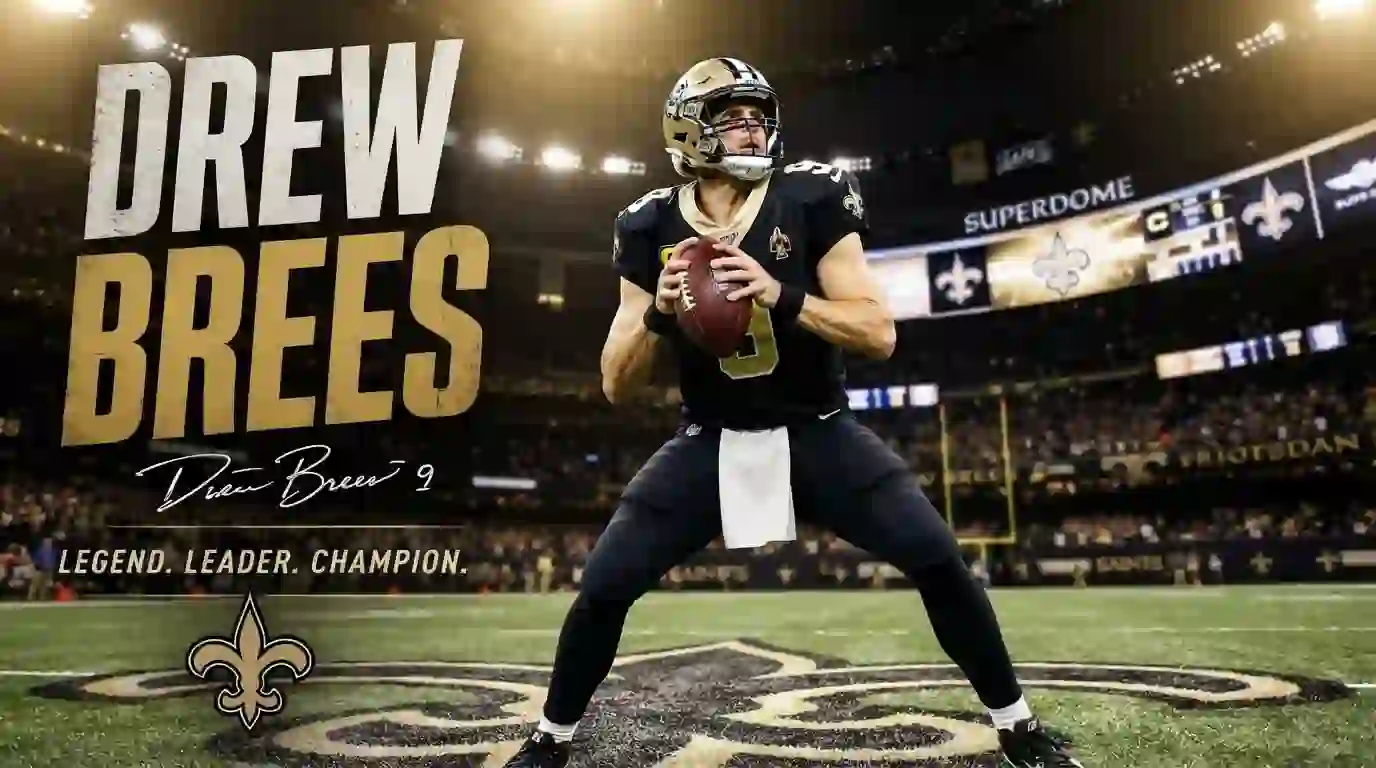
Drew Brees walked into Super Bowl XLIV as the overlooked quarterback in a duel with Peyton Manning, the league's most decorated passer of that era. The Saints had never hoisted a Lombardi Trophy, and every pregame show predicted Manning would add a second ring to his collection. Brees solved the problem himself, completing 32 of 39 passes for 288 yards and two touchdowns to deliver New Orleans its first championship in franchise history.
Drew Brees Biography
Before the snap-by-snap breakdown, here is the complete bio file on the man who changed the Saints forever.
| Detail | Drew Brees Biography |
|---|---|
| Full Name | Drew Christopher Brees |
| Born | January 15, 1979 — Austin, Texas |
| Drew Brees Height & Weight | 6 ft 0 in (1.83 m) / 209 lb (95 kg) |
| High School | Westlake High School, Austin, Texas |
| College | Purdue University (1997–2000) |
| NFL Draft | 2001, Round 2, Pick 32 — San Diego Chargers |
| Teams | San Diego Chargers (2001–2005), New Orleans Saints (2006–2020) |
| Position | Quarterback |
| Jersey Number | No. 9 |
| Drew Brees Career Passing Yards | 80,358 |
| Drew Brees Passing Touchdowns | 571 |
| Career Completion Percentage | 67.7% |
| Pro Bowls | 13 |
| Major Honors | Super Bowl XLIV Champion & MVP, 2× NFL Offensive Player of the Year (2008, 2011), NFL Comeback Player of the Year (2004), Walter Payton NFL Man of the Year (2006), First-Team All-Pro (2006), Maxwell Award (2000) |
| Family | Wife Brittany (married 2003); children Baylen, Bowen, Callen, Rylen |
The Lead: A Championship 43 Years in the Making
On February 7, 2010, a crowd of 74,059 packed into Sun Life Stadium in Miami Gardens, Florida, to watch the New Orleans Saints face the Indianapolis Colts in Super Bowl XLIV. The Saints entered the game as the NFC's top seed at 13-3, while the Colts arrived as the AFC's top seed at 14-2, making this only the second Super Bowl in league history to feature a pair of 13-plus-win teams. New Orleans had never won a title in its 43 years of existence, a drought that hung over the city like the storm clouds of 2005.
The Saints won the game 31-17, and the final score only begins to tell the story. Drew Brees out-executed Peyton Manning in nearly every category that mattered, completing 32 of 39 throws (82.1%) for 288 yards and two touchdowns with zero interceptions on his way to the Super Bowl MVP award. New Orleans trailed 10-0 after the first quarter and 17-13 in the third, yet outscored Indianapolis 25-7 after the early deficit thanks to a surprise onside kick, a fourth-quarter interception returned 74 yards for a touchdown by Tracy Porter, and a quarterback who simply refused to miss.
Match Overview
| Information | Match Details |
|---|---|
| Event | Super Bowl XLIV (NFL, 2009 season) |
| Game | New Orleans Saints vs Indianapolis Colts |
| Date | February 7, 2010 |
| Venue | Sun Life Stadium, Miami Gardens, Florida |
| Attendance | 74,059 |
| Winner | New Orleans Saints |
| Final Score | Saints 31, Colts 17 |
| Broadcast | CBS (Jim Nantz, Phil Simms), Westwood One Radio |
Core Match Statistics Overview
The box score tells a strange story at first glance: the Colts outgained the Saints by exactly 100 yards and still lost by two touchdowns. That gap is the heart of this game's tactical lesson, and the team-level numbers below explain how a team can dominate yardage and lose the scoreboard.
Team Statistics Comparison
| Team Statistic | New Orleans Saints | Indianapolis Colts |
|---|---|---|
| First Downs | 20 | 23 |
| Total Yards | 332 | 432 |
| Passing Yards (Net) | 281 | 333 |
| Passing Completions / Attempts | 32 / 39 | 31 / 45 |
| Passing Touchdowns / Interceptions | 2 / 0 | 1 / 1 |
| Rushing Yards | 51 (18 carries) | 99 (19 carries) |
| Yards Per Rush | 2.8 | 5.2 |
| Sacks Allowed | 1 (7 yards) | 0 |
| Third Down Efficiency | 3 / 9 | 6 / 13 |
| Fourth Down Efficiency | 0 / 1 | 1 / 2 |
| Turnovers | 0 | 1 |
| Penalties / Yards | 3 / 19 | 5 / 45 |
| Time of Possession | 30:11 | 29:49 |
Drew Brees Super Bowl XLIV Stats: A Completion-Percentage Masterclass
Drew Brees's Super Bowl XLIV stat line is one of the cleanest ever produced by a quarterback on the game's biggest stage, and his efficiency single-handedly tilted the matchup.
- Brees finished 32 of 39 for 288 yards, two touchdowns, zero interceptions, and a 114.5 passer rating, with a completion percentage of 82.1% that still ranks as the second-highest in Super Bowl history behind Phil Simms' 88.0% in Super Bowl XXI.
- His 32 completions tied the Super Bowl record Tom Brady set in Super Bowl XXXVIII, and he sustained it across every quarter, including a second-half stretch in which he connected on pass after pass to keep drives alive.
Third Down and Red Zone Efficiency
Third down is where Super Bowls are normally decided, and this game flipped the usual script in an instructive way.
- Indianapolis actually converted third downs at a far better rate, moving the chains on 6 of 13 attempts while the Saints managed just 3 of 9, yet the Colts turned those conversions into only 17 total points.
- New Orleans made its limited conversions count, scoring touchdowns on two of its three red-zone possessions late, while Indianapolis settled for a field goal, missed a 51-yard attempt from Matt Stover, and turned the ball over on downs at the Saints' 5-yard line.
The Turnover Battle
A single giveaway decided the game's direction in the fourth quarter.
- The Saints protected the football completely, finishing with zero turnovers, the cleanest possible foundation for an underdog trying to close out a favorite.
- The Colts committed one turnover, and it was catastrophic: a Peyton Manning interception that Tracy Porter returned 74 yards for a touchdown, a 14-point swing in one play.
Period-by-Period Analysis
Super Bowl XLIV broke into four distinct acts, each with its own momentum signature.
First Quarter: Colts Strike First
| Period | Saints | Colts | Key Moments |
|---|---|---|---|
| 1st Quarter | 0 | 10 | Stover 38-yd FG; Garçon 19-yd TD catch |
- The Colts opened with a methodical 11-play, 53-yard drive that ate 5:53 off the clock and ended in a Matt Stover 38-yard field goal, a statement that Manning intended to control the tempo all night.
- Manning then marched Indianapolis 96 yards in 11 plays, finishing with a 19-yard touchdown strike to Pierre Garçon with 36 seconds left in the quarter for a 10-0 lead.
- New Orleans looked tight early, with Drew Brees unable to find rhythm against Dwight Freeney's initial pass rush, and the Saints went scoreless for the entire opening period.
Second Quarter: Brees Steadies the Ship
| Period | Saints | Colts | Key Moments |
|---|---|---|---|
| 2nd Quarter | 6 | 0 | Hartley 46-yd and 44-yd field goals |
- The Saints finally got on the board with a Garrett Hartley 46-yard field goal, then added a 44-yarder as time expired in the half to pull within 10-6.
- Brees began stringing together completions and leaned on Marques Colston and Devery Henderson on underneath routes, softening the Colts' aggressive coverages.
- Indianapolis' offense stalled badly, punting on consecutive drives as the New Orleans defensive front started winning its individual battles.
Third Quarter: The Ambush Onside Kick Flips the Game
| Period | Saints | Colts | Key Moments |
|---|---|---|---|
| 3rd Quarter | 10 | 7 | Thomas 16-yd TD catch; Addai 4-yd TD run; Hartley 47-yd FG |
- Sean Payton made the gutsiest call in Super Bowl history to open the half, ordering Thomas Morstead to attempt an onside kick that safety Chris Reis recovered, instantly stealing a possession from Manning.
- Brees cashed the gamble six plays later, hitting Pierre Thomas on a 16-yard screen pass for a touchdown that put New Orleans ahead 13-10.
- The Colts answered with a 10-play, 76-yard drive capped by a Joseph Addai 4-yard touchdown run, but a third Hartley field goal, this one from 47 yards, trimmed the deficit to 17-16 entering the fourth quarter.
Fourth Quarter: Drew Brees Super Bowl MVP Seals the Game
| Period | Saints | Colts | Key Moments |
|---|---|---|---|
| 4th Quarter | 15 | 0 | Shockey 2-yd TD + 2-pt conversion; Porter 74-yd pick-six |
- Brees engineered a 9-play, 59-yard go-ahead drive, finishing it with a 2-yard touchdown pass to Jeremy Shockey and a two-point conversion to Lance Moore for a 24-17 lead with 5:42 left.
- On the Colts' next possession, Tracy Porter jumped a route intended for Reggie Wayne and returned the interception 74 yards for a touchdown, effectively ending the game at 31-17.
- Indianapolis made one final push, driving 81 yards to the Saints' 5-yard line, but the defense held on downs and the 43-year wait for a championship was over.
New Orleans Saints Player Statistics
Drew Brees (Quarterback) — Super Bowl XLIV MVP
| Stat | Value |
|---|---|
| Completions / Attempts | 32 / 39 |
| Passing Yards | 288 |
| Touchdowns / Interceptions | 2 / 0 |
| Completion Percentage | 82.1% |
| Passer Rating | 114.5 |
| Rushing | 1 carry, -1 yard |
Brees was the calmest man in the building, spreading the ball to six different receivers and never forcing a throw into danger. His 82.1% completion percentage against a defense that had frustrated offenses all postseason is the reason the Saints won this game.
Pierre Thomas (Running Back)
| Stat | Value |
|---|---|
| Rushing | 9 carries, 30 yards |
| Receiving | 6 catches, 55 yards, 1 touchdown |
Thomas did his damage as a receiver, catching a 16-yard screen pass for the go-ahead touchdown in the third quarter. His dual-threat work gave Brees a reliable outlet whenever the Colts' edge rushers closed in.
Marques Colston (Wide Receiver)
| Stat | Value |
|---|---|
| Receptions | 7 |
| Receiving Yards | 83 |
Colston was Brees' most dependable target, leading the Saints in catches and repeatedly moving the chains on second and third down. His physicality against smaller corners kept the middle of the field open all evening.
Jeremy Shockey (Tight End)
| Stat | Value |
|---|---|
| Receptions | 3 |
| Receiving Yards | 13 |
| Touchdowns | 1 |
Shockey's 2-yard touchdown catch gave the Saints their first lead of the night late in the fourth quarter. The emotional tight end, denied a Super Bowl appearance with the Giants in 2008, finally got his ring.
Indianapolis Colts Player Statistics
Peyton Manning (Quarterback)
| Stat | Value |
|---|---|
| Completions / Attempts | 31 / 45 |
| Passing Yards | 333 |
| Touchdowns / Interceptions | 1 / 1 |
| Completion Percentage | 68.9% |
| Passer Rating | 88.5 |
Manning threw for more yards than Brees, but his efficiency lagged badly in the second half as the Saints' zone looks forced him into checkdowns. His lone interception was the backbreaking pick-six that decided the game.
Joseph Addai (Running Back)
| Stat | Value |
|---|---|
| Rushing | 13 carries, 77 yards, 1 touchdown |
| Receiving | 7 catches, 58 yards |
Addai was the Colts' most complete offensive weapon, scoring on a 4-yard run and serving as Manning's safety valve out of the backfield. His production kept Indianapolis in control for three quarters before the collapse.
Dallas Clark (Tight End)
| Stat | Value |
|---|---|
| Receptions | 7 |
| Receiving Yards | 86 |
Clark led the Colts in receiving yards, exploiting soft spots in the Saints' intermediate coverage. He converted several key third downs but could not find the end zone.
Pierre Garçon (Wide Receiver)
| Stat | Value |
|---|---|
| Receptions | 5 |
| Receiving Yards | 66 |
| Touchdowns | 1 |
Garçon hauled in the game's first touchdown, a 19-yard grab that put Indianapolis up 10-0. He flashed big-play ability all night, though the Saints limited his chances after halftime.
Statistical Leaders Summary
| Category | New Orleans Saints | Indianapolis Colts |
|---|---|---|
| Leading Passer | Drew Brees — 288 yds, 2 TD | Peyton Manning — 333 yds, 1 TD |
| Second Leading Scorer | Pierre Thomas — 1 TD (55 rec yds) | Joseph Addai — 1 TD (77 rush yds) |
| Top Receiver | Marques Colston — 7 rec, 83 yds | Dallas Clark — 7 rec, 86 yds |
| Most Assists / Playmaker | Drew Brees — 2 TD passes + 2-pt conversion | Peyton Manning — 1 TD pass |
| Top Defensive Play | Tracy Porter — 74-yd INT return TD | No takeaways |
Analytical Breakdown: Why the Saints Won
Pinpoint Accuracy and Ball Security
New Orleans won this game on a foundation of accuracy that the Colts simply could not match.
| Passing Metric | Drew Brees | Peyton Manning |
|---|---|---|
| Completion Percentage | 82.1% | 68.9% |
| Yards Per Attempt | 7.4 | 7.4 |
| Touchdowns / Interceptions | 2 / 0 | 1 / 1 |
| Passer Rating | 114.5 | 88.5 |
- Brees completed 82.1% of his passes while Manning managed only 68.9%, a 13-point gap that translated directly into sustained drives and second-half points.
- Brees never put the ball in harm's way, finishing without an interception in the biggest game of his life, while Manning's one mistake produced seven points for the other team.
A Zero-Turnover Operation
| Ball Security | Saints | Colts |
|---|---|---|
| Turnovers | 0 | 1 |
| Interceptions Thrown | 0 | 1 |
| Fumbles Lost | 0 | 0 |
| Points Off Turnovers | 0 allowed | 7 allowed (pick-six) |
- New Orleans became one of the rare Super Bowl winners to play a completely clean game, and that discipline meant every drive had a chance to score.
- Indianapolis, by contrast, watched its single turnover get returned 74 yards for a touchdown, a 14-point swing that no yardage advantage could overcome.
Aggression: The Ambush Onside Kick
Sean Payton's decision to open the second half with an onside kick remains one of the boldest calls in football history, and it worked.
| Second-Half Opening | Result |
|---|---|
| Kickoff Call | Surprise onside kick by Thomas Morstead |
| Recovery | Chris Reis (Saints) |
| Resulting Drive | 6 plays, 58 yards, touchdown (Thomas) |
- The recovered onside kick stole a possession from the Colts and gave Brees the ball with instant momentum, which he converted into a 13-10 lead.
- The gamble was the first successful onside kick before the fourth quarter in Super Bowl history, and it set the tone for a second half New Orleans owned by a 25-7 margin.
A Balanced Distribution of Targets
Brees spread the football to six different receivers, keeping the Colts' defense guessing all night.
- Colston (7 catches), Henderson (7 catches), and Thomas (6 catches) each demanded attention, which meant no single defender could squat on one route.
- This distribution neutralized the Colts' blitz packages and forced Indianapolis to play honest coverage in the exact moments Brees needed one-on-one matchups.
Analytical Breakdown: Why the Colts Lost
432 Yards, Only 17 Points
The Colts moved the ball better than the Saints for most of the night and still lost by 14 points, a statistical paradox with a clear explanation.
| Offensive Output | Colts | Saints |
|---|---|---|
| Total Yards | 432 | 332 |
| Points Scored | 17 | 31 |
| Yards Per Point | 25.4 | 10.7 |
| Missed Field Goals | 1 (51 yards) | 0 |
- Indianapolis gained 100 more yards than New Orleans but scored 14 fewer points because its drives stalled in scoring range: a 51-yard Matt Stover miss and a turnover on downs at the Saints' 5-yard line cost the Colts at least six points.
- The Colts' 6-of-13 third-down rate was far better than the Saints' 3-of-9, yet those conversions produced yardage between the 20s rather than touchdowns, the classic sign of an offense that could move but not finish.
The Porter Interception and the Fourth-Quarter Collapse
One read decided the game, and Peyton Manning got it wrong at the worst possible moment.
- With the Colts trailing 24-17, Manning threw toward Reggie Wayne on a route Tracy Porter had studied on film all week, and the cornerback jumped it for a 74-yard pick-six.
- The touchdown pushed the lead to 31-17 and forced Indianapolis into a desperate final drive that ended at the Saints' 5-yard line, completing a fourth quarter in which the Colts scored zero points.
Could Not Contain Brees Late
Indianapolis' defense faded exactly when the game demanded one more stop.
- The Saints scored touchdowns on two of their final three full possessions, with Brees completing nearly every throw he attempted in the fourth quarter.
- A hobbled Dwight Freeney, playing through a torn ankle ligament, gave the Colts an early spark but offered little late pressure, letting Brees step into throws and dissect the secondary.
Historical Context & Advanced Insights
Head-to-Head Series Breakdown
The Colts had owned this matchup for nearly a decade before the Super Bowl, which made the result an even bigger shock.
| Date | Matchup | Result | Note |
|---|---|---|---|
| Sep 28, 2003 | Colts @ Saints | Colts 55, Saints 21 | Manning threw 6 touchdown passes |
| Sep 6, 2007 | Saints @ Colts | Colts 41, Saints 10 | Season-opening blowout |
| Feb 7, 2010 | Super Bowl XLIV | Saints 31, Colts 17 | Brees MVP, first Saints title |
- Entering Super Bowl XLIV, the Saints had lost the previous two meetings by a combined 96-31, and the Colts held the all-time edge in the series.
- The tables turned permanently after this game: New Orleans hammered Indianapolis 62-7 in 2011, and the Colts' later wins in 2014 (34-27) and 2022 (27-13) never restored the old dynamic.
Advanced Statistical Insights: Efficiency Per Throw
Digging past raw yardage reveals why Brees' night was more valuable than Manning's despite the yardage gap.
- Yards per attempt were almost identical, with Brees at 7.4 and Manning at 7.4, meaning the quarterbacks generated the same value per throw, but Brees converted that value into points through completion percentage and zero giveaways.
- Points per drive separated the two offenses sharply: the Saints scored roughly 3.4 points per possession while the Colts managed under 2.0, dragged down by the missed field goal, the interception, and the failed fourth-down try.
- Brees' entire 2009 postseason run was historically clean, with 72 completions on 102 attempts for 732 yards, eight touchdowns, zero interceptions, and a 117.0 rating across three games, a level of error-free play that carried straight into the Super Bowl.
- The Saints' willingness to chase possessions, seen in the onside kick and a fourth-down attempt, effectively gave Brees extra drives that offset the Colts' yardage edge.
Game Implications & Key Lessons
What This Means for the New Orleans Saints
- The victory ended a 43-year championship drought and validated the Sean Payton-Drew Brees partnership as one of the defining coach-quarterback combinations of the era.
- It transformed the franchise's identity from lovable underdog to perennial contender, with the Saints posting winning records in 11 of the next 12 seasons.
- For a city still rebuilding after Hurricane Katrina, the title carried emotional weight no box score could measure, and Brees became a permanent civic icon.
What This Means for the Indianapolis Colts
- The loss dropped Manning to 1-1 in Super Bowls at that point and reignited questions about the Colts' ability to win close, low-scoring postseason games despite prolific regular seasons.
- The defense's late-game fade exposed a unit built to protect leads rather than generate stops, a flaw the organization spent years trying to fix.
- The 2011 rematch, a 62-7 Saints blowout, confirmed that the Colts' window had closed the moment Brees hoisted the Lombardi in Miami.
Key Lessons
- Completion percentage beats volume: Brees threw for 45 fewer yards than Manning but won because 82.1% efficiency outscored 68.9% volume.
- Protect the football and you protect the game, since the Saints' zero turnovers against the Colts' one giveaway produced the decisive 14-point swing.
- Aggression with a plan works, and the Ambush onside kick proved that a well-prepared gamble can steal momentum from a superior roster.
- Yards between the 20s are empty calories, as the Colts' 432 total yards and 100-yard edge produced just 17 points.
- Big games turn on one read, and Porter's 74-yard pick-six showed how film study turns preparation into points.
- Balance beats dependence, with six Saints receivers recording catches versus an Indianapolis attack that leaned on Clark and Addai once Garçon was bracketed.
Frequently Asked Questions
Who won Super Bowl XLIV?
The New Orleans Saints defeated the Indianapolis Colts 31-17 on February 7, 2010, at Sun Life Stadium in Miami Gardens, Florida, for the first championship in franchise history.
What were Drew Brees' Super Bowl XLIV stats?
Drew Brees completed 32 of 39 passes for 288 yards and two touchdowns with zero interceptions and a 114.5 passer rating, earning Super Bowl MVP honors.
What are Drew Brees' career passing yards?
Drew Brees finished his 20-year career with 80,358 passing yards, a total that stood as the NFL record until Tom Brady passed him, and he remains second all-time.
How many passing touchdowns did Drew Brees throw in his career?
Drew Brees threw 571 career touchdown passes, the second-most in NFL history behind Tom Brady, along with 7,142 completions and a league-record 67.7% completion rate at the time of his retirement.
What is Drew Brees' net worth?
Drew Brees' net worth is estimated at roughly $120 million, accumulated from over $269 million in career NFL salary plus endorsements with brands like Nike, Pepsi, and Wrangler, along with his later broadcasting work.
When did Drew Brees retire?
Drew Brees announced his retirement in March 2021 after the 2020 season, ending a 20-year career split between the San Diego Chargers and the New Orleans Saints.
Conclusion
Super Bowl XLIV was a clinic in why efficiency and teamwork outlast individual brilliance. Peyton Manning outgained Drew Brees and posted gaudier volume numbers, but Brees completed passes at a historic 82.1% clip, protected the ball, and spread it to six different receivers while his defense manufactured the game's biggest play. Add Sean Payton's fearless onside kick and a clean turnover sheet, and the result was the most precise Super Bowl performance by a quarterback since the 1980s. The Saints didn't beat the Colts with more talent; they beat them with better execution, smarter risk, and a quarterback who understood that in February, accuracy is the only stat that truly wins games.